Key points
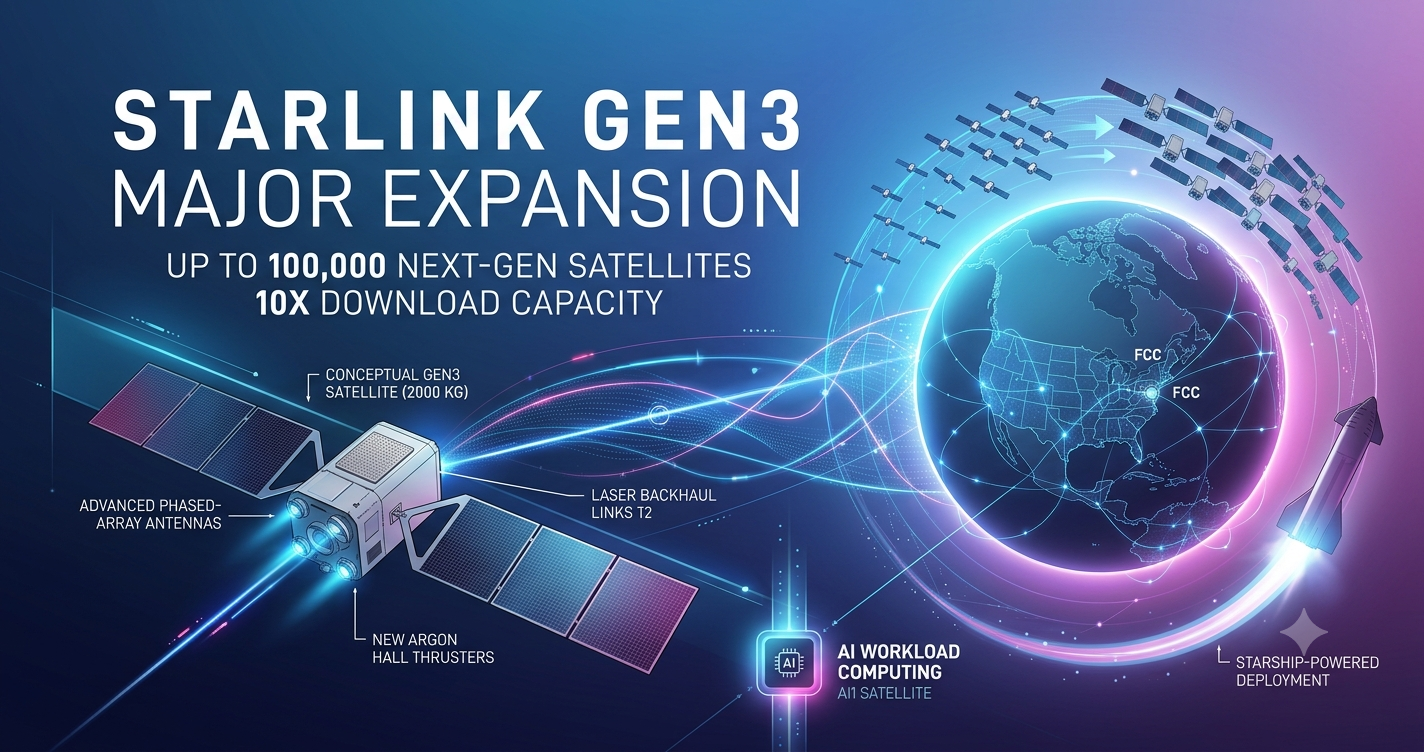
- Massive Constellation: SpaceX is seeking FCC approval to deploy up to 100,000 next-generation Gen3 Starlink satellites.
- Huge Speed Increase: The new hardware will deliver a 10-fold increase in internet download speeds.
- Starship Required: Because each satellite weighs 2,000 kilograms, SpaceX must use its massive Starship rocket for launches.
- Hardware Upgrades: Consequently, customers will eventually need new satellite dishes to access these gigabit-class speeds.
ISLAMABAD – SpaceX has officially filed a major request with the U.S. Federal Communications Commission (FCC). The company is seeking permission to launch up to 100,000 next-generation Gen3 Starlink satellites. This application marks a massive expansion plan for its global satellite internet network.
These upcoming Gen3 satellites introduce massive upgrades over the current Gen2 models. For example, each new satellite will weigh 2,000 kilograms. This is a massive jump from the 575-kilogram weight of the Gen2 models. Because they are much heavier and larger, SpaceX will rely entirely on its heavy-lift Starship rocket to carry them into orbit. Furthermore, the fleet will operate in very-low Earth orbit (VLEO) at a low altitude of roughly 350 kilometers.
Massive Performance Boosts On the Way
According to the official FCC documents, SpaceX designed the Gen3 platform completely from scratch. Therefore, this is a total rebuild rather than a simple software update.
The company expects these new satellites to deliver a massive 10-fold increase in download capacity, hitting 1 terabit per second (Tbps) per satellite. Additionally, upload speeds will improve by 22 times to reach up to 200 gigabits per second (Gbps).
To achieve this, the larger satellite body will host advanced phased-array antennas, massive solar panels, and next-generation onboard modems. The system will also use advanced laser links and dynamic power controls. As a result, this tech will improve spectrum sharing and prevent signal interference.
“The upcoming constellation follows the success of the Gen2 network, which already increased data throughput by 20 times compared to the original Gen1 models,” SpaceX noted in the filing.
Because of these extreme system upgrades, current Starlink users will eventually need to buy new hardware. Customers must upgrade their satellite dishes and user terminals to actually connect to these new gigabit-class internet speeds.
Technical Constellation Data
| Feature |
System Specifications |
| Constellation Generation |
Gen3 Starlink Satellites |
| Proposed Fleet Size |
Up to 100,000 Satellites |
| Satellite Weight |
2,000 kg Each (Requires Starship Rocket) |
| Target Download Speed |
1 Terabit per second (10x Increase) |
| Target Altitudes |
323–327.5 km and 473–477.5 km |
| Operational Spectrum |
Ku-, Ka-, V-, E-, W-, and D-band frequencies |
Dedicated AI Satellites Revealed
In a completely separate announcement, SpaceX also introduced its very first satellite built entirely for artificial intelligence workloads. Named the AI1 satellite, this dedicated computing platform supports up to 150 kilowatts of peak processing capacity.
The advanced AI1 spacecraft features liquid cooling radiators, meteoroid shielding, and automated computing modules. SpaceX plans to manufacture these units at its Gigasat facility in Texas. While the AI1 models are not yet in active production, the new FCC filing shows that SpaceX is ready to start mass production on the Gen3 Starlink satellites very soon.
Finally, SpaceX clarified that this 100,000-satellite request is completely separate from its long-term vision to eventually launch one million satellites to build a “Kardashev II-level civilization.” The FCC is reviewing both applications completely independently.
What are Gen3 Starlink satellites?
They are SpaceX’s next-generation internet satellites designed to deliver 10 times more download capacity and faster gigabit-class internet speeds across the globe.
Why do the new Gen3 satellites require the Starship rocket?
The new models weigh 2,000 kilograms each, which is nearly four times heavier than the previous generation. Only the massive Starship rocket has the space and power to launch them.
Will I need to buy a new Starlink dish for Gen3?
Yes. Because the network upgrades are so substantial, current users will need to upgrade their user terminals and dishes to access the faster speeds.
Read more : Claude Cowork expansion brings AI agents to mobile and web









 Fashion4 months ago





 Pakistan2 weeks ago