Connect with us

Sci&Tech

Apple sues OpenAI: Trade secrets case filed

Published

on

Apple Sues OpenAI Over Alleged Trade Secret Theft
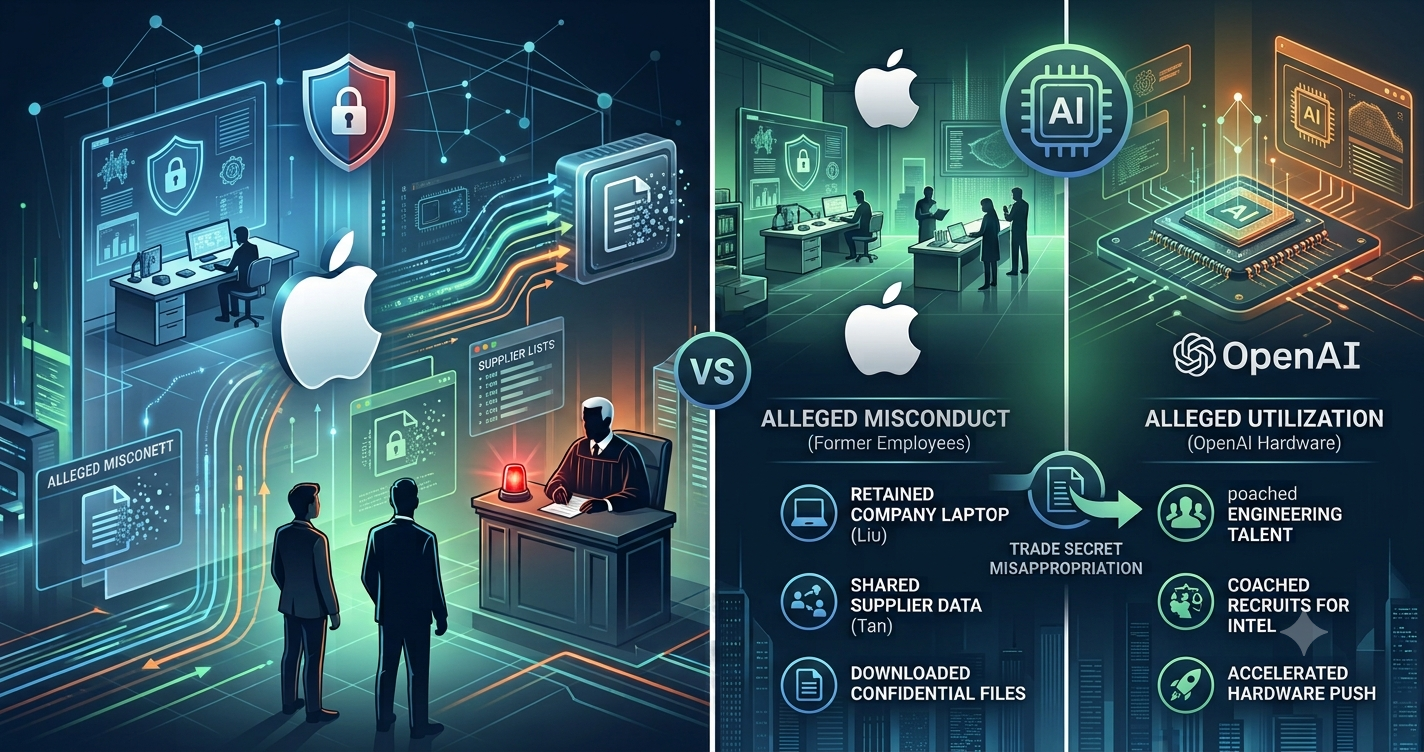
The image is AI-generated and used for illustration purposes only

Key Points:

  • Federal Lawsuit Filed: Apple has officially launched a massive federal lawsuit against OpenAI and two former employees.

  • Severe Accusations Raised: Specifically, the tech giant accuses the defendants of stealing highly confidential information to accelerate OpenAI’s consumer hardware push.

  • Key Targets Named: Furthermore, the 41-page complaint names former Apple executives Tang Yew Tan and Chang Liu alongside multiple OpenAI corporate entities.

  • Partnership Fractured Deeply: Consequently, this high-profile legal battle marks a sharp escalation in tensions between these former technology partners.

KARACHI – Apple has officially filed a major federal lawsuit against OpenAI in California. Specifically, the tech giant accuses the defendants of stealing highly confidential information to accelerate OpenAI’s consumer hardware push. Consequently, this high-profile legal battle marks a sharp escalation in tensions between the former partners. Furthermore, the 41-page complaint names former Apple employees Tang Yew Tan and Chang Liu alongside multiple OpenAI corporate entities. However, OpenAI quickly responded by stating it has zero interest in the trade secrets of competing firms.

Apple Sues OpenAI: Trade Secrets Case Filed

Detailed Allegations of Intellectual Property Theft

In the official filing, Apple details a coordinated effort to harvest proprietary intelligence during the recruitment process. For example, the lawsuit claims OpenAI actively coached candidates to share protected details about unreleased Apple products. Specifically, the complaint alleges that former senior engineer Chang Liu deliberately kept a company-issued laptop after leaving.

Subsequently, he exploited a software authentication flaw to access internal servers and download dozens of sensitive files. Meanwhile, the lawsuit targets former product design vice president Tang Yew Tan for similar misconduct. According to the complaint, Tan methodically emailed himself critical supplier lists and internal industry reports before his departure. Moreover, he allegedly instructed prospective hires to bring physical Apple components to job interviews for visual demonstrations.

Dispute Element Specific Allegations Against Chang Liu Specific Allegations Against Tang Yew Tan
Former Apple Role Senior System Electrical Engineer Vice President of Product Design
Current OpenAI Role Hardware Division Engineer Chief Hardware Officer
Primary Accusation Downloaded files via network vulnerability Shared supplier information and requested physical parts
Retained Material Kept a company-issued work laptop Emailed internal data summaries to himself

Hardware Expansion Triggers Open Rivalry

These aggressive hiring strategies directly support OpenAI’s new consumer hardware unit. Previously, OpenAI acquired io Products, a specialized hardware startup co-founded by legendary designer Jony Ive. Although the startup has kept its exact product designs secret, it aims to redefine human interactions with artificial intelligence.

As a result, Apple claims this new venture relies heavily on stolen manufacturing techniques and supply chain data. Ultimately, this intense conflict shatters the collaborative relationship that integrated ChatGPT directly into Apple’s Siri ecosystem. Therefore, Apple now seeks substantial financial damages alongside a strict court order to block OpenAI’s use of its data.

Why is Apple suing OpenAI?

Apple claims that OpenAI systematically poached its engineering talent to steal trade secrets. Specifically, they allege OpenAI used this proprietary data to jumpstart its new consumer hardware division.

What specific items did the former employees allegedly steal?

The lawsuit claims Chang Liu downloaded dozens of confidential hardware files using a retained company laptop. Meanwhile, Tang Yew Tan allegedly took supplier lists and asked job candidates to bring physical Apple components to interviews.

How does this lawsuit affect the existing partnership between the two companies?

This legal battle marks a severe degradation of their relationship. While they previously collaborated to bring ChatGPT features to iPhones, they are now shifting into direct corporate rivals in the consumer hardware space.

Read More : OpenAI retires ChatGPT Atlas browser .

Continue Reading

Sci&Tech

Meta disables controversial Muse Image AI feature

Published

on

meta-disables-muse-image-ai-instagram-feature
This Image is AI generated and used for illustration purposes only

Key Points:

  • Feature Discontinued: Meta has officially disabled the Muse Image AI capability. Specifically, the tool allowed users to generate custom visuals by referencing public Instagram accounts.

  • Strategic Reversal: This sudden decision came just days after the initial launch. Consequently, it followed immediate backlash regarding user privacy and automatic opt-in defaults.

  • Corporate Admission: Furthermore, in an updated statement, Meta acknowledged the tool “missed the mark” regarding user sentiment and control.

  • Industry Pressure: Major entertainment groups vocally opposed the tool to protect creator likenesses. For example, these groups included talent agency CAA and labor union SAG-AFTRA.

LAHORE – Meta has officially announced the removal of a highly debated feature within its new Muse Image AI ecosystem. However, the change occurred just days after the tool’s public debut. When the tech giant first introduced the image generation tool, it included a native Instagram capability. This specific feature allowed anyone to tag a public account to automatically generate new visuals.

Subsequently, the system used that profile’s public photos to build the new images. Because the tool was active by default for all public adult profiles, users faced a distinct problem. Therefore, their visual likeness could be incorporated into AI creations without their active awareness or explicit permission.

Consequently, digital rights advocates and general users expressed intense concern over the potential for non-consensual digital replicas. In response to the growing wave of criticism, Meta updated its product roadmap. As a result, the company admitted that the rollout strategy missed the mark and confirmed the feature has been permanently pulled.
meta-disables-muse-image-ai-instagram-feature

Explaining the Opt-Out Controversy and Default Settings

The primary driver behind the immediate public pushback was the aggressive implementation framework chosen by Meta. Instead of requiring individuals to proactively sign up for the service, the platform automatically opted in all public account holders over the age of 18.

To protect their personal photos from being used as generative source material, users faced an uphill battle. Specifically, they were forced to manually navigate through complex privacy menus. Moreover, they had to toggle off options under the “Sharing and reuse” sub-menu or convert their entire profile to private. Therefore, privacy groups criticized the system as an unfair invasion of personal data. Furthermore, they noted that it buried user control options beneath default corporate settings.

AI Feature Rollout Status

Parameter Original Launch Configuration Post-Backlash Status (July 2026 Update)
Profile Referencing Anyone could tag a public account to generate AI images Feature completely disabled
Consent Model Automatic opt-in by default for adult public accounts N/A (Feature removed entirely)
Privacy Safeguards Required manual menu toggling or setting profile to private Automatic exclusion maintained for minors/private profiles
Platform Availability Planned expansion to Facebook, WhatsApp, and Messenger Halted indefinitely for the account-tagging feature

Entertainment Industry Pushes Back Against Likeness Scrape

Beyond ordinary social media users, prominent entertainment organizations actively lobbied against the tool. For instance, they wanted to shield professional performers. Hollywood talent firm Creative Artists Agency (CAA) reportedly initiated direct discussions with Meta leadership to express its deep disapproval. Specifically, CAA represents high-profile actors like Tom Hanks and Meryl Streep.

Therefore, the agency firmly asserted a clear principle. No individual’s name, image, or creative work should ever be utilized by third-party AI systems without explicit, documented consent. Concurrently, the American labor union SAG-AFTRA aggressively urged its nationwide membership to turn off the sharing toggles. The union called the default opt-in a total miscalculation of public sentiment regarding digital safety. Following the official removal announcement, the union welcomed the change. Ultimately, they called it a responsible step toward combatting unauthorized digital replicas.

Why did Meta disable the Muse Image account-tagging feature?

Meta deactivated the capability after widespread public outcry from users, privacy experts, and labor unions. These groups objected to an AI tool that could use people’s photos to create digital replicas without explicit consent.

Do I still need to change my Instagram settings to block this specific tool?

No. Meta has completely removed the feature from the Meta AI chatbot. Because of this, users no longer need to look for a specific toggle to block other accounts from referencing their profile.

Was anyone automatically protected from this feature before it was removed?

Yes. From the initial launch, Meta automatically excluded certain accounts. All private profiles and any accounts belonging to users under the age of 18 were safe from being referenced by the tool.

Read More : Original creators can now edit their own videos on X .

Continue Reading

Sci&Tech

OpenAI retires ChatGPT Atlas browser

Published

on

OpenAI retires ChatGPT Atlas browser
The image is AI-generated and used for illustration purposes only

Key Points:

  • Standalone Sunset: OpenAI has confirmed the official retirement of ChatGPT Atlas, its dedicated AI-powered browser, less than a year after its initial debut.

  • Core Integration: Instead of maintaining a separate browser, the company is merging Atlas’ core agentic capabilities into a redesigned desktop app and a new Chrome extension.

  • Final Deadline: The target date for the complete shutdown of Atlas is set for August 9, 2026.

  • Strategy Pivot: Consequently, the heavily anticipated Windows version of ChatGPT Atlas has been officially canceled as OpenAI shifts focus to companion tools.

ISLAMABAD – OpenAI has officially announced that it will retire ChatGPT Atlas, its standalone AI-first web browser, marking a major shift in its product ecosystem. Initially launched for macOS in October 2025, the browser was designed to weave conversational AI directly into the fabric of daily web navigation. However, rather than continuing down the path of maintaining an independent web browser, OpenAI has chosen to consolidate its engineering efforts.

By pulling the plug on Atlas, the company plans to centralize its advanced browsing and automated agent features into its core software lineup. The final operational deadline for the software is scheduled for August 9, 2026, and active users will receive transition instructions via email and in-app alerts leading up to the sunset date.
OpenAI retires ChatGPT Atlas browser

Redesigned Desktop App Absorbs Agentic Capabilities

To replace the standalone browser experience, OpenAI is rolling out a heavily overhauled ChatGPT desktop application. This new unified platform brings together standard ChatGPT models, Codex development tools, and dedicated ChatGPT Work spaces under one roof.

Furthermore, the desktop application features a fully embedded browsing engine. This internal tool can seamlessly scan live websites, cross-reference data from multiple digital sources, and interact directly with cloud files stored across Google Workspace and Microsoft 365 environments. Most notably, the app inherits Atlas’ ability to run complex, long-form automation sequences silently in the background while users focus on other activities.

Digital Workspace Comparison

Feature Capability Retired ChatGPT Atlas Browser Redesigned ChatGPT Desktop Platform (2026)
OS Compatibility Restricted exclusively to macOS Broad deployment with unified app ecosystem
Workspace Sync Limited local environment access Full Google Workspace & Microsoft 365 integration
Execution Model Standalone browser window environment Background execution while working in other apps
Windows Variant Canceled entirely Replaced by the native desktop software experience

Introducing the Native Chrome Sidebar Extension

In addition to the updated desktop software, OpenAI is launching an official Chrome extension to capture the browser-native audience. This utility places ChatGPT directly into the Google Chrome sidebar, allowing for instant accessibility without switching tabs.

Through this extension, users can instantly summarize lengthy web content, ask contextual questions about active pages, and initiate automated workflows. OpenAI noted that the streamlined design of the extension directly reflects the user feedback gathered during the limited rollout of the Atlas browser.

Ultimately, instead of trying to compete head-to-head with entrenched browsers like Chrome, OpenAI is repositioning AI-driven web navigation as a foundational feature of its existing services. While Atlas offered groundbreaking autonomy, early metrics revealed that its specialized automation modes could occasionally be slower than manual browsing. By embedding these features into existing workflows, the company aims to deliver a faster, more practical toolset.

Why is OpenAI retiring the ChatGPT Atlas browser?

OpenAI is sunsetting Atlas to streamline its product line. Instead of managing a standalone web browser, the company is embedding its automated browsing features straight into the main ChatGPT desktop app and a new Chrome sidebar extension.

When will ChatGPT Atlas stop working completely?

The official retirement date for the Atlas browser is August 9, 2026. Users will receive regular update notifications and transition support prior to the shutdown.

Will there still be a Windows version of ChatGPT Atlas?

No. Because OpenAI changed its product roadmap to focus on integrated apps rather than separate browsers, the planned Windows release of Atlas has been officially canceled.

Read More : OpenAI formally launches next-Gen GPT-5.6 AI model family .

Continue Reading

Sci&Tech

OpenAI formally launches next-Gen GPT-5.6 AI model family

Published

on

openai-gpt-5-6-sol-terra-luna-models
This Image has been generated using Ai

Key Points: 

  • Three-Tier Lineup: OpenAI has introduced three distinct capability tiers named GPT-5.6 Sol, GPT-5.6 Terra, and GPT-5.6 Luna.  
  • Global Rollout: The models are actively rolling out across ChatGPT, Codex, and the OpenAI API.  
  • Advanced Architecture: Flagship variants include new reasoning modes like “max” and “ultra” to solve complex, multi-step tasks.  
  • Drastic Cost Reductions: Ultimately, these models achieve significantly higher efficiency by requiring fewer tokens per task compared to prior iterations.  

ISLAMABAD – OpenAI has officially introduced the OpenAI GPT-5.6 AI models lineup, bringing a structured tier system to its conversational and programmatic intelligence platforms. Instead of releasing a single monolithic model, the company has broken the release into three variants targeting different operational priorities.  

All about GPT-5.6 models

First, GPT-5.6 Sol serves as the flagship tier, offering maximum performance for the most intensive logic-driven tasks. Next, GPT-5.6 Terra acts as the balanced option, providing a sweet spot between operational speed, high capability, and everyday affordability. Finally, GPT-5.6 Luna stands as the fastest and most economical model, optimized for lightweight tasks and rapid background processing. According to OpenAI, this naming scheme represents permanent capability tiers, allowing each specific engine to evolve independently in subsequent iterations.  

Breakthrough Performance and Reasoning Controls 

To maximize the power of its flagship tier, OpenAI deployed two novel processing settings specifically for GPT-5.6 Sol. For instance, the new max mode grants the model extended time to think through complex math, engineering, or structural logic problems before delivering an output. Alternatively, the ultra mode actively coordinates four separate AI sub-agents in a parallel workflow, allowing them to collaborate instantly and solve multi-layered problems much faster.  

Furthermore, the model family achieves these higher success rates while using fewer tokens than previous generations. Consequently, developers receive a massive boost in performance-per-dollar efficiency.  

Official API Pricing Structure 

To keep up with market changes, the API layout has been explicitly priced to allow for highly targeted routing strategies. Below is the official developer pricing structure per million tokens: 

Model Tier  Input Price (Per 1M Tokens)  Output Price (Per 1M Tokens)  Primary Use Case Designation 
GPT-5.6 Sol  $5.00  $30.00  Heavy reasoning, expert programming, and security 
GPT-5.6 Terra  $2.50  $15.00  Everyday production code and general workflows 
GPT-5.6 Luna  $1.00  $6.00  High-volume tasks, low-latency calls, and triage 

Performance Metrics & Technical Benchmarks 

On top of the architectural changes, OpenAI has published preliminary validation data across coding, agentic autonomy, and deep technical reasoning. Therefore, the performance curves closely scale alongside the primary pricing tiers.  

Agentic Coding and Execution Evaluation 

In independent evaluations like Terminal-Bench 2.1, which tracks command-line competency, tool-calling accuracy, and multi-step execution over hours of continuous work, the flagship variant achieved unprecedented heights.  

AI Model Variant  Terminal-Bench 2.1 Score  Evaluation Framework Focus 
GPT-5.6 Sol (Ultra Mode)  91.9%  Long-horizon multi-step code execution 
GPT-5.6 Sol (Standard)  88.8%  Autonomous repository interaction 
GPT-5.5 (Legacy Reference)  88.0%  Command-line tool orchestration 
GPT-5.6 Luna  82.5%  Lightweight scripting and parsing 

Professional Knowledge and Specialized Research 

Beyond traditional software development, the GPT-5.6 family shows a massive leap forward in handling data pipelines. For example, on Agents’ Last Exam—a standardized evaluation measuring independent workflow completion across 55 academic and professional domains—GPT-5.6 Sol scored a high of 53.6, outpacing competing models by wide margins.  

Similarly, the models demonstrate massive accuracy spikes in specialized scientific testing grounds like GeneBench v1 (genomics analysis) and ExploitBench (defensive vulnerability patch generation). Importantly, OpenAI noted that despite these advancements, the models remain safely below “Critical” risk thresholds for biology and automated offensive cyber operations.  

Platform Availability and Global Access Rules 

Access to the new ecosystem is being distributed immediately across different user accounts based on membership tiers. 

  • ChatGPT Plus & Team Users: Granted instant access to GPT-5.6 Sol using medium and higher default reasoning profiles. 
  • Pro & Enterprise Accounts: Receive unlimited entry to GPT-5.6 Sol, along with the option to deploy the advanced Sol Pro configurations.  
  • Free & Go Tier Users: Automatically upgraded to GPT-5.6 Terra through ChatGPT Work spaces and Codex.  
  • API Developers: Full access to all three models is live immediately, featuring optimized prompt caching rules where cache writes are billed at 1.25x and cache reads enjoy an aggressive 90% discount. 

What makes the OpenAI GPT-5.6 AI models distinct from past releases? 

Instead of pushing out a single model, OpenAI launched a family of three explicit tiers (Sol, Terra, Luna) built to help developers seamlessly route their tasks according to speed, depth of reasoning, and budget requirements.  

How do the “max” and “ultra” settings function in GPT-5.6 Sol? 

Max mode allows the flagship model to spend more continuous compute time thinking through tricky logic puzzles. Meanwhile, ultra mode splits the core task among four parallel AI agents to tackle massive, disjointed workflows simultaneously.  

Is there prompt caching available for these models? 

Yes. The OpenAI API includes updated, highly predictable prompt caching configurations with explicit breakpoints and a minimum 30-minute cache lifetime to aggressively drive down enterprise costs.  

Read More :  SpaceX files FCC Request for 100,000 Gen3 Starlink satellites . 

Continue Reading

About

Upfront influence about 20 million users and is the number one business and technology news network on the planet


© 2022 upfront. All Rights Reserved.

Trending

Copyright © 2026