Connect with us

Sci&Tech

OpenAI formally launches next-Gen GPT-5.6 AI model family

Published

on

openai-gpt-5-6-sol-terra-luna-models
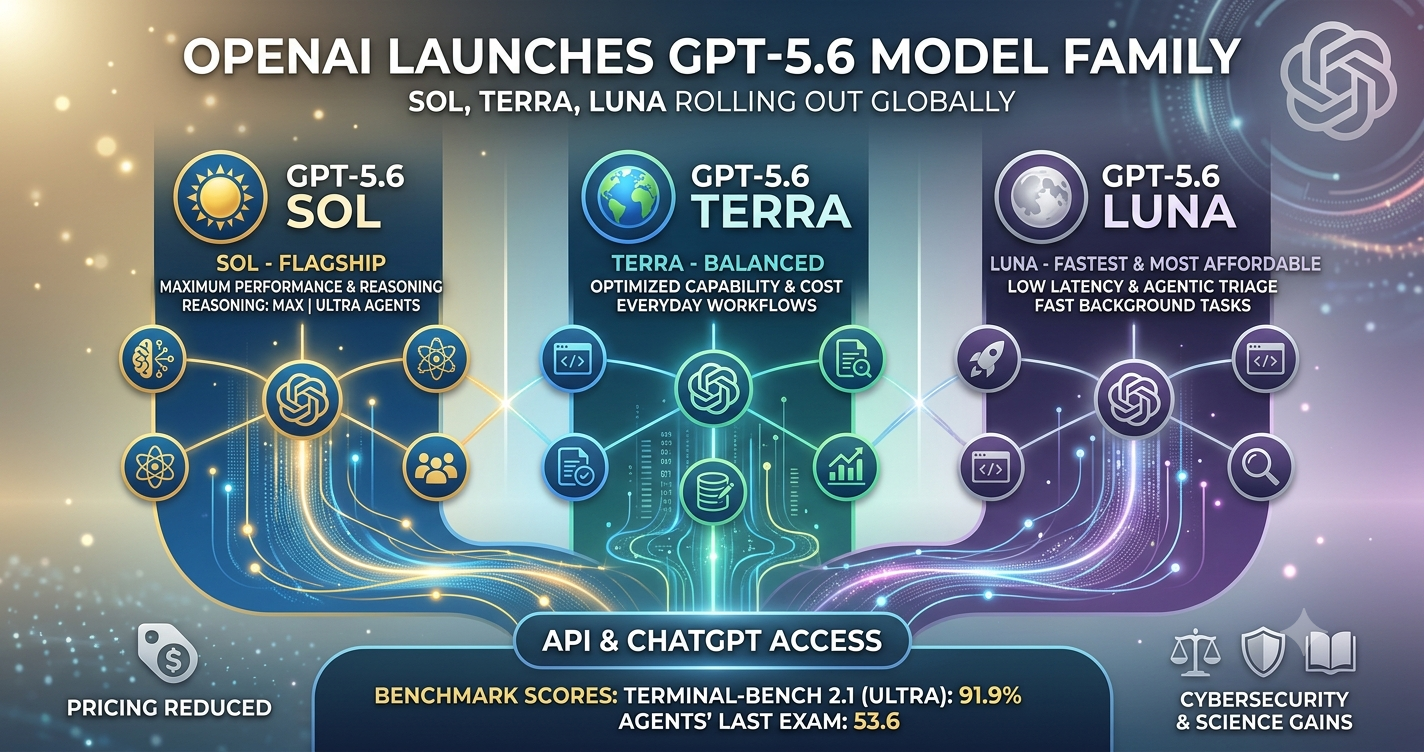
This Image has been generated using Ai

Key Points: 

  • Three-Tier Lineup: OpenAI has introduced three distinct capability tiers named GPT-5.6 Sol, GPT-5.6 Terra, and GPT-5.6 Luna.  
  • Global Rollout: The models are actively rolling out across ChatGPT, Codex, and the OpenAI API.  
  • Advanced Architecture: Flagship variants include new reasoning modes like “max” and “ultra” to solve complex, multi-step tasks.  
  • Drastic Cost Reductions: Ultimately, these models achieve significantly higher efficiency by requiring fewer tokens per task compared to prior iterations.  

ISLAMABAD – OpenAI has officially introduced the OpenAI GPT-5.6 AI models lineup, bringing a structured tier system to its conversational and programmatic intelligence platforms. Instead of releasing a single monolithic model, the company has broken the release into three variants targeting different operational priorities.  

All about GPT-5.6 models

First, GPT-5.6 Sol serves as the flagship tier, offering maximum performance for the most intensive logic-driven tasks. Next, GPT-5.6 Terra acts as the balanced option, providing a sweet spot between operational speed, high capability, and everyday affordability. Finally, GPT-5.6 Luna stands as the fastest and most economical model, optimized for lightweight tasks and rapid background processing. According to OpenAI, this naming scheme represents permanent capability tiers, allowing each specific engine to evolve independently in subsequent iterations.  

Breakthrough Performance and Reasoning Controls 

To maximize the power of its flagship tier, OpenAI deployed two novel processing settings specifically for GPT-5.6 Sol. For instance, the new max mode grants the model extended time to think through complex math, engineering, or structural logic problems before delivering an output. Alternatively, the ultra mode actively coordinates four separate AI sub-agents in a parallel workflow, allowing them to collaborate instantly and solve multi-layered problems much faster.  

Furthermore, the model family achieves these higher success rates while using fewer tokens than previous generations. Consequently, developers receive a massive boost in performance-per-dollar efficiency.  

Official API Pricing Structure 

To keep up with market changes, the API layout has been explicitly priced to allow for highly targeted routing strategies. Below is the official developer pricing structure per million tokens: 

Model Tier  Input Price (Per 1M Tokens)  Output Price (Per 1M Tokens)  Primary Use Case Designation 
GPT-5.6 Sol  $5.00  $30.00  Heavy reasoning, expert programming, and security 
GPT-5.6 Terra  $2.50  $15.00  Everyday production code and general workflows 
GPT-5.6 Luna  $1.00  $6.00  High-volume tasks, low-latency calls, and triage 

Performance Metrics & Technical Benchmarks 

On top of the architectural changes, OpenAI has published preliminary validation data across coding, agentic autonomy, and deep technical reasoning. Therefore, the performance curves closely scale alongside the primary pricing tiers.  

Agentic Coding and Execution Evaluation 

In independent evaluations like Terminal-Bench 2.1, which tracks command-line competency, tool-calling accuracy, and multi-step execution over hours of continuous work, the flagship variant achieved unprecedented heights.  

AI Model Variant  Terminal-Bench 2.1 Score  Evaluation Framework Focus 
GPT-5.6 Sol (Ultra Mode)  91.9%  Long-horizon multi-step code execution 
GPT-5.6 Sol (Standard)  88.8%  Autonomous repository interaction 
GPT-5.5 (Legacy Reference)  88.0%  Command-line tool orchestration 
GPT-5.6 Luna  82.5%  Lightweight scripting and parsing 

Professional Knowledge and Specialized Research 

Beyond traditional software development, the GPT-5.6 family shows a massive leap forward in handling data pipelines. For example, on Agents’ Last Exam—a standardized evaluation measuring independent workflow completion across 55 academic and professional domains—GPT-5.6 Sol scored a high of 53.6, outpacing competing models by wide margins.  

Similarly, the models demonstrate massive accuracy spikes in specialized scientific testing grounds like GeneBench v1 (genomics analysis) and ExploitBench (defensive vulnerability patch generation). Importantly, OpenAI noted that despite these advancements, the models remain safely below “Critical” risk thresholds for biology and automated offensive cyber operations.  

Platform Availability and Global Access Rules 

Access to the new ecosystem is being distributed immediately across different user accounts based on membership tiers. 

  • ChatGPT Plus & Team Users: Granted instant access to GPT-5.6 Sol using medium and higher default reasoning profiles. 
  • Pro & Enterprise Accounts: Receive unlimited entry to GPT-5.6 Sol, along with the option to deploy the advanced Sol Pro configurations.  
  • Free & Go Tier Users: Automatically upgraded to GPT-5.6 Terra through ChatGPT Work spaces and Codex.  
  • API Developers: Full access to all three models is live immediately, featuring optimized prompt caching rules where cache writes are billed at 1.25x and cache reads enjoy an aggressive 90% discount. 

What makes the OpenAI GPT-5.6 AI models distinct from past releases? 

Instead of pushing out a single model, OpenAI launched a family of three explicit tiers (Sol, Terra, Luna) built to help developers seamlessly route their tasks according to speed, depth of reasoning, and budget requirements.  

How do the “max” and “ultra” settings function in GPT-5.6 Sol? 

Max mode allows the flagship model to spend more continuous compute time thinking through tricky logic puzzles. Meanwhile, ultra mode splits the core task among four parallel AI agents to tackle massive, disjointed workflows simultaneously.  

Is there prompt caching available for these models? 

Yes. The OpenAI API includes updated, highly predictable prompt caching configurations with explicit breakpoints and a minimum 30-minute cache lifetime to aggressively drive down enterprise costs.  

Read More :  SpaceX files FCC Request for 100,000 Gen3 Starlink satellites . 

Continue Reading

Sci&Tech

TCL launches VoxIN T4 AC in Pakistan with certified energy-saving technology

Published

on

Key points:

  • TCL has introduced the VoxIN T4 air conditioner in Pakistan.
  • The AC features SGS-certified T-AI Energy Saving Technology.
  • TCL claims the unit saves up to 37% more energy than conventional inverter ACs.
  • The company says the AC can reduce electricity use by up to 75% compared to non-inverter models.
  • The VoxIN T4 supports offline voice control, Wi-Fi connectivity and real-time energy monitoring.
  • The air conditioner is designed to operate in temperatures ranging from -20°C to 65°C.

LAHORE – TCL has introduced the VoxIN T4 air conditioner in Pakistan, claiming it offers certified energy efficiency and smart features aimed at reducing electricity consumption during the country’s hot summer months.

The company said the new model is designed for Pakistan’s extreme weather conditions and rising electricity costs. It added that the air conditioner delivers measurable energy savings backed by independent certification.

SGS certification backs efficiency claims

According to TCL, the VoxIN T4 features the company’s proprietary T-AI Energy Saving Technology, which automatically optimises cooling while reducing electricity consumption.

The company said SGS, an independent testing and certification organisation, has certified the unit’s energy-saving performance.

TCL claimed the VoxIN T4 can save up to 37% more energy than conventional inverter air conditioners.

It also said the unit can reduce electricity consumption by up to 75% compared with non-inverter air conditioners.

Built for Pakistan’s climate

TCL said the VoxIN T4 is designed to deliver stable cooling even during extreme temperatures.

According to the company, the air conditioner can operate in temperatures as high as 65°C and as low as -20°C.

The company said this allows the unit to provide consistent cooling throughout the year.

Smart features included

The VoxIN T4 also includes several smart features designed to improve convenience and energy management.

Users can control the air conditioner through Offline Voice Control without an internet connection.

In addition, Smart Wi-Fi Connectivity allows users to monitor and operate the unit remotely through the TCL Home App.

The air conditioner also includes built-in energy monitoring, enabling users to track electricity consumption in real time.

Read more: SpaceX files FCC Request for 100,000 Gen3 Starlink satellites

Availability

TCL said customers can purchase the VoxIN T4 through its flagship stores, authorised electronics retailers across Pakistan and the company’s official website.

Feature Details
Product TCL VoxIN T4 Air Conditioner
Technology T-AI Energy Saving Technology
Certification SGS-certified energy efficiency
Energy Savings Up to 37% more efficient than conventional inverter ACs
Compared With Up to 75% lower energy consumption than non-inverter ACs
Operating Temperature -20°C to 65°C
Offline Voice Control Yes
Smart Wi-Fi Remote control through TCL Home App
Energy Monitoring Real-time electricity consumption tracking
Availability TCL flagship stores, electronics retailers and TCL Pakistan’s official website

Continue Reading

Sci&Tech

SpaceX files FCC Request for 100,000 Gen3 Starlink satellites

Published

on

SpaceX Files FCC Request for 100,000 Gen3 Starlink Satellites
The image is AI-generated and used for illustration purposes only

Key points 

  • Massive Constellation: SpaceX is seeking FCC approval to deploy up to 100,000 next-generation Gen3 Starlink satellites. 
  • Huge Speed Increase: The new hardware will deliver a 10-fold increase in internet download speeds. 
  • Starship Required: Because each satellite weighs 2,000 kilograms, SpaceX must use its massive Starship rocket for launches. 
  • Hardware Upgrades: Consequently, customers will eventually need new satellite dishes to access these gigabit-class speeds. 

ISLAMABAD – SpaceX has officially filed a major request with the U.S. Federal Communications Commission (FCC). The company is seeking permission to launch up to 100,000 next-generation Gen3 Starlink satellites. This application marks a massive expansion plan for its global satellite internet network. 

These upcoming Gen3 satellites introduce massive upgrades over the current Gen2 models. For example, each new satellite will weigh 2,000 kilograms. This is a massive jump from the 575-kilogram weight of the Gen2 models. Because they are much heavier and larger, SpaceX will rely entirely on its heavy-lift Starship rocket to carry them into orbit. Furthermore, the fleet will operate in very-low Earth orbit (VLEO) at a low altitude of roughly 350 kilometers. 

Massive Performance Boosts On the Way 

According to the official FCC documents, SpaceX designed the Gen3 platform completely from scratch. Therefore, this is a total rebuild rather than a simple software update. 

The company expects these new satellites to deliver a massive 10-fold increase in download capacity, hitting 1 terabit per second (Tbps) per satellite. Additionally, upload speeds will improve by 22 times to reach up to 200 gigabits per second (Gbps). 

To achieve this, the larger satellite body will host advanced phased-array antennas, massive solar panels, and next-generation onboard modems. The system will also use advanced laser links and dynamic power controls. As a result, this tech will improve spectrum sharing and prevent signal interference. 

“The upcoming constellation follows the success of the Gen2 network, which already increased data throughput by 20 times compared to the original Gen1 models,” SpaceX noted in the filing. 

Because of these extreme system upgrades, current Starlink users will eventually need to buy new hardware. Customers must upgrade their satellite dishes and user terminals to actually connect to these new gigabit-class internet speeds. 

Technical Constellation Data 

Feature  System Specifications 
Constellation Generation  Gen3 Starlink Satellites 
Proposed Fleet Size  Up to 100,000 Satellites 
Satellite Weight  2,000 kg Each (Requires Starship Rocket) 
Target Download Speed  1 Terabit per second (10x Increase) 
Target Altitudes  323–327.5 km and 473–477.5 km 
Operational Spectrum  Ku-, Ka-, V-, E-, W-, and D-band frequencies 

Dedicated AI Satellites Revealed 

In a completely separate announcement, SpaceX also introduced its very first satellite built entirely for artificial intelligence workloads. Named the AI1 satellite, this dedicated computing platform supports up to 150 kilowatts of peak processing capacity. 

The advanced AI1 spacecraft features liquid cooling radiators, meteoroid shielding, and automated computing modules. SpaceX plans to manufacture these units at its Gigasat facility in Texas. While the AI1 models are not yet in active production, the new FCC filing shows that SpaceX is ready to start mass production on the Gen3 Starlink satellites very soon. 

Finally, SpaceX clarified that this 100,000-satellite request is completely separate from its long-term vision to eventually launch one million satellites to build a “Kardashev II-level civilization.” The FCC is reviewing both applications completely independently. 

What are Gen3 Starlink satellites? 

They are SpaceX’s next-generation internet satellites designed to deliver 10 times more download capacity and faster gigabit-class internet speeds across the globe. 

Why do the new Gen3 satellites require the Starship rocket? 

The new models weigh 2,000 kilograms each, which is nearly four times heavier than the previous generation. Only the massive Starship rocket has the space and power to launch them. 

Will I need to buy a new Starlink dish for Gen3? 

Yes. Because the network upgrades are so substantial, current users will need to upgrade their user terminals and dishes to access the faster speeds.

Read more : Claude Cowork expansion brings AI agents to mobile and web 

Continue Reading

Sci&Tech

Samsung unveils key details, pricing and launch of Wide Foldable and Z Fold 8 Ultra

Published

on

The image is AI-generated and used for illustration purposes only

Key points:

  • Samsung has confirmed its next Galaxy Unpacked event for July 22 in London.
  • The launch event will begin at 6:00pm Pakistan Standard Time (PKT).
  • Samsung is expected to introduce the Galaxy Z Fold 8, Galaxy Z Fold 8 Ultra, and Galaxy Z Flip 8.
  • The Galaxy Z Fold 8 is rumoured to feature a wider display and a lower price than its predecessor.
  • The Galaxy Z Fold 8 Ultra is expected to offer premium features, including improved display technology and upgraded cameras.
  • Samsung may also unveil the Galaxy Watch 9, Galaxy Watch Ultra 2, and its Android XR smart glasses.

LAHORE – Samsung has confirmed that its next Galaxy Unpacked event will be held on July 22 in London, where the company is expected to introduce its latest foldable smartphones and other Galaxy devices.

The event is scheduled to begin at 6:00pm Pakistan Standard Time (PKT) and will be streamed live through Samsung’s official website and YouTube channel.

While Samsung has not officially revealed the names of the upcoming products, the company said the event will showcase its latest Galaxy innovations as it continues to expand its foldable smartphone portfolio.

Recent teaser videos released by Samsung hint at a foldable smartphone with a wider design, suggesting a significant redesign for the Galaxy Z Fold series.

When is the Galaxy Z Fold 8 series expected?

According to recent leaks and industry reports, Samsung could introduce two book-style foldable smartphones for the first time.

The standard Galaxy Z Fold 8 is expected to feature a wider main display, offering a more practical aspect ratio for watching videos and multitasking. Reports also suggest Samsung may reduce the rear camera setup from three cameras to two in an effort to lower production costs.

Meanwhile, the Galaxy Z Fold 8 Ultra is expected to become the flagship foldable in Samsung’s lineup. It is rumoured to feature an upgraded processor, improved display technology with a less visible crease, three rear cameras and faster charging support.

Samsung has not confirmed these specifications.

If the reports prove accurate, it would mark the first time the company launches two book-style foldable smartphones during the same Galaxy Unpacked event.

What’s the expected price?

Industry reports suggest the Galaxy Z Fold 8 could be priced below the previous-generation Galaxy Z Fold 7, positioning it as a more affordable option.

The Galaxy Z Fold 8 Ultra, on the other hand, is expected to become Samsung’s most premium foldable smartphone and may carry a higher price tag than the Galaxy Z Fold 7.

Samsung has yet to announce official pricing.

Galaxy Z Flip 8 also expected

Samsung is also widely expected to unveil the Galaxy Z Flip 8 during the event.

The clamshell foldable is rumoured to feature a redesigned hinge, improved performance and a lighter body. However, reports indicate that the overall design may remain largely unchanged because of ongoing global RAM supply constraints.

Which of the other devices?

In addition to foldable smartphones, Samsung could also announce several wearable devices. The expected lineup includes the Galaxy Watch 9, Galaxy Watch Ultra 2, and Samsung’s Android XR smart glasses.However, some of these products could be introduced at a separate launch event later this year.

Category Details
Event Samsung Galaxy Unpacked 2026
Date July 22, 2026
Location London, United Kingdom
Pakistan Time 6:00 PM PKT
Live Stream Samsung Official Website & YouTube Channel
Expected Phones Galaxy Z Fold 8, Galaxy Z Fold 8 Ultra, Galaxy Z Flip 8
Galaxy Z Fold 8 Wider display, expected lower price, dual rear cameras (rumoured)
Galaxy Z Fold 8 Ultra Premium model, improved crease reduction, upgraded processor, triple cameras, faster charging (rumoured)
Galaxy Z Flip 8 Redesigned hinge, lighter body, performance improvements (rumoured)
Other Expected Devices Galaxy Watch 9, Galaxy Watch Ultra 2, Android XR Smart Glasses
Official Confirmation Event date and venue confirmed; product specifications remain unconfirmed.

Continue Reading

About

Upfront influence about 20 million users and is the number one business and technology news network on the planet


© 2022 upfront. All Rights Reserved.

Trending

Copyright © 2026