Sci&Tech
Meta disables controversial Muse Image AI feature

Key Points:
-
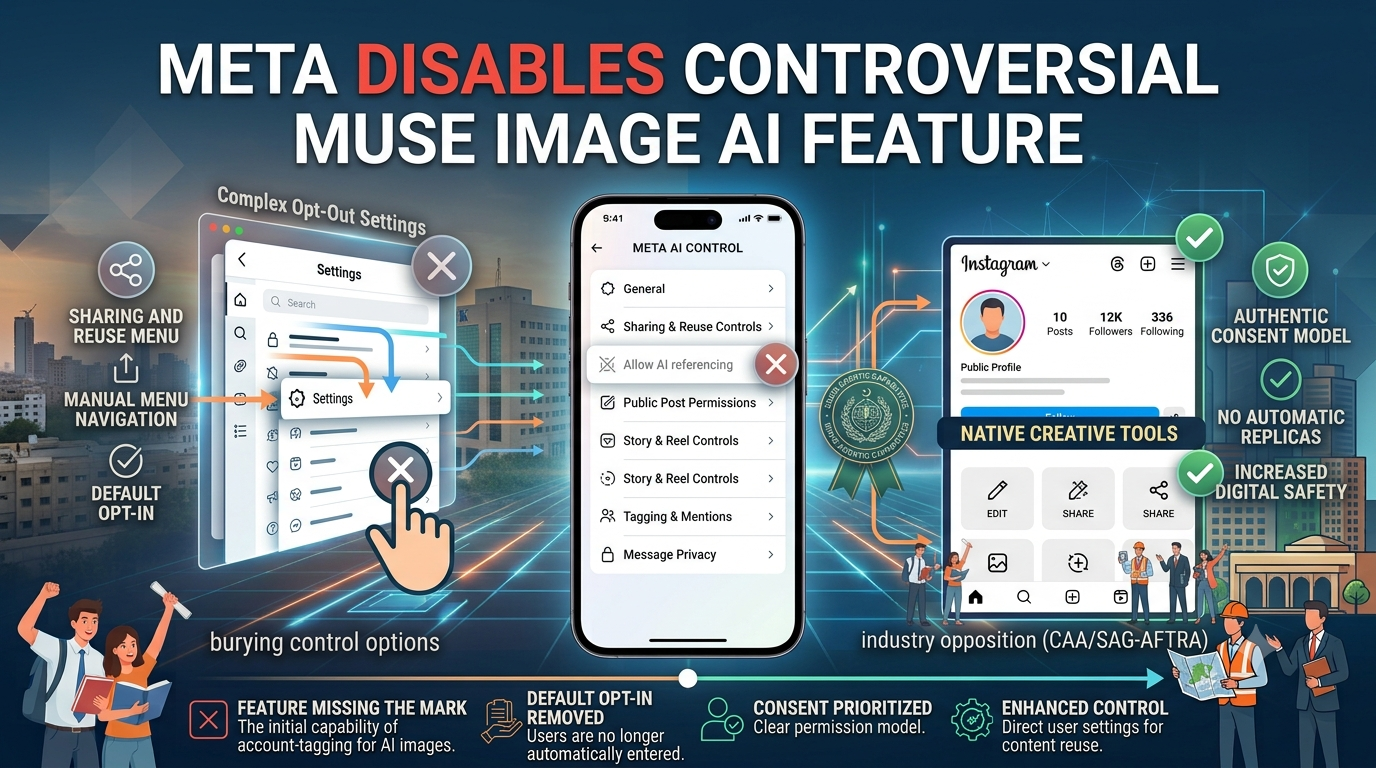
Feature Discontinued: Meta has officially disabled the Muse Image AI capability. Specifically, the tool allowed users to generate custom visuals by referencing public Instagram accounts.
-
Strategic Reversal: This sudden decision came just days after the initial launch. Consequently, it followed immediate backlash regarding user privacy and automatic opt-in defaults.
-
Corporate Admission: Furthermore, in an updated statement, Meta acknowledged the tool “missed the mark” regarding user sentiment and control.
-
Industry Pressure: Major entertainment groups vocally opposed the tool to protect creator likenesses. For example, these groups included talent agency CAA and labor union SAG-AFTRA.
LAHORE – Meta has officially announced the removal of a highly debated feature within its new Muse Image AI ecosystem. However, the change occurred just days after the tool’s public debut. When the tech giant first introduced the image generation tool, it included a native Instagram capability. This specific feature allowed anyone to tag a public account to automatically generate new visuals.
Subsequently, the system used that profile’s public photos to build the new images. Because the tool was active by default for all public adult profiles, users faced a distinct problem. Therefore, their visual likeness could be incorporated into AI creations without their active awareness or explicit permission.
Consequently, digital rights advocates and general users expressed intense concern over the potential for non-consensual digital replicas. In response to the growing wave of criticism, Meta updated its product roadmap. As a result, the company admitted that the rollout strategy missed the mark and confirmed the feature has been permanently pulled.
Explaining the Opt-Out Controversy and Default Settings
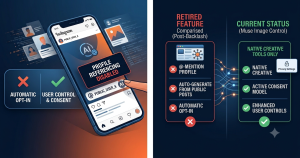
The primary driver behind the immediate public pushback was the aggressive implementation framework chosen by Meta. Instead of requiring individuals to proactively sign up for the service, the platform automatically opted in all public account holders over the age of 18.
To protect their personal photos from being used as generative source material, users faced an uphill battle. Specifically, they were forced to manually navigate through complex privacy menus. Moreover, they had to toggle off options under the “Sharing and reuse” sub-menu or convert their entire profile to private. Therefore, privacy groups criticized the system as an unfair invasion of personal data. Furthermore, they noted that it buried user control options beneath default corporate settings.
AI Feature Rollout Status
| Parameter | Original Launch Configuration | Post-Backlash Status (July 2026 Update) |
| Profile Referencing | Anyone could tag a public account to generate AI images | Feature completely disabled |
| Consent Model | Automatic opt-in by default for adult public accounts | N/A (Feature removed entirely) |
| Privacy Safeguards | Required manual menu toggling or setting profile to private | Automatic exclusion maintained for minors/private profiles |
| Platform Availability | Planned expansion to Facebook, WhatsApp, and Messenger | Halted indefinitely for the account-tagging feature |
Entertainment Industry Pushes Back Against Likeness Scrape
Beyond ordinary social media users, prominent entertainment organizations actively lobbied against the tool. For instance, they wanted to shield professional performers. Hollywood talent firm Creative Artists Agency (CAA) reportedly initiated direct discussions with Meta leadership to express its deep disapproval. Specifically, CAA represents high-profile actors like Tom Hanks and Meryl Streep.
Therefore, the agency firmly asserted a clear principle. No individual’s name, image, or creative work should ever be utilized by third-party AI systems without explicit, documented consent. Concurrently, the American labor union SAG-AFTRA aggressively urged its nationwide membership to turn off the sharing toggles. The union called the default opt-in a total miscalculation of public sentiment regarding digital safety. Following the official removal announcement, the union welcomed the change. Ultimately, they called it a responsible step toward combatting unauthorized digital replicas.
Why did Meta disable the Muse Image account-tagging feature?
Meta deactivated the capability after widespread public outcry from users, privacy experts, and labor unions. These groups objected to an AI tool that could use people’s photos to create digital replicas without explicit consent.
Do I still need to change my Instagram settings to block this specific tool?
No. Meta has completely removed the feature from the Meta AI chatbot. Because of this, users no longer need to look for a specific toggle to block other accounts from referencing their profile.
Was anyone automatically protected from this feature before it was removed?
Yes. From the initial launch, Meta automatically excluded certain accounts. All private profiles and any accounts belonging to users under the age of 18 were safe from being referenced by the tool.
Read More : Original creators can now edit their own videos on X .
Stay Connected with Upfront
Get the latest news, technology, business, sports and entertainment stories from Upfront.
Add Upfront as a preferred source on GoogleAdd Upfront to your preferred sources to see more of our stories across Google Search.