Connect with us

Sci&Tech

Learn about NASA’s undergoing discovery of life on Mars

Published

on

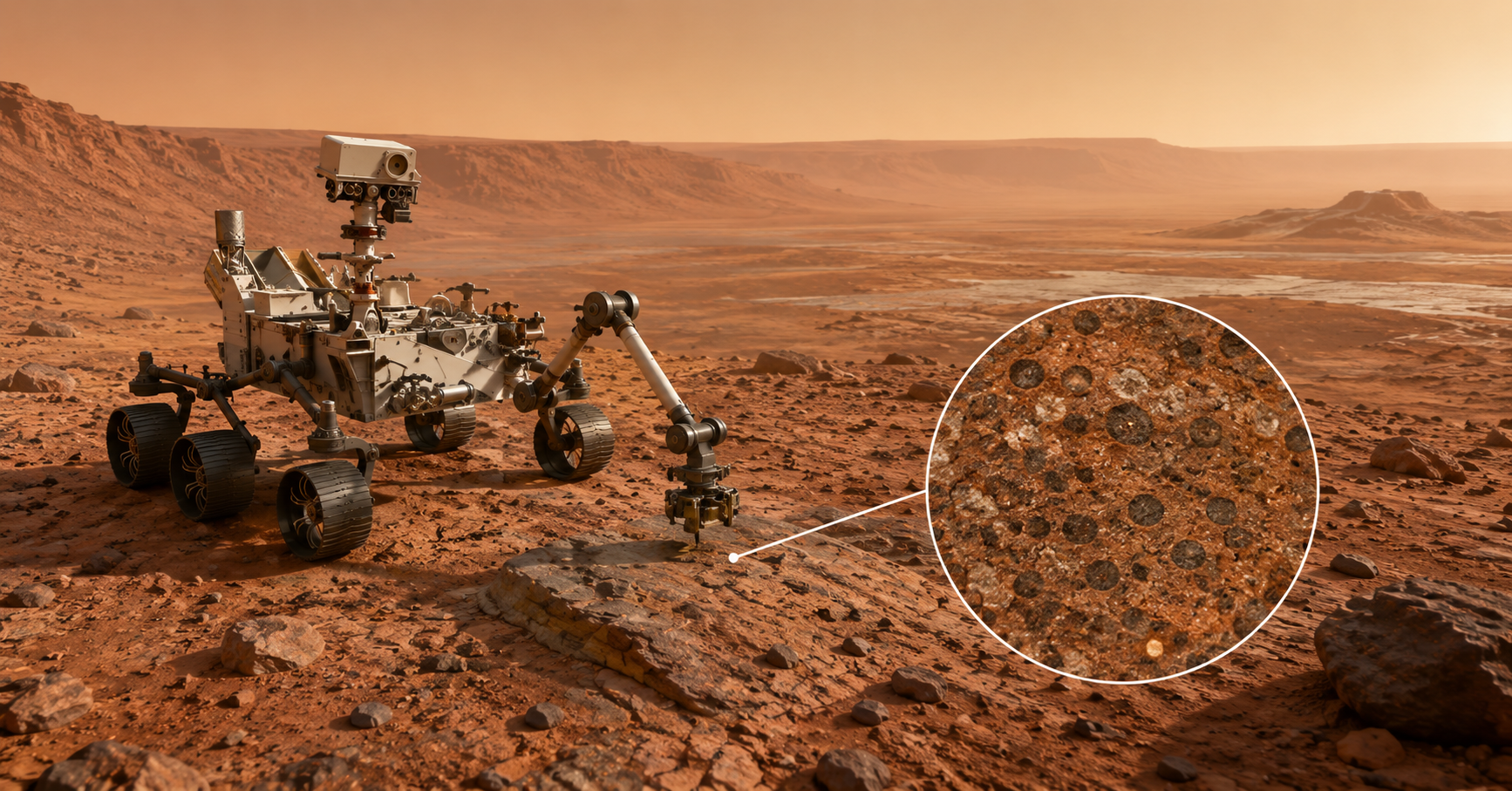
The image is AI-generated and used for illustration purposes only

WASHINGTON – Scientists analysing samples collected by NASA’s Perseverance rover have identified complex organic carbon in ancient Martian rocks, providing further evidence that Mars once possessed chemical ingredients and environmental conditions that may have been suitable for life.

The findings, published in the journal Science Advances, focus on sedimentary rocks in Jezero Crater that formed beneath a long-vanished body of water between about 3.2bn and 3.8bn years ago.

Researchers examined organic carbon detected in two rocks, named Cheyava Falls and Walhalla Glades, which were sampled about 100 metres apart by the rover. The carbon is described as macromolecular carbon — a complex form that resembles carbon produced through both biological and non-biological processes on Earth, as well as carbon found in some meteorites.

The discovery marks the first time macromolecular carbon has been identified in mudstones within Jezero Crater, where Perseverance landed in 2021. NASA’s Curiosity rover had previously detected similar material in Gale Crater, roughly 3,700km away.

“These findings indicate that the habitability of Mars and the availability of organic materials may have been widespread across the planet billions of years ago,” said planetary scientist Kyle Uckert of NASA’s Jet Propulsion Laboratory, a co-leader of the study.

Organic carbon forms the chemical basis of molecules such as DNA, proteins and cells, making it an important target in the search for past life. However, scientists stressed that its presence does not constitute evidence of life because it can also be produced through geological and chemical processes involving rock and water.

Last year, NASA released images of the Cheyava Falls rock showing fine-grained rusty-red mudstone containing ring-shaped patterns and dark specks that on Earth can sometimes be associated with microbial activity. Researchers classified these features as a potential biosignature, meaning they could have a biological origin but require further study.

Using Perseverance’s SHERLOC instrument, the team conducted a more detailed examination of the carbon compounds but said the rover’s onboard instruments could not determine whether the material originated through biological processes.

“We need the return of these samples to Earth for more rigorous testing with higher sensitivity and higher resolution laboratory instruments,” Uckert said.

Scientists believe that early Mars had a thicker atmosphere and a warmer climate that allowed liquid water to exist on its surface. Jezero Crater is thought to have once contained a lake fed by ancient river channels, potentially creating habitats suitable for microbial life.

“The only place in the universe where we know life has emerged is Earth,” Uckert said. “If life is discovered on Mars, it could indicate that the emergence of life is not restricted to Earth, assuming the right conditions and ingredients are available, which would be a profound discovery.”


Continue Reading

Latest

Quantum sensor breakthrough explores dark matter

Published

on

QUANTUM SCENSOR BREKATHROUGH
Generated with AI

KARACHI -A major quantum sensor breakthrough has brought scientists one step closer to solving the biggest mysteries of the universe. Researchers successfully unveiled a new prototype device today. This advanced technology could soon help detect dark matter and ancient gravitational waves. 

The project relies on a highly advanced quantum system. The system utilizes two clouds of ultracold atoms to measure incredibly tiny forces. Until now, tracking these microscopic cosmic ripples was nearly impossible.  

According to the engineering team, this new device offers unprecedented sensitivity. The sensor can detect environmental shifts at a subatomic scale. This capability opens a brand-new window into deep space exploration. 

Unlocking the Puzzling Deep Universe 

The primary goal of this quantum sensor breakthrough is to study what we cannot see. Dark matter makes up most of the universe’s mass. Yet, it remains completely invisible to traditional telescopes. 

“We are building quantum detectors that could reveal some of the universe’s biggest secrets,” the lead researcher noted during the unveiling. 

By measuring how dark matter interacts with ultracold atoms, the sensor can map invisible cosmic structures. For a deeper look at international physics research initiatives, readers can view the latest physics tracking metrics on the official Stockholm International Peace Research Institute Portal. 

Mapping Ancient Waves From the Big Bang 

Beyond dark matter, this technology targets ancient gravitational waves. These waves are ripples in the fabric of space and time. They were created during the earliest moments of the universe.  

Current laser detectors can only spot massive cosmic collisions. However, this new device can find much smaller, older signals. Scientists believe these signals will help explain how the first galaxies formed. 

The technology is expected to scale rapidly over the next decade. Production teams are already designing a space-ready version of the sensor. Putting these devices into orbit will eliminate interference from Earth’s gravity. 

What Lies Ahead for Advanced Physics 

The scientific community is welcoming the discovery with great excitement. Teams around the world are preparing to test the prototype in different environments. Initial field tests will begin late next month. 

The research team will share their open-source data with global laboratories. This move aims to accelerate international development. 

To track all real-time updates and breaking physics press releases, be sure to bookmark our comprehensive International Relations Coverage Archive as this incredible quantum sensor breakthrough reshapes modern science. 

Continue Reading

Sci&Tech

The biggest battery ever in Honor’s wide foldable phone: Details

Published

on

ISLAMABAD – Honor is reportedly in the final stages of developing its first wide-format foldable smartphone, with a new leak outlining its expected display, battery and camera specifications.

According to Chinese tipster Digital Chat Station, the device has entered its final refinement phase after completing engineering tests. Honor has not officially confirmed the handset or announced a launch timeline.

The leak suggests the foldable will feature a 7,000mAh battery, which would make it one of the largest batteries fitted in a flagship foldable smartphone. Honor has previously equipped its foldable devices with comparatively large batteries, including the Magic V6, which carries a 6,660mAh unit.

The device is also expected to feature a 7.6-inch inner foldable display and a 5.5-inch outer screen, offering a wider cover display for everyday tasks without unfolding the handset.

According to the leak, Honor has finalised a 200-megapixel primary rear camera for the device. The camera system is also expected to include a periscope telephoto lens, although details of the remaining sensors have not been disclosed.

Earlier reports suggested the foldable could be powered by Qualcomm’s Snapdragon 8 Elite Gen 6-series processor, reportedly based on a 2-nanometre manufacturing process. However, neither Honor nor Qualcomm has confirmed the chipset.

While the company has yet to announce a release date, the latest leak suggests development of the foldable smartphone is nearing completion.

Continue Reading

Sci&Tech

All about GeForce RTX 3060 comeback in the market: Nvidia

Published

on

The image is AI-generated and used for illustration purposes only

ISLAMABAD – Nvidia has reintroduced its GeForce RTX 3060 12GB graphics card to the market nearly five years after its original launch, as ongoing memory shortages and growing demand driven by artificial intelligence (AI) continue to affect the consumer graphics card market.

Originally released in 2021 with a suggested retail price of $329, the RTX 3060 has returned to retailers in the United States at roughly the same price. The development comes at a time when Nvidia would typically be preparing refreshed products for its latest graphics card lineup.

According to industry reports, the return of the RTX 3060 follows increased demand for mainstream graphics cards, while semiconductor manufacturers continue prioritising AI-related products over consumer hardware. Rising DRAM prices have also constrained production, making it more difficult for board partners to manufacture lower-cost graphics cards.

Despite offering 12GB of GDDR6 memory, the RTX 3060 remains based on Nvidia’s Ampere architecture and lacks several features available on the newer GeForce RTX 5060, including support for the latest DLSS technologies, updated Tensor Cores and improved media engines.

The RTX 5060, built on the newer Blackwell architecture, also delivers higher performance, greater memory bandwidth and lower power consumption despite having 8GB of GDDR7 memory.

The RTX 5060 officially launched at $299 but is currently selling for around $349 to $359 in several markets, leaving only a modest price difference between the newer model and the returning RTX 3060.

Industry analysts say the RTX 3060’s reappearance reflects broader challenges facing the graphics card market rather than a renewed demand for older hardware. Rising memory costs, fuelled by expanding AI infrastructure, have increased manufacturing costs across the industry and limited the availability of competitively priced consumer GPUs.

Manufacturers have also shifted production towards higher-margin memory products, while major DRAM suppliers have signed long-term supply agreements and announced new investments largely aimed at meeting AI-related demand.

As a result, prices for both current-generation and older graphics cards are expected to remain elevated, with analysts suggesting that supply conditions may not improve significantly in the near term.

Continue Reading

About

Upfront influence about 20 million users and is the number one business and technology news network on the planet


© 2022 upfront. All Rights Reserved.

Trending

Copyright © 2026