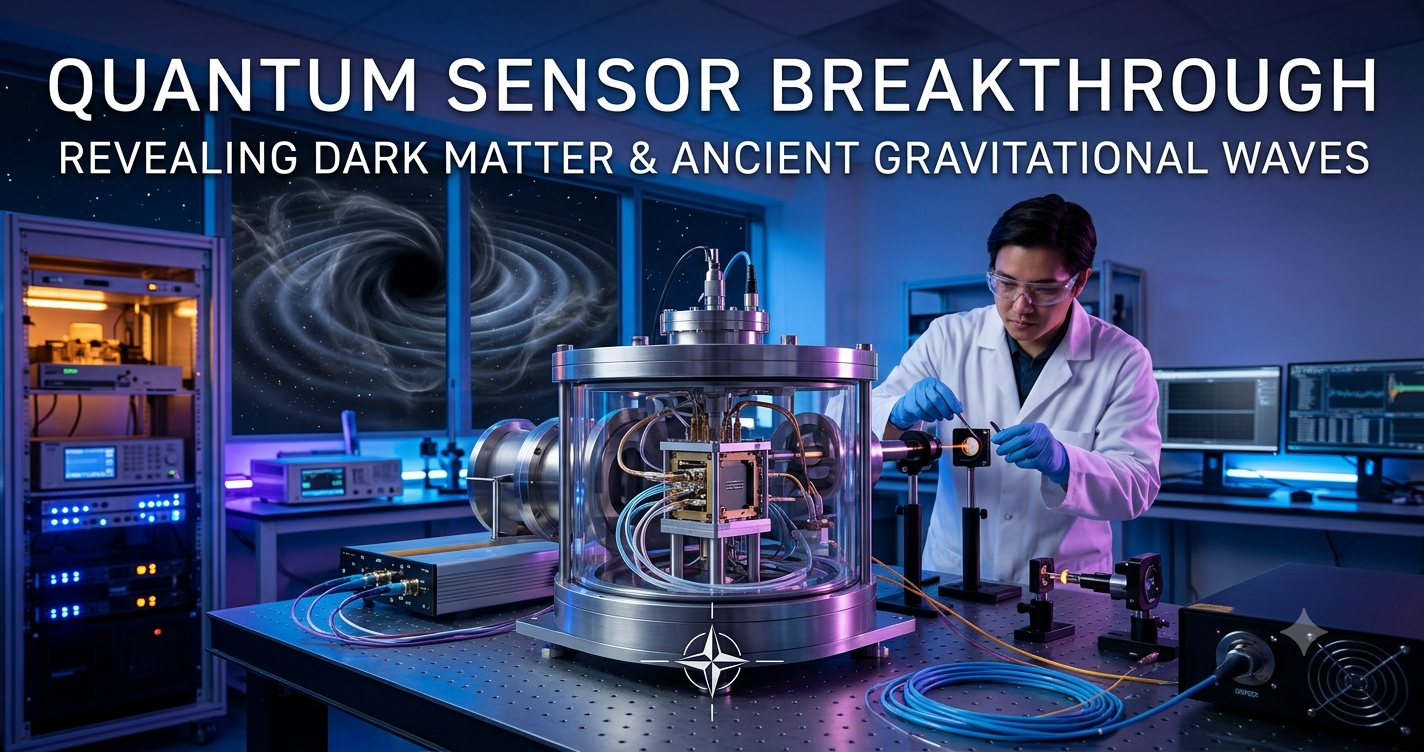
KARACHI -A major quantum sensor breakthrough has brought scientists one step closer to solving the biggest mysteries of the universe. Researchers successfully unveiled a new prototype device today. This advanced technology could soon help detect dark matter and ancient gravitational waves.
The project relies on a highly advanced quantum system. The system utilizes two clouds of ultracold atoms to measure incredibly tiny forces. Until now, tracking these microscopic cosmic ripples was nearly impossible.
According to the engineering team, this new device offers unprecedented sensitivity. The sensor can detect environmental shifts at a subatomic scale. This capability opens a brand-new window into deep space exploration.
Unlocking the Puzzling Deep Universe
The primary goal of this quantum sensor breakthrough is to study what we cannot see. Dark matter makes up most of the universe’s mass. Yet, it remains completely invisible to traditional telescopes.
“We are building quantum detectors that could reveal some of the universe’s biggest secrets,” the lead researcher noted during the unveiling.
By measuring how dark matter interacts with ultracold atoms, the sensor can map invisible cosmic structures. For a deeper look at international physics research initiatives, readers can view the latest physics tracking metrics on the official Stockholm International Peace Research Institute Portal.
Mapping Ancient Waves From the Big Bang
Beyond dark matter, this technology targets ancient gravitational waves. These waves are ripples in the fabric of space and time. They were created during the earliest moments of the universe.
Current laser detectors can only spot massive cosmic collisions. However, this new device can find much smaller, older signals. Scientists believe these signals will help explain how the first galaxies formed.
The technology is expected to scale rapidly over the next decade. Production teams are already designing a space-ready version of the sensor. Putting these devices into orbit will eliminate interference from Earth’s gravity.
What Lies Ahead for Advanced Physics
The scientific community is welcoming the discovery with great excitement. Teams around the world are preparing to test the prototype in different environments. Initial field tests will begin late next month.
The research team will share their open-source data with global laboratories. This move aims to accelerate international development.
To track all real-time updates and breaking physics press releases, be sure to bookmark our comprehensive International Relations Coverage Archive as this incredible quantum sensor breakthrough reshapes modern science.