ISLAMABAD – PTI government on Thursday declared the findings of the inquiry report on the sugar crisis public.
PM Imran Khan’s aide on accountability, made the much-awaited sugar inquiry report public in the federal capital.
Following the Federal Cabinet approval, the government on Thursday made the inquiry report of the Sugar Inquiry Commission public, which revealed that the major sugar mills groups had under-reported sales and committed fraud using different tactics.
View Here Complete Sugar Inquiry Report
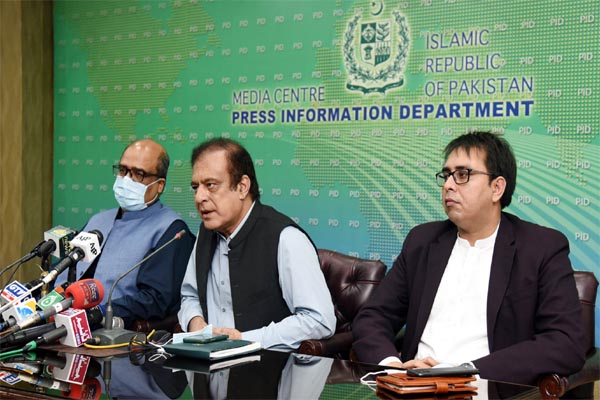
Briefing newsmen after the special cabinet meeting chaired by Prime Minister Imran Khan here, Minister for Information and Broadcasting Shibli Faraz flanked by Special Assistant to the PM on Accountability Shahzad Akbar and SAPM Shahbaz Gill, said the present government was firmly committed to accountability and transparency in governance.
He said in the past, only lip service was paid regarding sugar and flour crises, and no practical steps were taken to address the problem and find out the culprits. It was Prime Minister Imran Khan who ordered the inquiry as the common man was the main victim of the loot and plunders on account of the sugar and flour shortages.
The prime minister had also issued directives to the Cabinet Secretary to gather the details of the assets of unelected advisers and special assistants and made them public.
SAPM Shahzad Akbar said today was a very important day in the history of Pakistan as no government had ever made the reports of such inquiry commissions public in the past.
He said the Sugar Inquiry Commission was established to ascertain the reasons for the increase in the sugar prices in the last couple of years, and its detailed report was presented in the special cabinet meeting held today.
The commission’s report, he said, proved what PM Imran Khan had always maintained that “whenever a businessman comes into politics, he will always do business even at the expense of the poor.” The report would be available online following the prime minister’s orders, he added.
Shahzad Akbar said the report explicitly stated that the sugar mill owners not only purchased the product from the sugarcane growers at the price less than the support price announced by the government but also cut the weight of sugarcane by 15 to 30 percent.
He said the commission also found irregularities in the form of giving advance payments to farmers in the form of cash or commodity, which was akin to unregulated banking and they earned up to 35 per cent profit on the loaned amount.
Shahzad Akbar said a subsidy of Rs 29 billion was given to the sugar industry in the last five years.
He said it was found that the net total income tax paid by around 88 sugar mills of the country was mere Rs 10 billion after getting refunds. Six big industrial groups of Pakistan, which had a 51 percent share of the sugar industry and were acting as a ‘cartel’, and the forensic audit of their mills was conducted by the commission.
He said the audit of Alliance Sugar Mill from Rahim Yar Khan partially owned by Pakistan Muslim League- Quaid (PML-Q) senior leader Moonis Elahi, showed that between 2014 to 2018, it made a systematic cut of 11 to 14 percent of the amount it owed to the farmers, which translated to Rs 970 million. It was was a huge blow for the farmers.
The said mill under-reported its sales for several years and sold sugar to unnamed buyers, he said, adding the inquiry report mentioned violations of the Pakistan Penal Code committed by the mills.
Mentioning the JDW Sugar Mills in which Jahangir Tareen owned 21 percent shares, he said according to the report, the mill management was involved in double booking, under-reporting, and over-invoicing. It under-invoiced sales from bagasse and molasses, which resulted in 25 percent cost inflation. The mill was involved in forward sales, satta and benami sales.
He said the Al-Arabiya Sugar Mills owned by Salman Shehbaz Sharif was also audited, which found to be involved in a fraud of Rs 400 million through informal receipts and market manipulation.
Shahzad Akbar said the report revealed that certain sugar mills used informal receipts and it was ultimately the farmer, who was crushed because there was no official record. The mill owners showed the price of production to be more than the support price which meant that farmers earned less than the support price.
He said it was the first time that an “independent inquiry” had been conducted into the cost of production. He said in 2017-18, sugar mills determined the cost of production at Rs 51 per kilograms whereas as per the calculations of the commission it was estimated at Rs 38 instead.
Similarly in 2018-19, the sugar mills gave the cost price of one kg at Rs 52.60 while according to the report the estimated cost was Rs 40, he added.
The SAPM said the report also pointed out that the sucrose content as shown by the Pakistani mills’ owners (9.5pc to 10.5pc) was less than the international standard.
He said on the one hand, the inflated cost of production and market manipulation was being done and on the other, accounting fraud was also being committed by the sugar mill owners.
Shahzad Akbar said the report of the commission had also shown that the mill owners were maintaining two account books – one for the government and the other for themselves. There was an under-reporting on sugar procurement up to 25-30 percent, which was a scandal as no tax was evaded because of that factor.
He said the report revealed that the Omni Group in Sindh had specifically benefited from the subsidies given by Sindh Chief Minister Murad Ali Shah. The Omni Group was already getting subsidies from the Federal Government, but the Sindh Government gave it an additional subsidy.
Shahzad Akbar said the inquiry commission headed by Director General of Federal Investigation Agency Wajid Zia, in its forensic audit report, had recommended strengthening the regulatory framework and pushing the regulators to perform their assigned duties.
The commission noted that the failure of regulators right from the role of Sugarcane Commissioner up to policy-making level was quite obvious, and recommended to rectify the gaps and shortcomings in that regard.
Any fraud in sales tax by a sugar mill was impossible sans the connivance of Federal Board of Revenue (FBR) representative deployed at its premises, the SAPM said. The delivery, sales, and purchase mechanism of sugar mills should be regulated as no authentic record of their sales, exports, purchases or even production was available.
Shahzad Akbar said the cabinet decided that looted money should be recovered from the sugar mills and recommendation for a mechanism in that regard would be finalized after Eid ul Fitr.
He said the commission had determined the price of sugar by giving sugar mill owners a 15 percent margin of profit.
The mills were looting the farmers by showing 15 to 30 percent less weight of the sugarcane on the receipts of purchases, which were also not in proper form.
He said the commission determined the production cost of per kg sugar at Rs 38, Rs 40.60, and Rs 46.04 in the years 2017-18, 2018-19 and 2019-20whereas the mills were showing Rs 51, Rs 52.6 and Rs 62 per kg respectively.
He said the bye-products price was also shown less by sugar mills owners. He said over 100 billion was earned by the sugar mafia as windfall profit by market manipulations during the current year. Most of the sales were Benami, including in the names of truck drivers and others to devour taxes. Most of the mills committed fraud in the sale tax payments.
He said the crushing capacity had been enhanced by various mills without getting approval from the relevant authorities.
He said 68 percent sugar was exported to Afghanistan but the data of Pakistan and Afghanistan did not match. He elaborated that the weight lifting capacity of a truck was 15 to 20 tons whereas the sugar mills invoices showed that each truck carried some 70 to 80 tons of sugar to Afghanistan. The payment to sugar barons was done from Afghanistan through telegraphic transfers, he added.
He said the commission had recommended a thorough probe into the sugar export to Afghanistan.-APP








 Fashion1 month ago




You must be logged in to post a comment Login