Connect with us

Pakistan

Jamaat-i-Islami stages Lahore protest against fuel prices

Published

on

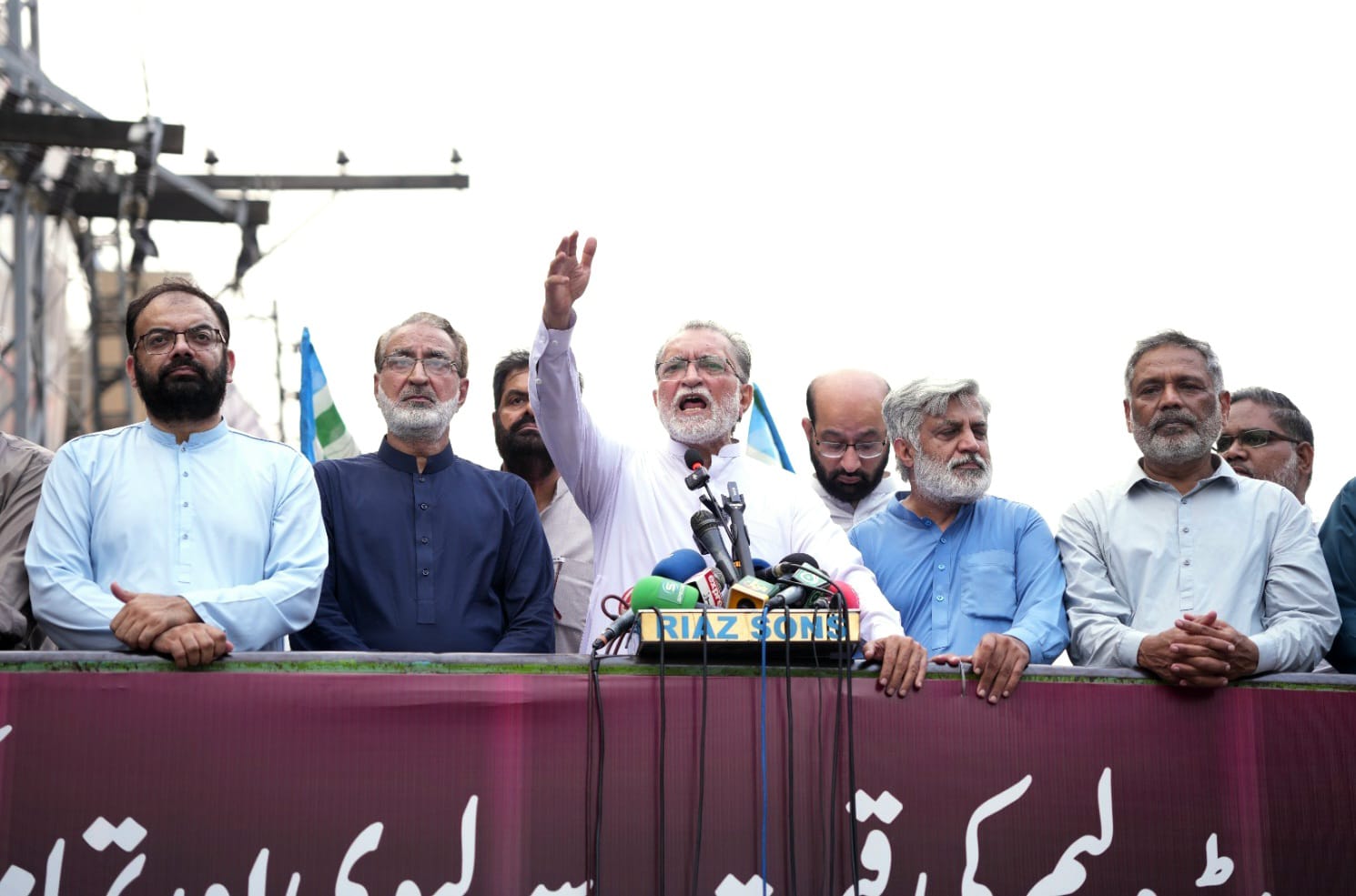
Ameer Jamaat-e-Islami Lahore, Ziauddin Ansari Advocate, addresses a protest demonstration at Ichhra, Ferozepur Road, against rising petroleum prices, electricity tariffs, IPPs, flour and LPG mafias, and increasing inflation.-Photo by Aqil Ashiq.

Key points:

  • Jamaat-i-Islami Lahore held a protest at Ichhra on Ferozepur Road against rising petroleum prices and inflation.
  • The demonstration was led by Ziauddin Ansari Advocate, while Hafiz Naeemur Rehman addressed participants.
  • Protesters demanded the abolition of the petroleum levy and other taxes on petroleum products.
  • The party called for the immediate withdrawal of recent electricity tariff increases.
  • Demonstrators urged the government to take action against alleged flour and LPG profiteering.
  • Jamaat-i-Islami proposed fixing petrol prices at Rs225 per litre for the next three years.
  • The party warned it would continue its campaign if public demands remained unaddressed.

LAHORE – Jamaat-i-Islami (JI) on Friday organised a protest demonstration in Lahore against rising petroleum prices, electricity tariff increases, inflation and what it described as the influence of Independent Power Producers (IPPs), while demanding the abolition of the petroleum levy and other taxes on fuel.

The protest was held at Ichhra on Ferozepur Road following an appeal by JI chief Hafiz Naeemur Rehman. The demonstration was led by Jamaat-i-Islami Lahore Ameer Ziauddin Ansari Advocate, while Hafiz Naeem addressed participants during the gathering.

A large number of party workers, traders, youth and local residents attended the protest. Several senior party leaders, including Lahore Secretary Azhar Bilal, deputy ameers Khalid Ahmed Butt, Engineer Akhlaq Ahmed, Chaudhry Muhammad Shaukat, Malik Shahid Aslam and Waqas Ahmed Butt, also participated.

The demand of protestors

The protesters demanded the abolition of all taxes imposed on petroleum products, including the petroleum levy, and called on the government to withdraw recent electricity tariff increases. They also urged authorities to take action against those allegedly responsible for artificial increases in flour and LPG prices.

Participants further proposed freezing petrol prices at Rs225 per litre for the next three years, arguing that such a measure would help curb inflation and provide economic stability.

Addressing the rally, Ziauddin Ansari said continuous increases in petroleum prices were placing additional financial pressure on households by raising transportation costs and increasing the prices of essential commodities.

He maintained that the government should pass on the benefit of lower international oil prices to consumers and restore petroleum prices to previous levels to provide relief from inflation.

Read more: Pakistan’s IT exports reach record $4.5 Billion in FY2025-26

What the JI Lahore Chief further stated

The JI Lahore chief also alleged that electricity tariff increases primarily benefited IPPs rather than consumers, while accusing flour and LPG traders of creating artificial shortages and price hikes. He called on the government to ensure implementation of official prices and take action against hoarding and profiteering.

Criticising the government’s economic policies, Ansari said the administration had failed to provide meaningful relief to citizens and was placing additional financial burdens on the public through taxes and inflation.

He said Jamaat-i-Islami would continue its campaign under the leadership of Hafiz Naeemur Rehman if the government’s policies remained unchanged.

Continue Reading

Pakistan

Federal Constitutional Court Karachi demolition verdict

Published

on

This Image has been generated using Ai

Key Points:

  • Jurisdictional Boundary: Senior lawyers fully agree with the Federal Constitutional Court (FCC) that the Supreme Court overstepped its legal bounds by ordering sweeping citywide demolitions.

  • Shifting Responsibility: Consequently, the fresh verdict places the legal onus back on the Sindh government and the Sindh Building Control Authority (SBCA) to regulate urban land use.

  • No Legalization of Illegality: Furthermore, the FCC clarified that its ruling does not validate unauthorized structures, as existing provincial frameworks must address these violations.

  • Due Process Restored: Ultimately, legal analysts point out that the initial apex court orders bypassed essential trial processes and stripped citizens of their right to a fair appeal.

KARACHI – The Federal Constitutional Court (FCC) has issued a landmark detailed verdict recalling previous Supreme Court orders that led to high-profile demolition drives across Karachi, including the 15-storey Nasla Tower. Following this decision, senior constitutional experts and prominent lawyers immediately voiced their support for the FCC’s stance. They collectively maintained that the apex court had vastly exceeded its appellate jurisdiction during the initial rulings.

Nevertheless, these experts simultaneously warned that this fresh judicial intervention places a massive responsibility back onto the provincial administration. Specifically, the Sindh government and the Sindh Building Control Authority (SBCA) must now strictly monitor, regulate, and eliminate illegal constructions on public amenity plots.

While discussing the long-term impact of the decision, former Attorney General for Pakistan Anwar Mansoor Khan explained that the Supreme Court had clearly gone beyond its scope by directly ordering the leveling of wedding halls, residential buildings, and commercial establishments. Therefore, he highly supported the FCC’s clarification that provincial authorities must determine the fate of these properties using localized urban planning laws.

Similarly, former Sindh Advocate General Barrister Zameer Ghumro recalled that the entire controversy originated from a highly localized appeal regarding a single building in Lyari. Instead of focusing on the specific case, the apex court expanded its purview to issue sweeping mandates across the entire metropolis.

“Rulings passed upon personal whims create widespread insecurity within the real estate market, effectively driving critical investment out of the city,” observed former Sindh Bar Council Vice Chairman Syed Haider Imam Rizvi.

Regulatory Action and Structural Restructuring

Because the Supreme Court previously acted as a trial court in these matters, affected parties were fundamentally deprived of their basic right to a fair hearing. To rectify this structural anomaly, the FCC’s latest decision shifts enforcement authority back to the executive branch. Specifically, any future regularisation or demolition must happen strictly under the Karachi Building and Town Planning Regulations 2002 and the Sindh Building Control Ordinance 1979.

Moreover, instead of arbitrary destruction, the provincial government is under a strict statutory duty to systematically preserve public amenities for future generations. Consequently, delinquent civil servants who aided illegal construction can now be held accountable through proper administrative due process rather than summary judicial decrees.

Case Review Overview

Legal Metric Original Supreme Court Stance (2018-2019) New Federal Constitutional Court Position (2026)
Judicial Focus Ordered immediate citywide demolitions of disputed structures. Recalled orders due to judicial overreach.
Primary Domain Acted under original jurisdiction during an appeal. Restored regulatory power to provincial bodies.
Enforcement Agency Summary judicial mandates directly targeting properties. Mandated the SBCA and Sindh Government to act via due process.
Core Framework High-profile case involving Nasla Tower & Jam Sadiq Ali Park. Focuses on systemic preservation of public amenities.

What did the Federal Constitutional Court decide regarding the Karachi demolitions?

The FCC recalled several sweeping Supreme Court demolition orders, ruling that while the intentions to improve the city were good, the judiciary overstepped its domain because building law enforcement belongs primarily to the provincial government.

Does this new FCC verdict legalize illegal buildings in Karachi?

No, the FCC explicitly stated that it does not confer lawful cover upon unauthorized constructions. Instead, it notes that a comprehensive local legal framework already exists for the SBCA to address these violations properly.

How does this ruling affect the rights of property owners and builders?

Because the previous Supreme Court orders bypassed standard trial procedures, this ruling restores due process, meaning properties cannot be summarily demolished without proper administrative hearings and lawful evaluation under provincial ordinances.

Read More : Jamat-i-Islami stages Lahore protest against fuel prices 

Continue Reading

Pakistan

Pakistan’s IT exports reach record $4.5 Billion in FY2025-26

Published

on

Key points:

  • Pakistan’s IT exports reached approximately $4.5 billion in FY2025-26.
  • Exports increased from $3.475 billion recorded a year earlier.
  • Pakistani technology firms expanded into Asia-Pacific markets, including Japan and Singapore.
  • Software, BPO, SaaS and gaming emerged as key growth segments.
  • Industry leaders credited the growth to Pakistan’s skilled and competitive workforce.
  • Payoneer expanded support for exporters through multi-currency payment solutions.

ISLAMABAD – Pakistan’s information technology (IT) exports reached approximately $4.5 billion during fiscal year 2025-26, marking a record high as technology companies expanded beyond their traditional markets in the United States and Europe.

Official data compiled by the Pakistan Bureau of Statistics (PBS) showed that IT exports maintained steady growth throughout the fiscal year. The sector generated $4.5 billion, compared with $3.475 billion in FY2024-25.

Asia-Pacific emerges as a key market

Pakistani small and medium-sized businesses (SMBs) increasingly targeted Asia-Pacific (APAC) markets, particularly Japan and Singapore, as part of efforts to diversify export destinations.

The expansion reduced dependence on traditional markets and opened new opportunities for technology companies across the region.

Software, BPO and gaming drive growth

The IT sector continued to benefit from demand for software development services.

At the same time, high-growth segments such as Business Process Outsourcing (BPO), Software-as-a-Service (SaaS) and gaming expanded their global presence.

Industry experts attributed the growth to Pakistan’s young, skilled and cost-competitive workforce, which continues to provide digital services to international clients.

Payoneer highlights expanding opportunities

Nagesh Devata, Senior Vice President and Head of APAC at Payoneer, said the sector’s performance reflected sustained international demand for Pakistan’s digital services.

He added that Pakistani businesses were increasingly focusing on building diversified revenue streams across multiple global markets.

However, he noted that expansion into Asia-Pacific also requires businesses to navigate different payment systems and financial regulations.

Payoneer said it continues to support Pakistani exporters through multi-currency payment solutions, allowing businesses to receive and manage payments in major currencies, including the US dollar, euro, British pound, Canadian dollar, Australian dollar, Japanese yen and Singapore dollar.

Read more: Audi cuts prices of most models after Budget 2026-27 tax changes

Category Details
Sector Information Technology (IT)
FY2025-26 IT Exports Approximately $4.5 billion
FY2024-25 IT Exports $3.475 billion
Growth Trend Record annual exports with uninterrupted growth throughout FY2025-26
New Target Markets Japan, Singapore and other Asia-Pacific countries
Key Growth Segments Software Development, BPO, SaaS and Gaming
Competitive Advantage Young, skilled and cost-competitive workforce
Financial Services Support Payoneer multi-currency payment solutions
Supported Currencies USD, EUR, GBP, CAD, AUD, JPY and SGD
Data Source Pakistan Bureau of Statistics (PBS)

Continue Reading

Pakistan

FOSPAH Imposes Rs2.7 Million Fine for Workplace Harassment

Published

on

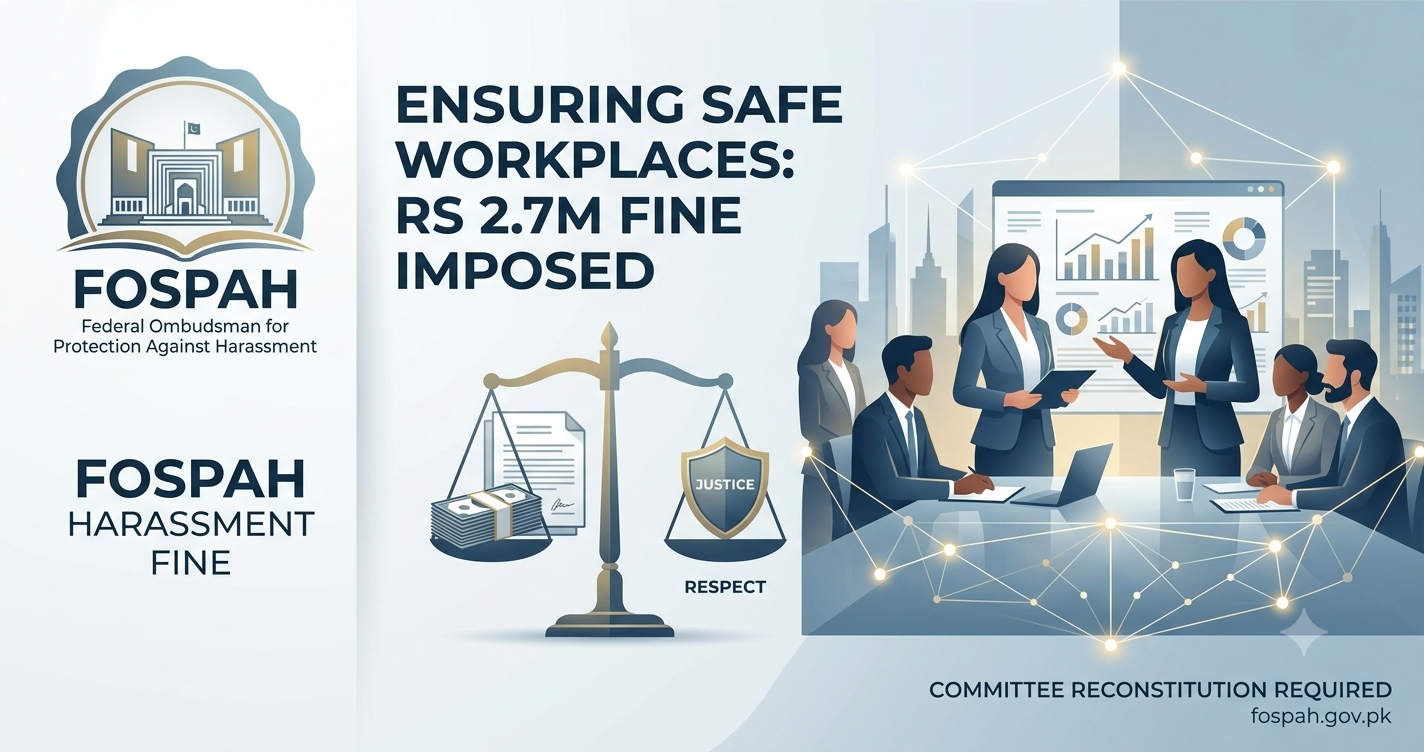
This Image has been generated using Ai

Key points: 

  • Significant Penalty: FOSPAH levied a collective Rs2.7 million FOSPAH harassment fine against five executives. 
  • Victim Retaliation: The executives faced charges of misconduct, deleting evidence, and forcing a resignation. 
  • Defense Rejected: The Ombudsman ruled that a worker’s attire or personality never justifies workplace abuse. 
  • Corporate Mandate: Therefore, the employer must completely reform its internal committee within 30 days. 

LAHORE – The Federal Ombudsman for Protection Against Harassment (FOSPAH) has taken decisive action against corporate misconduct. In a recent ruling, the regulatory body imposed a collective Rs2.7 million FOSPAH harassment fine on five high-ranking officials of a private firm. This penalty was issued because the individuals were found guilty of workplace harassment and systematic retaliation against a female employee. 

Initially, the complainant brought the case forward after experiencing repeated inappropriate conduct, unwanted out-of-office meeting requests, and derogatory remarks from management. Furthermore, when she attempted to use internal channels to report the behavior, the company’s internal systems failed to protect her. For instance, one official actively neglected to secure vital CCTV footage. Meanwhile, others launched retaliatory actions that forced her resignation and blocked her remaining financial dues. 

FOSPAH Establishes Clear Legal Boundaries 

During the formal legal hearings, the accused attempted to defend their actions by criticizing the victim’s attire and social personality. However, the Federal Ombudsman categorically rejected these arguments. The tribunal ruled that an employee’s personal style or social demeanor can never be used as a defense for predatory behavior. 

“Politeness does not equal consent, and maintaining a secure, safe work environment remains a fundamental legal duty of the employer,” the formal verdict clarified. 

Ultimately, the Ombudsman confirmed the patterned harassment and workplace retaliation by using forensic evidence and supporting witness statements. Consequently, along with the heavy financial penalties, FOSPAH issued a mandatory directive to the private institution to reform its legal compliance structures. 

Case Compliance Overview 

Case Metric  Ruling Details 
Adjudicating Body  Federal Ombudsman for Protection Against Harassment (FOSPAH) 
Total Fine Amount  Rs2.7 Million (Distributed among five guilty officials) 
Focus Keyphrase  FOSPAH harassment fine 
Core Infractions  Workplace harassment, withholding dues, and destroying CCTV evidence 
Corporate Mandate  Reconstitute the internal anti-harassment committee within 30 days 

Frequently Asked Questions (FAQs) 

What triggered the FOSPAH harassment fine? 

The penalty was issued after five corporate executives were found guilty of inappropriate workplace behavior, retaliatory actions, and deliberately failing to preserve security footage after a complaint was made. 

How did the Ombudsman address the defenses presented by the accused? 

FOSPAH completely rejected defenses targeting the victim’s attire or personality, explicitly stating that professional courtesy or politeness does not constitute consent. 

What corporate changes must the company make following the verdict? 

In addition to the financial penalties, the private company is legally required to completely restructure its internal anti-harassment committee within a strict 30-day window. 

Continue Reading

About

Upfront influence about 20 million users and is the number one business and technology news network on the planet


© 2022 upfront. All Rights Reserved.

Trending

Copyright © 2026

Exit mobile version