E-governance is defined as the use of Information and Communications Technology (ICTs) to more effectively and efficiently deliver government services to citizens and businesses.
The concept emerged in the late 1990s from the US. Starting around the late 1990s, the US Federal Chief Information Officer’s Council began emphasizing IT projects that offered “service to the citizen” and so the US was among the first nations to focus IT-enabled government.
Leading research and advisory company, Gartner has listed down four phases of e-governance: Presence, interaction, transaction, and transformation.
Presence means basic information is put online for the public, followed by interaction wherein users are able to get in touch with the organizations.
In the transaction phase, users can complete the entire transaction e.g citizens can apply for any state service like tax payment or license application. The final phase of transformation involves a reinvention of how government functions are conceived and organized and it is bilateral in the form of surveys and discussion forums.
E-government has multiple advantages over the conventional form of government, the most important of which is that direct representation and voice of the public are heard loud and clear which consolidates democratic values in the country and in the governance apparatus as well. When citizens are sure of the fact that their voice matters, they tend to register their complaints with the competent authorities which can then take adequate action.
Other benefits of e-government include transparency, access to information, streamlining bureaucratic procedures, and round the clock operation.
When the statistics and government procedures are available on the digital horizon, it would be nearly impossible for government employees to conceal anything from the public, which in turn leads to enhanced transparency.
Another advantage that e-government enjoys over the traditional forms of governance is round the clock operation. The affected or information-seeking citizens can interact with the governance machinery without any limits regarding time and even space as they can remotely engage with government offices.
Punjab has also made efforts to opt for the e-governance culture and for this purpose, Punjab Information Technology Board (PITB) was formed in 1999 as an autonomous body under the Department of Industries, however, it was given under the administration of Information Technology Department on15th October 2001.
Finally, after the dissolution of the Information Technology Department in 2011, PITB was attached to the Planning & Development Department of Punjab.
The Punjab Information Technology Board has taken multiple initiatives in diverse sectors ranging from Health to education to law and order besides other moves.
The most important and beneficial initiative in the health sector is Dengue Activity Tracking System, a mobile application developed after 2011 Dengue outbreak.
The app provided real-time information on larvae prevention, detection, and public hygiene activities. With the help of geo-tagging, effective dengue surveillance was carried out for affected areas and teams were mobilized to cope up with the menace.
Other initiatives in the health sector include e-Vaccs, Disease Surveillance System, Biometric Attendance System for Health Facilities, Monitoring System for Polio Campaign, Drug Inspection, and Monitoring Evaluation System, Drug Testing Laboratory Automation Programme, Medicine Procurement.
PITB also took very important measures to reform the law and order sector of Punjab and launched an online complaint management system (CMS). PITB developed an automated web-based complaint management system. Details of the complaints and the complainants are entered into the system and a complaint number is provided to the complainant through SMS.
With the digitalization, the complainant can check the status of their complaint. Moreover, police personnel can also monitor the activities.
The record of the Lahore High Court was also automated through which each case now has a planned date for the next hearing. The system automatically generates dates for hearings and judges to be assigned to the case.
The Higher Education Department worked with the PITB to implement a standardised admissions application mechanism that is simple, convenient, and cost-effective, and nearly 1 million admissions applications have been processed via OCAS (Online College Admission System) in recent years.
Moreover, with ‘Measuring Student Learning Outcomes’ initiative, a tablet-PC based student assessment app was devised to be used by School Monitoring Officers who conducted on-spot testing for English, Mathematics, and Urdu across all public schools in Punjab to access the learning outcomes.
PITB developed the Restaurant Invoice Monitoring System (RIMS) which aids registration of various food businesses and collection of provincial sales tax from these establishments. Using RIMS, 386 restaurants have been added to the tax net.
Agriculture e-credit scheme provides loans to small farmers by easing them as previously they used to visit Punjab Land Records Authority 10 times which was reduced to 3 visits.
A centralised system for wheat procurement was designed by PITB which provides real-time reports of the wheat procurement process from each centre wherein farmer’s data is collected.
Agriculture Marketing Information Service disseminates prices of agriculture commodities prices from 135 markets located across the province of Punjab.
In the transport sector, the e-challan system has changed the way traffic inspectors issued tickets. “Traffic Violation Reporting System” (e-challan) is an Android-based mobile application that helps the Traffic Police in verifying the license status of a person who has violated the traffic laws and issuing traffic violation tickets on the spot.
Moreover, Rasta App facilitates the citizens with Traffic Advisory Route Planner, Challan Payment, E-License, E-Driving Test Scheduling, Traffic Feedback/Complaints, My License Info, My Car Info.
Another initiative by PITB was e-stamping through which anyone wanting to purchase high value non-judicial and judicial stamp papers can do so by using a computer with an internet connection. The process is simple, fill the challan form 32-A, take out the print and get e-stamp paper from Bank of Punjab.
PITB provided a video conferencing facility for the top leadership of the province to interact with the district administration without having to go anywhere, thus saving logistic costs. This facility has helped the government save an estimated Rs. 290 million (PITB).
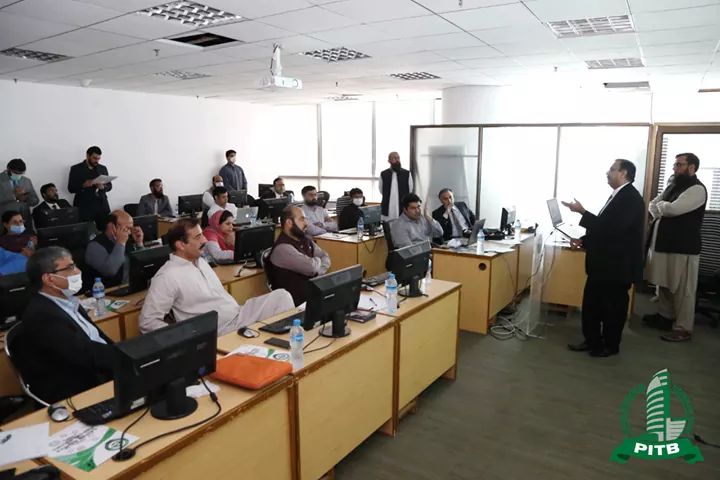
Moreover, PITB collaborates with the National School of Public Policy (NSPP) to provide IT training to civil servants at MCMC, SMC, and NMC levels across Pakistan. These training programs comprises of ICT basics, hands-on exercises, and case studies for the participants. Officers are being trained to use ICT as a tool for efficient decision making to address their respective sectoral issues.
A special case is of Pakistan Citizen portal through which citizens can file complaints which is then routed to the concerned authorities. But, broadly speaking, this application falls in Interaction phase of Gartner’s four phases of e-governance.
According to the data by Prime Minister’s Performance Delivery Unit (PMDU), 1.2 million complaints have been resolved up until now with over 87 per cent redressal rate of complaints.
Top officials of police have been sacked for non-compliance which shows that the government is keeping the e-governance model in focus.
So, we can say that e-governance would replace the conventional model of governance in years to come because of its ease, effectiveness, economic benefit, and efficiency. Pakistan is currently ranked 148 as compared to Bangladesh’s 115 on E-Government Development Index furnished by UN e-government survey 2018 and so we lag behind other countries.
The internet penetration is increasing across Pakistan and statistics by Pakistan Telecommunication Authority confirm that there are 163 million cellular subscribers across the country – the teledensity comes out to be 77% which confirms that e-governance would set aside the conventional model of governance in Pakistan very soon.
A few recommendations can be given in this regard, starting from the enhancement of digital literacy as Pakistan is ranked at 77th spot on Inclusive Internet Index 2019 by The Economist. For this, organizations like Digital Rights Foundation can collaborate with tech giants like Google and Facebook to impart training to the populace which will help lessen the digital divide.
Moreover, merit-based appointments should be made especially at top positions. Dr Umar Saif, who launched around 50 broads and 250 smaller projects across Pakistan, was removed after the incumbent government swept to power. The move was perceived more as a political maneuver rather than an administrative decision.
ICT training should be imparted to staff at the lower level, especially to the staff which has been handling archives and files manually. ICT infrastructure should be given special focus to move from the present phase to the transformation phase on Gartner’s e-governance model. A special focus should be given to the rural areas wherein vocational training institutes can be set up.
The writer is a civil servant.
















 Fashion3 months ago






 Pakistan5 days ago
You must be logged in to post a comment Login