Connect with us

Pakistan

IWMI launches digital tools to improve water and climate planning

Published

on

ISLAMABAD – Three new digital platforms have been launched to help Pakistan better manage its water, food, and energy resources, especially as the country faces serious climate challenges.

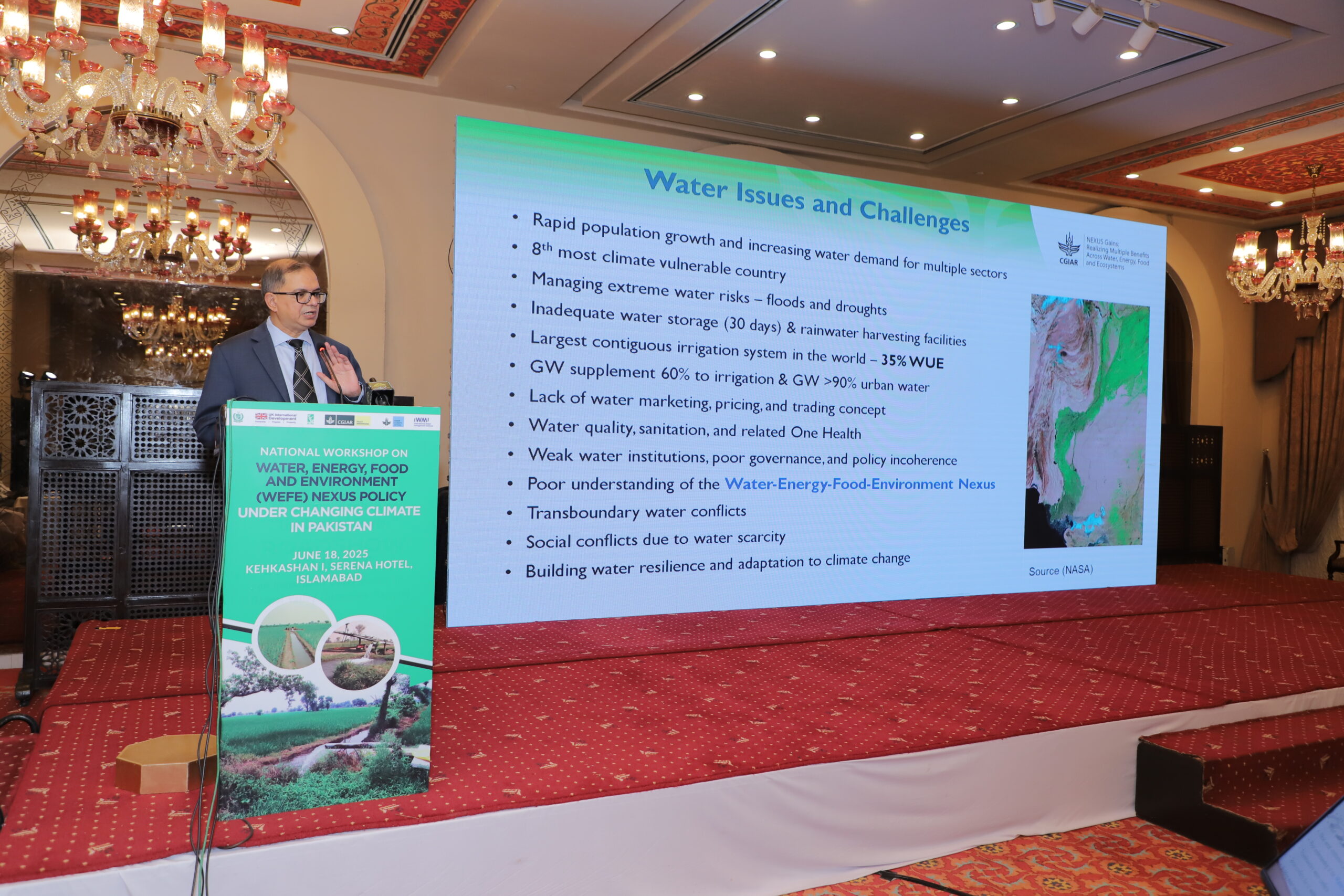
The tools called the Water Productivity Atlas, the Water Body Inventory of Pakistan, and the Hydro, economic Model for the Indus Basin, were introduced by the International Water Management Institute (IWMI) at a national workshop in Islamabad on Tuesday.

State Minister for Climate Change, Dr Shezra Mansab Ali Khan Kharal, praised the launch, saying these platforms would help the government plan more effectively by using real data. She said they would also make decision-making more open and help balance the needs of different sectors.

The workshop focused on the “Water, Energy, Food, and Environment (WEFE) Nexus” and how Pakistan can use this approach to deal with the risks of climate change. The event was supported by the UK’s Foreign, Commonwealth & Development Office (FCDO) and organised by IWMI and CGIAR, a global research group.

Federal and provincial officials, engineers, researchers, and members of civil society took part in the event.

Federal Secretary for Water Resources Syed Ali Murtaza said water issues between Pakistan and India have increased the pressure on Pakistan’s water system. He said better planning is needed to use water more efficiently and support farming.

“These tools will help the government make smart decisions about how to use water. They will also improve farming practices and guide better water distribution,” he said.

Dr Mohsin Hafeez, Director at IWMI, said Pakistan must stop treating water, food, energy, and the environment as separate problems. “These issues are connected. We must deal with them as a system,” he said.

The Senior Climate Lead at the FCDO, Ms. Anna Balance, shared that the UK government is collaborating with Pakistan to create a climate-resilient community. Our flagship program in Pakistan is the Water Resource Accountability in Pakistan (WRAP). It’s essential to develop a coherent approach that integrates water, food, and ecosystems.

We strongly encourage ministries to work together, promote widespread usage, and build capacity, she added.

IWMI Director General Dr Mark Smith said that science, policy, and government agencies need to work together to build climate resilience. “This event is just the beginning,” he said.

Dr Muhammad Ashraf, IWMI’s country head in Pakistan, said the work must continue beyond this one workshop. “The new tools and partnerships must become part of how the government plans and invests,” he said.

The workshop also saw the launch of two new global science programmes by CGIAR: Policy Innovations and Climate Action. These are aimed at helping governments, including Pakistan’s, create stronger policies for climate and agriculture.

Speakers from Punjab, Balochistan, and Khyber Pakhtunkhwa discussed how better data and planning can support local communities. Engineers, officials, and climate experts also shared ideas about how these tools can help Pakistan deal with climate risks in the years ahead.


Pakistan

How to get Sindh motorcyclists’ Rs2000 subsidy on petrol

Published

on

KARACHI – Motorcycle owners will be required to register through the Excise Department’s digital application by providing their CNIC and bank account details. Authorities have also allowed a 15-day window for citizens to transfer ownership of motorcycles into their own names in order to qualify

According to the government, payments will be made directly to verified bank accounts of eligible owners between April 15 and April 20, with each beneficiary receiving Rs2,000 per motorcycle. The initiative is aimed at providing short-term relief to commuters amid rising fuel costs, officials said.

Earlier, Sindh government announced a petrol subsidy of Rs2,000 for registered motorcycle owners, citing rising fuel costs and their impact on daily commuters. The move follows a sharp increase in fuel prices across the country, with petrol rising to Rs458.41 per litre and high-speed diesel to Rs520.35, significantly increasing transportation expenses.

Sindh Chief Minister Murad Ali Shah said motorcyclists were among the most affected groups amid escalating global oil prices, which he linked to geopolitical tensions, including the US-Israel war on Iran.

Addressing a press conference, he noted that Sindh has approximately 6.7 million registered motorcycles, underlining the scale of the initiative. The chief minister said the subsidy would be provided through a structured registration and verification process to ensure transparency.

Continue Reading

Business

CBD Pulse emerges as Punjab’s strongest signal to global investors

Published

on

 LAHORE – In today’s competitive global economy, where investors favour stability, growth potential, and quick returns, Central Business District Punjab (CBD Punjab) emphasises this message through CBD Pulse: Punjab is prepared for investment, and the moment to invest is now.

CBD Pulse is not just another promotional campaign; it is a strategic investment signal aimed at attracting serious investors, visionary developers and international partners. It reflects real momentum driven by execution and showcases a pipeline of high-value urban assets positioned to generate strong, long-term returns.

At a time when investors prioritize transparency and stability, CBD Punjab distinguishes itself through structured planning, regulatory clarity and rapid on-ground development. CBD Pulse brings this ecosystem into focus, highlighting premium commercial districts, high-yield real estate opportunities and modern infrastructure built to meet global standards.

What sets CBD Pulse apart is simple it is grounded in visible progress, not future promises. From accelerated development across key corridors to the rollout of strategically located projects, CBD Punjab is turning ambition into tangible results. The approach is clear prioritize speed, ensure delivery and maximize value creation.

For institutional investors, developers and strategic stakeholders, CBD Pulse offers a compelling advantage early entry into a rapidly growing urban market. With Pakistan’s urban expansion accelerating and demand for organized commercial infrastructure increasing, CBD Punjab is uniquely positioned to capture this growth at scale.

The initiative also reflects a strong pro-investment environment, backed by government support, streamlined procedures and investor-focused policies. These elements reduce barriers to entry while strengthening investor confidence an essential factor for both local and international participants.

CBD Pulse is designed to keep investors informed and engaged. Through regular updates, data-driven insights and direct communication channels, it ensures decision-makers have timely access to critical information. In fast-moving markets, timing and access are everything and CBD Pulse delivers both.

More than just infrastructure, CBD Pulse represents a shift in perception. It positions Punjab as a credible, competitive investment destination on the global stage. The objective is clear: attract capital, enable growth, and deliver measurable outcomes.

For those looking to invest in the future of urban Pakistan, the opportunity is open but not indefinitely. Early movers are best positioned to benefit as CBD Punjab continues to expand and unlock new value. CBD Pulse is more than an initiative it is a call to action. The investments made today will shape the skyline of tomorrow.

Continue Reading

Pakistan

Beyond the Aurat March: What Feminism Really Means!

Published

on

LAHORE – When we hear the word feminism, what usually comes to mind? Rights, independence, equality? At its core, feminism is meant to stand for fairness and justice, yet in our society, the term has often been misunderstood, misused, or even exploited. Broadly speaking, there are two types of women who call themselves feminists. The first group genuinely strives for equality in their professional roles, personal lives, and societal standing.

For them, feminism is about demanding respect and recognition, not superiority. The second group, however, uses feminism in the wrong way. For them, calling themselves feminist has become trendy or “cool.” They use it as a shield to justify going off track, behaving disrespectfully, or unfairly targeting men. To these women, hating men equals feminism, which is far from its true meaning.

This misuse creates injustice for men, who sometimes become victims when faced with such distorted versions of feminism.The problem arises when feminism is twisted into a tool for privilege rather than equality.

For some, it becomes a reason to demand advantages without responsibility, a trend to bash men while ignoring the challenges men face such as mental health struggles, financial pressures, or societal expectations, and even a justification for rudeness and disrespect disguised as empowerment. This distorted narrative not only damages men but also misguides younger generations, especially through social media, where radicalized voices dominate and influence perceptions.
Every year, events like the Aurat March become controversial. While raising voices for rights and justice is never wrong, many banners, slogans, and behaviors displayed during such events do not resonate with our cultural and religious values.

We live in an Islamic state where modesty is emphasized, and our youth are increasingly influenced by the wrong portrayal of feminism, confusing rebellion with empowerment. It is crucial to remember that Islam grants women immense respect and rights, but within defined boundaries. Women are encouraged to cover themselves, care for their families, and maintain dignity in society. At the same time, Islam elevates women by granting them inheritance rights, the right to education, respect as mothers, and recognition as equal partners in society. True equity lies in following this balance: rights with responsibilities, freedom with respect, and equality with values.
The debate over feminism, however, is not confined to Pakistan; it is global. According to IPSOS, 32% of men worldwide believe feminism does more harm than good, and 20% of women share this view. A King’s College London survey found that 16% of Gen Z men (ages 16–29) consider feminism harmful, higher than the 13% of men over 60 who feel the same. Globally, men are more likely than women to believe feminism has caused men to lose economic, social, or political power. On social media platforms like X (formerly Twitter), nearly 50% of posts about feminism are negative, and anti-feminist accounts often use insults and stereotypes three times more frequently than feminist accounts.

Even corporations have commodified feminism, using slogans like “The Future is Female” to market products. This selective adoption of feminist language reinforces stereotypes rather than addressing real issues of gender equality.
The essence of feminism is not about hating men, seeking privileges, or promoting disrespect. It is about equity, justice, and opportunity for all, values already embedded in Islam and universally acknowledged human rights. If feminism is to achieve its true purpose, it must be reclaimed from misuse, distortion, and commercialization. Only then can it inspire a healthier society where both men and women coexist with dignity, fairness, and respect.

Continue Reading

Trending

Copyright © 2026