Key Points:
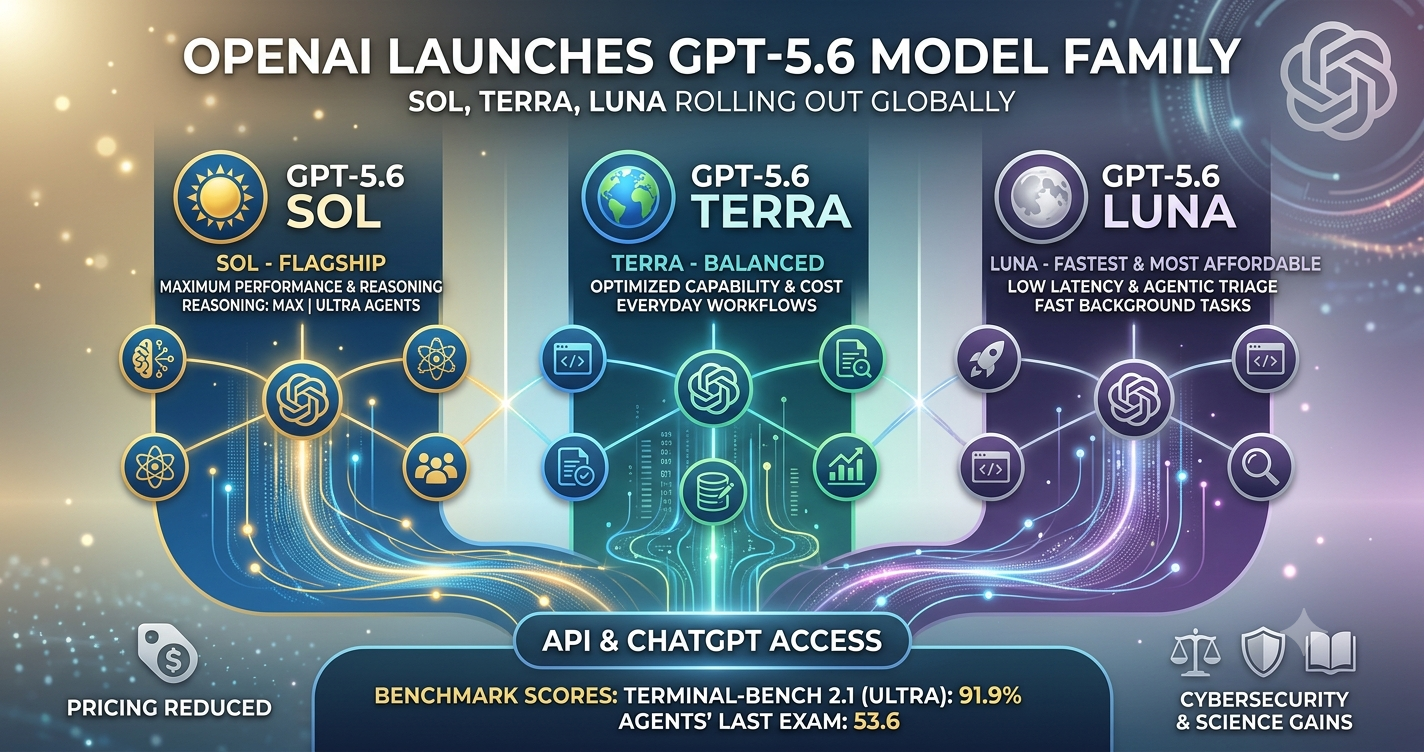
- Three-Tier Lineup: OpenAI has introduced three distinct capability tiers named GPT-5.6 Sol, GPT-5.6 Terra, and GPT-5.6 Luna.
- Global Rollout: The models are actively rolling out across ChatGPT, Codex, and the OpenAI API.
- Advanced Architecture: Flagship variants include new reasoning modes like “max” and “ultra” to solve complex, multi-step tasks.
- Drastic Cost Reductions: Ultimately, these models achieve significantly higher efficiency by requiring fewer tokens per task compared to prior iterations.
ISLAMABAD – OpenAI has officially introduced the OpenAI GPT-5.6 AI models lineup, bringing a structured tier system to its conversational and programmatic intelligence platforms. Instead of releasing a single monolithic model, the company has broken the release into three variants targeting different operational priorities.
All about GPT-5.6 models
First, GPT-5.6 Sol serves as the flagship tier, offering maximum performance for the most intensive logic-driven tasks. Next, GPT-5.6 Terra acts as the balanced option, providing a sweet spot between operational speed, high capability, and everyday affordability. Finally, GPT-5.6 Luna stands as the fastest and most economical model, optimized for lightweight tasks and rapid background processing. According to OpenAI, this naming scheme represents permanent capability tiers, allowing each specific engine to evolve independently in subsequent iterations.
Breakthrough Performance and Reasoning Controls
To maximize the power of its flagship tier, OpenAI deployed two novel processing settings specifically for GPT-5.6 Sol. For instance, the new max mode grants the model extended time to think through complex math, engineering, or structural logic problems before delivering an output. Alternatively, the ultra mode actively coordinates four separate AI sub-agents in a parallel workflow, allowing them to collaborate instantly and solve multi-layered problems much faster.
Furthermore, the model family achieves these higher success rates while using fewer tokens than previous generations. Consequently, developers receive a massive boost in performance-per-dollar efficiency.
Official API Pricing Structure
To keep up with market changes, the API layout has been explicitly priced to allow for highly targeted routing strategies. Below is the official developer pricing structure per million tokens:
| Model Tier |
Input Price (Per 1M Tokens) |
Output Price (Per 1M Tokens) |
Primary Use Case Designation |
| GPT-5.6 Sol |
$5.00 |
$30.00 |
Heavy reasoning, expert programming, and security |
| GPT-5.6 Terra |
$2.50 |
$15.00 |
Everyday production code and general workflows |
| GPT-5.6 Luna |
$1.00 |
$6.00 |
High-volume tasks, low-latency calls, and triage |
Performance Metrics & Technical Benchmarks
On top of the architectural changes, OpenAI has published preliminary validation data across coding, agentic autonomy, and deep technical reasoning. Therefore, the performance curves closely scale alongside the primary pricing tiers.
Agentic Coding and Execution Evaluation
In independent evaluations like Terminal-Bench 2.1, which tracks command-line competency, tool-calling accuracy, and multi-step execution over hours of continuous work, the flagship variant achieved unprecedented heights.
| AI Model Variant |
Terminal-Bench 2.1 Score |
Evaluation Framework Focus |
| GPT-5.6 Sol (Ultra Mode) |
91.9% |
Long-horizon multi-step code execution |
| GPT-5.6 Sol (Standard) |
88.8% |
Autonomous repository interaction |
| GPT-5.5 (Legacy Reference) |
88.0% |
Command-line tool orchestration |
| GPT-5.6 Luna |
82.5% |
Lightweight scripting and parsing |
Professional Knowledge and Specialized Research
Beyond traditional software development, the GPT-5.6 family shows a massive leap forward in handling data pipelines. For example, on Agents’ Last Exam—a standardized evaluation measuring independent workflow completion across 55 academic and professional domains—GPT-5.6 Sol scored a high of 53.6, outpacing competing models by wide margins.
Similarly, the models demonstrate massive accuracy spikes in specialized scientific testing grounds like GeneBench v1 (genomics analysis) and ExploitBench (defensive vulnerability patch generation). Importantly, OpenAI noted that despite these advancements, the models remain safely below “Critical” risk thresholds for biology and automated offensive cyber operations.
Platform Availability and Global Access Rules
Access to the new ecosystem is being distributed immediately across different user accounts based on membership tiers.
- ChatGPT Plus & Team Users: Granted instant access to GPT-5.6 Sol using medium and higher default reasoning profiles.
- Pro & Enterprise Accounts: Receive unlimited entry to GPT-5.6 Sol, along with the option to deploy the advanced Sol Pro configurations.
- Free & Go Tier Users: Automatically upgraded to GPT-5.6 Terra through ChatGPT Work spaces and Codex.
- API Developers: Full access to all three models is live immediately, featuring optimized prompt caching rules where cache writes are billed at 1.25x and cache reads enjoy an aggressive 90% discount.
What makes the OpenAI GPT-5.6 AI models distinct from past releases?
Instead of pushing out a single model, OpenAI launched a family of three explicit tiers (Sol, Terra, Luna) built to help developers seamlessly route their tasks according to speed, depth of reasoning, and budget requirements.
How do the “max” and “ultra” settings function in GPT-5.6 Sol?
Max mode allows the flagship model to spend more continuous compute time thinking through tricky logic puzzles. Meanwhile, ultra mode splits the core task among four parallel AI agents to tackle massive, disjointed workflows simultaneously.
Is there prompt caching available for these models?
Yes. The OpenAI API includes updated, highly predictable prompt caching configurations with explicit breakpoints and a minimum 30-minute cache lifetime to aggressively drive down enterprise costs.
Read More : SpaceX files FCC Request for 100,000 Gen3 Starlink satellites .