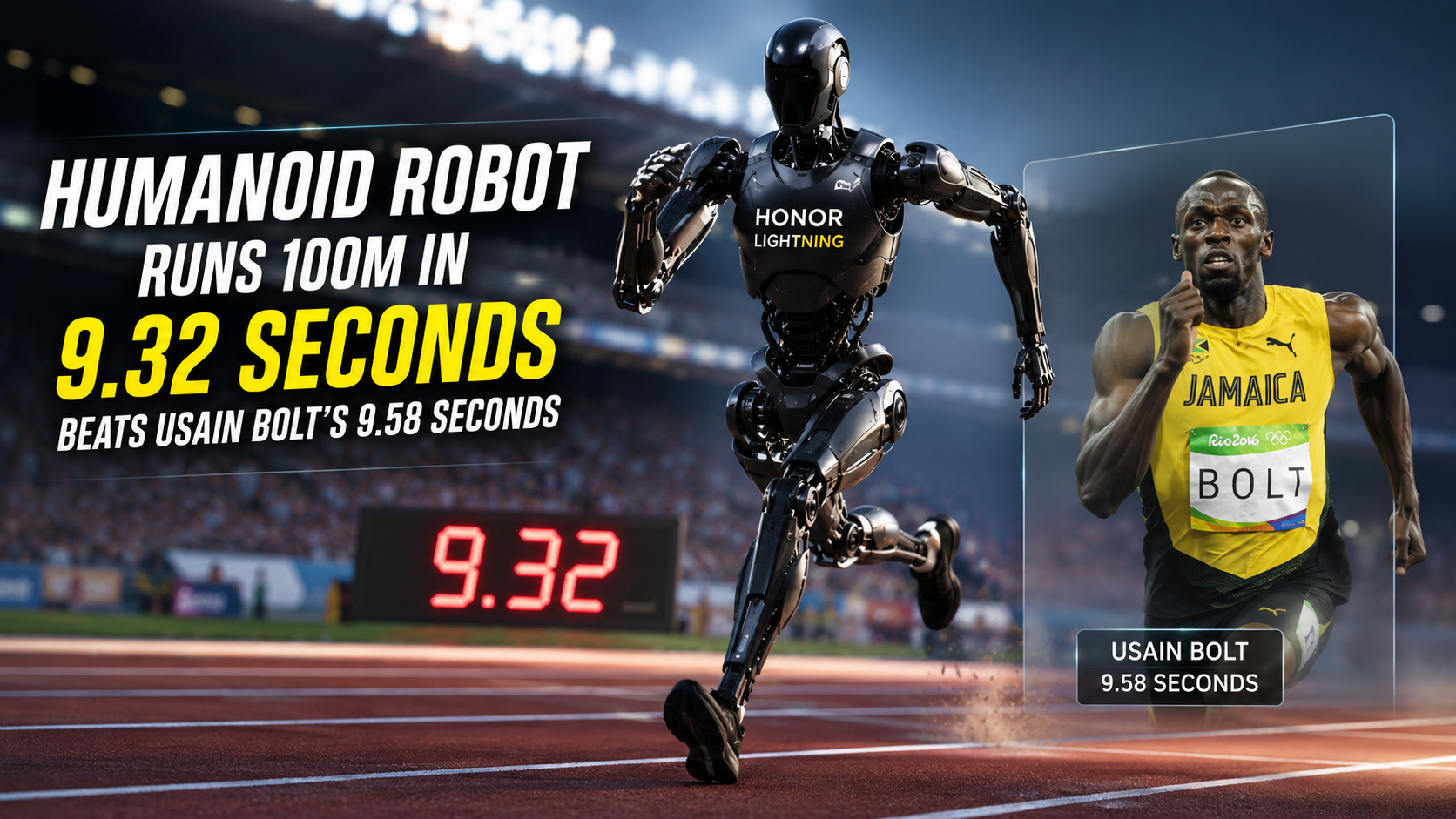
LAHORE – A Chinese humanoid robot has stunned the technology and sports worlds after reportedly running 100 metres in 9.32 seconds, faster than Usain Bolt’s long-standing 9.58-second human world record.
The robot, called Lightning, was developed by Chinese smartphone maker Honor and recorded the time during a preparatory test ahead of the second World Humanoid Robot Games in Beijing on August 22.
China’s state broadcaster reported that Lightning reached a peak speed of 14.5 metres per second.
The result is another striking demonstration of China’s rapid progress in humanoid robotics. However, the comparison needs an important qualification. Lightning’s time is a robot test performance, not a ratified athletics world record.
Lightning Runs 100m In 9.32 Seconds
The Chinese humanoid robot beats Usain Bolt comparison comes from Lightning’s 9.32-second run.
The test took place as part of preparations for the second World Humanoid Robot Games in Beijing. The competition opened on Saturday and features a range of robot sporting events.
Lightning’s reported peak speed reached 14.5 metres per second. That is equivalent to roughly 52.2 kilometres per hour.
For comparison, Bolt’s official 100-metre world record stands at 9.58 seconds. He set the mark at the 2009 World Championships in Berlin, and World Athletics continues to list it as the men’s 100m world record.
Lightning’s reported time is therefore 0.26 seconds faster than Bolt’s record.
| Performance
|
Time
|
| Honor Lightning robot
|
9.32 seconds
|
| Usain Bolt world record
|
9.58 seconds
|
| Difference |
0.26 seconds |
It Is Not An Official Athletics World Record
Despite the headline-grabbing comparison, Lightning has not officially replaced Bolt in the athletics record books.
World Athletics ratifies records for human athletics competitions under specific rules. Those rules include requirements around the competition, timing and other conditions.
Lightning’s 9.32-second performance instead belongs to the emerging field of humanoid robot racing.
That distinction matters because the robot and a human athlete operate under completely different physical and competition conditions.
Still, the performance demonstrates just how quickly robotic systems are improving in speed, balance and movement control.
Lightning Already Broke A Half-Marathon Record
The 100-metre sprint is not Lightning’s first major racing achievement.
In April, the same Honor robot won the Beijing E-Town Humanoid Robot Half-Marathon in 50 minutes and 26 seconds.
That performance was faster than the then human men’s half-marathon world record of 57 minutes and 20 seconds. Xinhua reported that Lightning used autonomous navigation during its winning run.
The robot was 169 centimetres tall and used a high-dynamic motion system designed for fast movement. Honor robots also occupied the top three positions in the event.
The result attracted attention from robotics experts, although analysts noted that the race environment and course were designed specifically for the competition. Some robots also required human intervention during the event.
Honor Upgraded Lightning For Sprinting
Lightning has since undergone hardware changes aimed at improving its short-distance performance.
According to Chinese reports, engineers lengthened the robot’s legs by 10 centimetres, taking them from 95 centimetres to 1.05 metres. The changes were intended to increase stride length and improve sprinting performance.
Reports also say engineers worked on the robot’s leg proportions, joint torque and response speed.
Those changes show that the technology behind humanoid robots is increasingly moving beyond simply making machines walk.
Developers are now trying to improve acceleration, balance, energy management and rapid changes in movement.
Why China Is Racing Humanoid Robots
The Lightning achievement comes as China places increasing emphasis on humanoid robotics.
Robot competitions have evolved from relatively small demonstrations into major showcases of China’s robotics capabilities. Reuters reported that the World Humanoid Robot Games have become part of a broader push to demonstrate advances in robotics and their potential commercial applications.
The technology has potential uses far beyond sport.
Chinese policymakers and companies are investing in humanoid robots for areas such as manufacturing, logistics and consumer applications. The goal is to develop machines capable of operating in environments designed for humans.
Sports competitions provide an unusual but useful testing ground.
Running requires precise coordination between motors, sensors, balance systems and control software. A robot that can run quickly and remain stable demonstrates progress across several of these areas at once.
Speed Is Only One Part Of The Challenge
Lightning’s 9.32-second run is impressive, but raw speed does not tell the entire story about humanoid robotics.
A machine can be designed specifically for running. Real-world robots face much more complicated environments.
They need to navigate around people, understand objects, recover from unexpected situations and perform useful tasks.
Scientific American noted similar limitations after Lightning’s half-marathon performance. The race showed significant progress in robotic locomotion, but it did not demonstrate that humanoid robots had reached the same level of versatility as humans.
That distinction will become increasingly important as companies move from demonstrations to commercial deployment.
What Happens At The World Humanoid Robot Games?
Lightning is expected to compete in several events at the second World Humanoid Robot Games.
Reports indicate that Honor plans to enter the robot in the 100m, 400m and 1,500m competitions. The games also feature events including obstacle races, football, table tennis, weightlifting and other robot competitions.
The competition is designed to test robots across different physical abilities rather than focusing solely on speed.
That could provide a better indication of how far humanoid technology has advanced.
Could Robots Eventually Outperform Humans In More Tasks?
The Lightning demonstration raises a bigger question about the future of humanoid robots.
Machines already outperform humans in many narrowly defined tasks. Computers can calculate faster, industrial robots can perform repetitive movements for long periods and autonomous systems can process huge amounts of data.
Humanoid robotics aims to combine those advantages with a physical form that can operate in human environments.
The challenge is making those systems reliable, affordable and versatile.
Lightning’s performance suggests that the physical side of that equation is progressing rapidly. The harder question is whether developers can translate impressive demonstrations into robots that can safely and independently perform useful work.
For now, the Chinese humanoid robot beats Usain Bolt’s 100m time only in the context of this reported robot test. Bolt’s 9.58-second mark remains the official human world record recognized by World Athletics.
But the fact that a humanoid machine can now run a 100-metre test in 9.32 seconds would have seemed almost impossible when Bolt set his record in 2009.
That alone makes Lightning’s latest run a remarkable milestone in the race to build faster and more capable humanoid robots.
Key Points:
- Honor’s Lightning humanoid robot reportedly ran 100 metres in 9.32 seconds.
- It reached a reported peak speed of 14.5 metres per second.
- The test time is 0.26 seconds faster than Usain Bolt’s 9.58-second human world record.
- Bolt’s 9.58-second mark remains the official men’s 100m world record recognized by World Athletics.
- Lightning previously won the Beijing humanoid half-marathon in 50 minutes and 26 seconds.
- Honor reportedly lengthened Lightning’s legs by 10 centimetres for its latest competition preparations.
- Lightning is expected to compete in the 100m, 400m and 1,500m events at the World Humanoid Robot Games.
- The achievement highlights China’s growing investment in humanoid robotics and robot sports.
Read More:
For more such exclusive articles, follow Upfront .