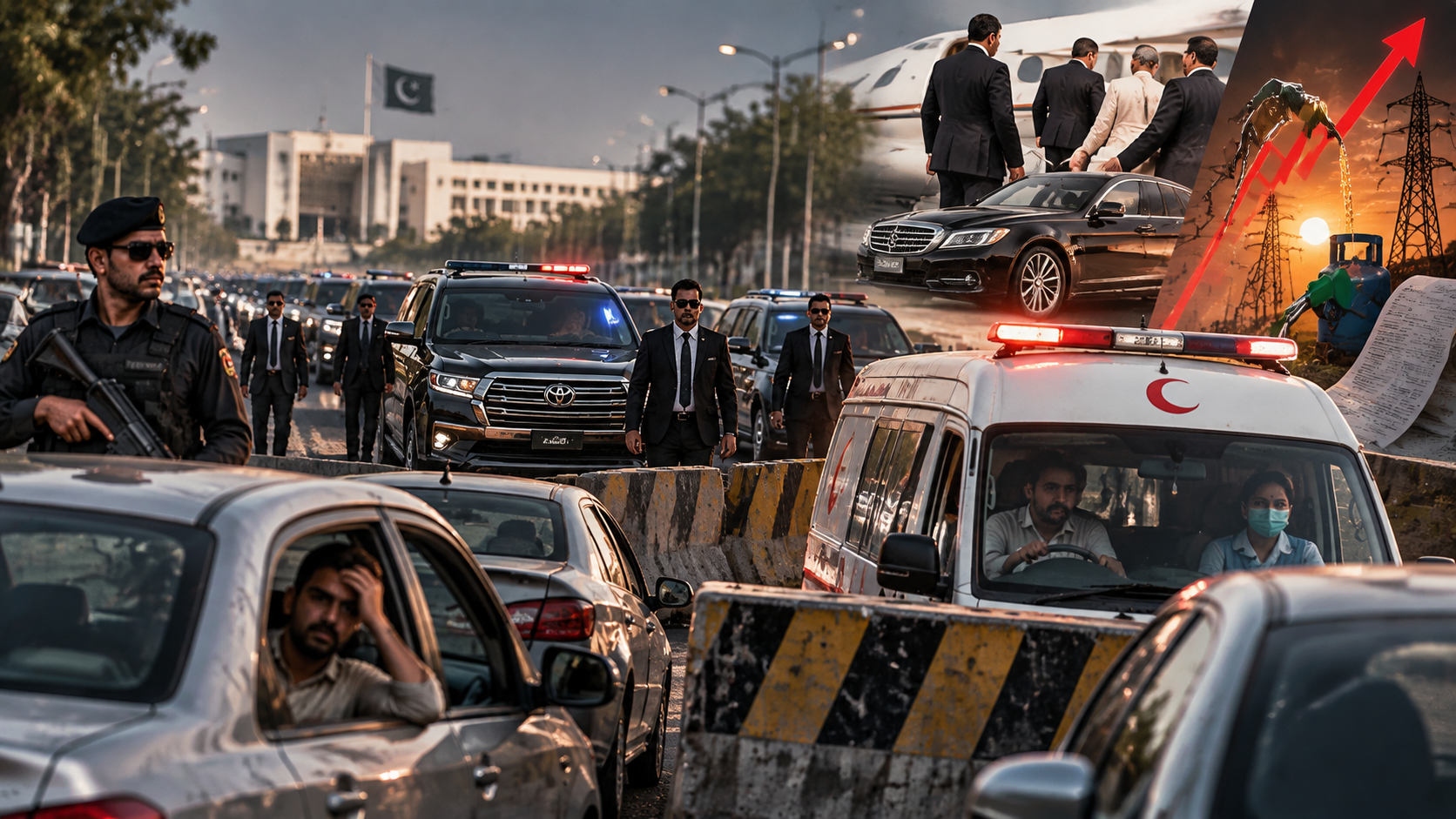
LAHORE – A road closure in Pakistan is rarely just a traffic issue. For thousands of citizens, it can mean hours stuck in congestion, delayed work, missed appointments and, in some cases, fears that an emergency vehicle may not reach its destination in time.
The debate around Pakistan VIP protocol road closures has continued for years, with critics questioning why public roads are frequently restricted for political leaders and officials while ordinary citizens face rising living costs and economic pressures.
Security officials argue that such arrangements are necessary to protect high-profile individuals. However, the repeated disruption caused by these movements has raised questions about whether security measures can be managed without placing the burden on everyday citizens.
When Public Roads Become Private Routes
Pakistan’s major cities have repeatedly witnessed roads being blocked or heavily restricted during political movements, official visits and security operations.
In Islamabad, authorities have used containers, barricades and extensive deployments during major political protests to control movement and protect sensitive areas. During recent security preparations ahead of a PTI march, major routes were blocked with containers and thousands of security personnel were deployed, causing disruption for residents. Reuters
While authorities describe these measures as necessary for maintaining public order, residents often question why ordinary commuters must absorb the consequences.
For a daily wage worker, a student, a business owner or a patient travelling to a hospital, a blocked road is not a minor inconvenience.
The Ambulance Question
One of the biggest concerns surrounding traffic restrictions is the possibility of delays for emergency services.
Over the years, activists and citizens have raised concerns that VIP movements and security arrangements can interfere with normal traffic flow, including creating difficulties for ambulances and patients trying to reach hospitals.
An emergency situation does not wait for a protocol route to clear.
A few minutes can make the difference between life and death, which is why critics argue that emergency access should always remain the highest priority.
A Different Approach Around the World
Many countries provide security arrangements for political leaders, but the visible disruption to public life varies significantly.
In several democracies, leaders often continue to travel through normal public spaces with limited disruption, although security planning still exists behind the scenes.
For example, officials in countries such as the United Kingdom, Canada and parts of Europe frequently maintain security protection while attempting to minimize large-scale road closures and inconvenience to citizens.
However, security requirements differ based on threat levels, political environments and local circumstances. Therefore, direct comparisons are not always straightforward.
The broader question is not whether leaders require protection. The question is whether public inconvenience can be reduced while maintaining necessary security.
Citizens Face Rising Costs While Trust Declines
The debate over VIP protocols is taking place during a period when many Pakistanis are already dealing with financial pressure.
Fuel prices, electricity tariffs and energy costs have become major concerns for households and businesses. Pakistan’s economic policies have included measures aimed at increasing revenues and managing fiscal pressures, but these steps have also contributed to public frustration over affordability.
For many citizens, the frustration comes from a perception that while they are being asked to manage higher expenses, state resources continue to support official privileges and security arrangements.
The criticism is not only about road closures. It is about priorities.
The Bigger Issue Is Equality Before the State
A government’s relationship with its citizens is often judged by small everyday experiences.
When a citizen sees a road blocked for an official movement while struggling with fuel bills, electricity payments or rising household expenses, the issue becomes symbolic.
The question many people ask is simple: should public systems be designed around convenience for those in power, or accessibility for everyone?
Security for public representatives is a legitimate requirement. However, a modern governance system must also ensure that security measures do not unnecessarily restrict the movement and rights of ordinary citizens.
Pakistan Needs A Balance Between Security And Public Convenience
The solution is not eliminating security protocols completely. Political leaders and officials can face genuine security threats, and protective measures remain necessary.
However, better planning, limited closures, alternative routes and stronger emergency access systems can reduce the burden on citizens.
A democracy is not only measured by elections and institutions. It is also measured by how ordinary people experience the state in their daily lives.
A road belongs to the public. Any restriction on it should be used carefully, transparently and only when absolutely necessary.
Key Points :
- Pakistan VIP protocol road closures have repeatedly sparked public debate.
- Security authorities say restrictions are necessary for protecting high-profile individuals.
- Critics argue that ordinary citizens face unnecessary delays and disruption.
- Concerns have been raised about possible delays for ambulances and emergency services.
- Rising fuel, electricity and energy costs have increased public frustration.
- The challenge is finding a balance between security needs and citizens’ right to free movement.
Read More:
For more such exclusive articles, follow Upfront .