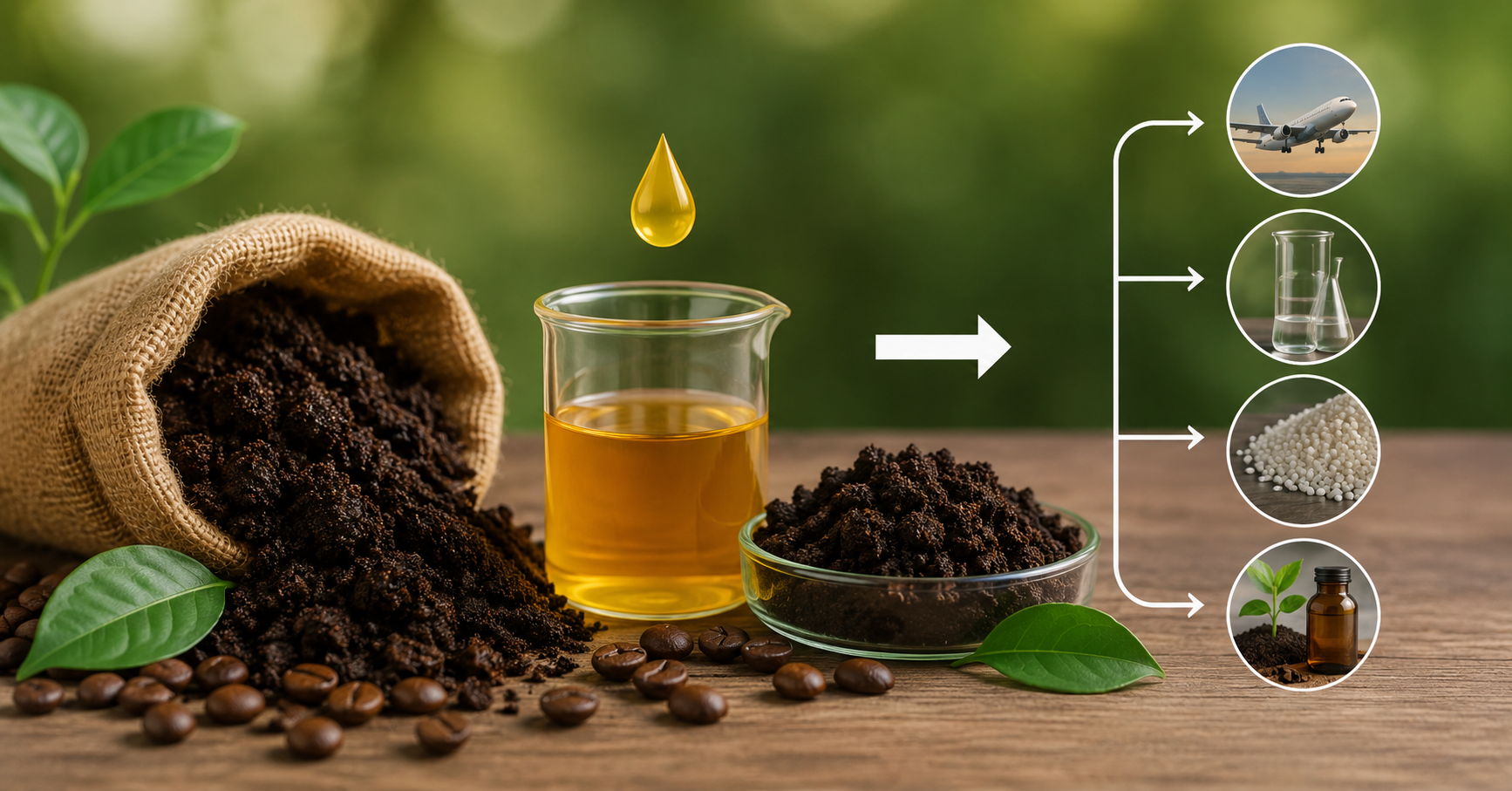
KARACHI – Scientists have developed a relatively simple method to recover oil from used coffee grounds while leaving the remaining material suitable for producing renewable fuels and other bio-based products.
Researchers at Universitat Rovira i Virgili (URV) in Spain examined more efficient ways to process spent coffee grounds as a potential raw material for biorefineries. They published their findings in the journal Biomass and Bioenergy.
Coffee production generates millions of tonnes of waste every year. Coffee producers harvest around 10 million metric tonnes of beans globally each year, but they discard much of the solid material left after brewing.
Spent coffee grounds, however, contain about 15 per cent lipids. This makes the material a potential source of oil for applications such as biodiesel production.
Read more: Jetour announces Azadi Offer major discounts given: Details
Researchers recover around 90pc of available oil
The researchers studied how factors including temperature, extraction time and the quantity of solvent affected oil recovery from spent coffee grounds.
They used n-hexane, a solvent commonly employed to extract fats and oils from biomass. The team found that 45°C for 60 minutes produced the best results. They used 35 millilitres of hexane per gram of dry coffee grounds.
This method recovered around 90pc of the oil obtained through Soxhlet extraction. The conventional laboratory method generally takes more time and energy.
The extracted oil was also considerably cleaner. It contained only 0.3pc impurities, compared with 3.9pc in oil obtained through the Soxhlet method.
The researchers found that the fatty acid composition of the recovered oil remained stable under the tested conditions. Linoleic and palmitic acids were among its main components.
According to the researchers, this composition indicates that the recovered oil could have potential for biodiesel production.
Read more: Muhammad Zubair wins Tekken 8 World Championship
Coffee residue can be used for other products
Importantly, the extraction process was designed to avoid damaging the lignocellulosic material left behind after the oil was removed.
The remaining residue contains cellulose, hemicellulose and lignin — components that can serve as raw materials for a range of bio-based products.
These include bioethanol, lactic acid, polyhydroxyalkanoate bioplastics and phenolic compounds. The material could also potentially be processed into precursors for sustainable aviation fuel.
Removing the oil may further improve the processing of the remaining biomass by allowing solvents, enzymes and catalysts to access it more easily.
The researchers also compared conventional batch extraction with ultrasound- and microwave-assisted techniques.
Although the alternative methods accelerated the initial oil release, the researchers found no clear overall benefit after comparing energy use, purity, efficiency and large-scale potential.
The study therefore identified moderate-temperature batch extraction using n-hexane as a potentially practical approach for biorefineries.
Rather than treating spent coffee grounds solely as waste, the approach could allow the material to be processed into several useful fuels, chemicals and renewable materials.
Read more: Paramount moving out of California amid Warner Bros. Discovery deal pressure
Key points:
- Researchers recovered around 90 per cent of the available oil from spent coffee grounds.
- The process used n-hexane at 45°C for 60 minutes to extract the oil.
- The recovered oil contained just 0.3pc impurities, compared with 3.9pc using a conventional method.
- The remaining coffee residue can potentially be used to make biofuels, bioplastics and other bio-based products.
- Researchers said the relatively simple extraction method could be suitable for future biorefinery applications.