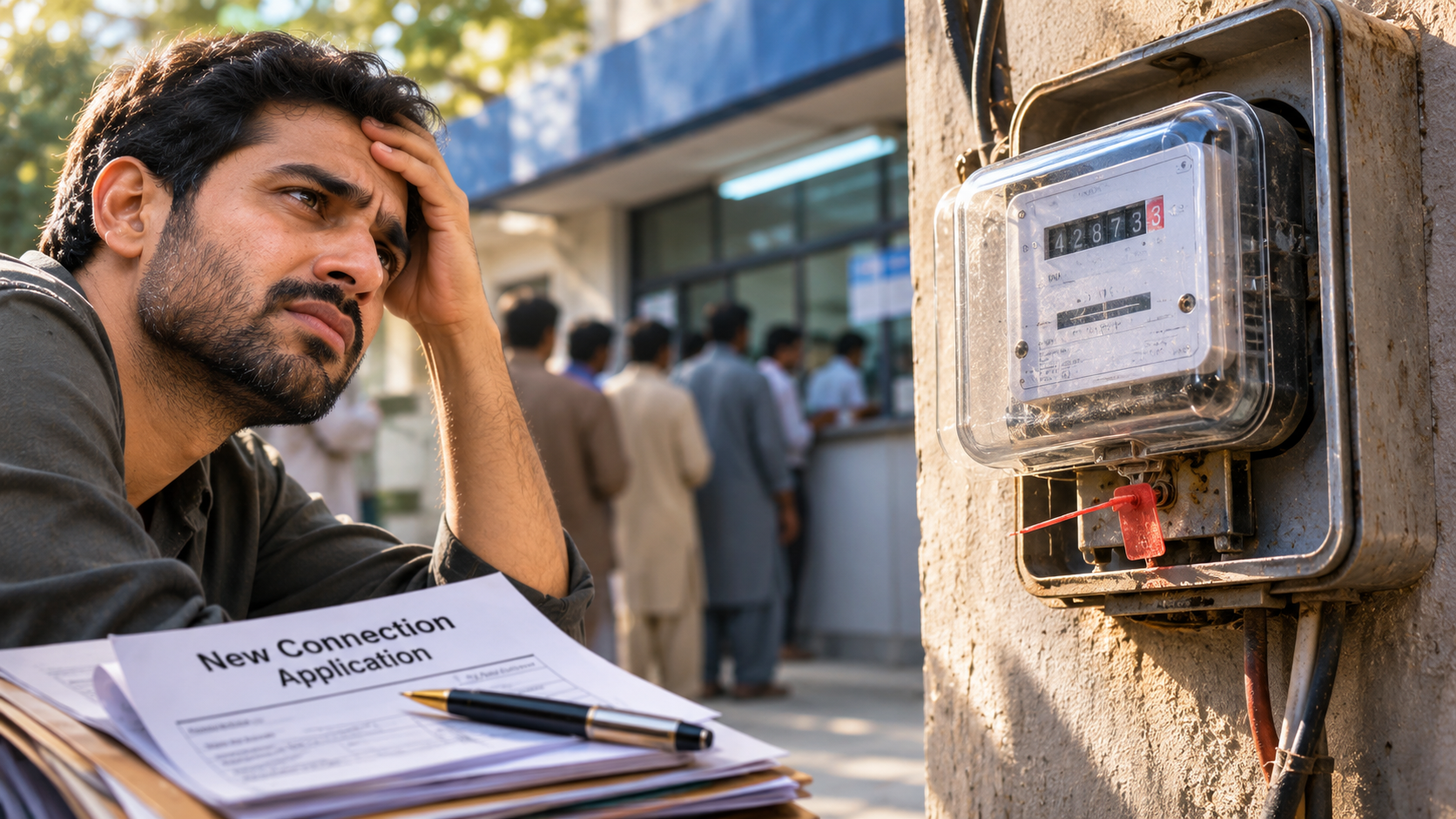
LAHORE – Getting a new electricity meter in Pakistan should be simple. Apply, submit the required documents, pay the charges and wait for installation.
Yet many households face a very different experience. What should take weeks can turn into months of office visits, delays and repeated complaints.
Imagine building your own house after years of saving. The construction is complete, the wiring is ready and your family wants to move in. But one thing stands in the way: an electricity meter.
You submit your application and complete the paperwork. You may even pay the demand notice. Still, the meter does not arrive.
For some applicants, the frustration eventually leads to an uncomfortable question: do they need sifarish, or a personal recommendation, to get something they have already paid for?
Electricity is a basic necessity. Getting a connection should not depend on knowing the right person.
Why Does Getting a New Electricity Meter Take So Long?
The process for getting a new electricity meter in Pakistan involves several steps.
Applicants must provide ownership documents, identity details and a wiring test report. The electricity company then checks the application, surveys the property and issues a demand notice.
Once the customer pays, the company arranges the meter and installation.
These steps help ensure safety and prevent illegal connections. However, problems arise when applications remain stuck without clear explanations.
Some consumers wait for document verification. Others struggle to obtain demand notices or face delays after making payments.
The biggest frustration often comes from not knowing who is responsible.
A lengthy process becomes even harder when no official can explain when it will end.
NEPRA Data Reveals Thousands Still Waiting
Official figures show that electricity connection delays remain a serious problem.
According to NEPRA’s Performance Evaluation Report for FY2024–25, 128,096 eligible consumers were still waiting for electricity connections as of June 2025 despite completing their payments.
These pending connections represented more than 1,021 megawatts of electricity demand.
The report also found that most distribution companies met the overall connection-time benchmark. However, MEPCO and K-Electric fell short.
This means not every applicant faces excessive delays. Many receive connections within the required period.
Still, the backlog shows that thousands of paying customers had yet to receive electricity.
For a family waiting to move into its home, these delays have real consequences.
Does Getting a WAPDA Meter Require Sifarish?
One of the biggest concerns involves the belief that personal connections can speed up the process.
People commonly call it a WAPDA meter, although distribution companies such as LESCO, MEPCO and IESCO handle household connections.
An applicant with influential contacts may know which official to approach or how to get an immediate response.
Someone without those contacts may spend weeks visiting offices and following up on an application.
This creates a troubling impression: the system works faster for people who know someone inside it.
A 2023 Dawn report highlighted long meter delays in Lahore. One consumer described approaching LESCO’s head office through an influential contact before getting a meter.
That experience does not prove everyone needs sifarish. However, it helps explain why many people lose faith in the normal process.
A public service should work equally for everyone, regardless of personal influence.
Bribery Allegations Raise Serious Questions
The issue becomes more concerning when officials allegedly demand money to install a meter.
On October 21, 2026, Dawn reported that the Federal Investigation Agency had arrested a MEPCO assistant lineman over an alleged Rs30,000 bribe.
A woman from Harappa had applied for an electricity meter after building her house.
According to her complaint, two officials demanded Rs35,000 and threatened to delay the installation unless she paid them.
The alleged demand later dropped to Rs30,000. The FIA arrested one official during a raid. The allegations remain subject to legal proceedings.
The wider complaint figures also raise concerns.
According to Business Recorder, consumers filed 65,330 complaints against electricity distribution companies with the Federal Ombudsman during the first seven months of 2026.
These complaints covered billing problems, faulty meters, delayed installations and alleged misconduct.
Not all involved new connections, and complaints alone do not prove wrongdoing.
However, the figures show why electricity consumers continue to demand greater accountability.
Paperwork and Meter Shortages Add to Delays
Corruption is not the only concern. Administrative procedures and equipment shortages can also slow down installations.
In October 2025, LESCO introduced online verification of wiring test reports for new connections.
Electrical inspectors must now verify these reports before LESCO can issue demand notices.
The system aims to improve safety. However, reports from October 2026 indicated that delays in verification were holding up applications.
Meter shortages have created similar problems in the past.
In October 2024, Dawn reported that LESCO borrowed 20,000 single-phase meters from GEPCO to address a shortage.
These problems highlight the need for better planning.
Online systems should make applications easier. Equipment shortages should not leave customers waiting indefinitely.
NEPRA’s Rules Allow 30 Days for Basic Connections
Pakistan already has rules intended to protect applicants from unnecessary delays.
Under NEPRA’s Consumer Service Manual, the standard process for a Category-1 connection, covering loads up to 15 kilowatts, follows a 30-day schedule.
This includes four days for registration and verification, six days for estimates and demand notices, 11 days for work orders and materials, and nine days for installation.
The schedule applies when applicants complete the required formalities, subject to relevant conditions.
In August 2026, NEPRA also introduced updated performance regulations. They strengthened consumer protections and provided compensation mechanisms for certain failures to meet service standards.
But regulations matter only when authorities enforce them.
A 30-day schedule means little to someone who has already waited several months without a clear explanation.
Ordinary Families Pay the Price
A delayed meter does not simply mean a few extra visits to an electricity office.
It can disrupt a family’s plans to move into a new home.
Some households must continue paying rent while their completed houses remain without electricity.
Others lose working hours, spend money travelling to offices and struggle to obtain updates.
For families with limited incomes, these extra expenses can create serious pressure.
The situation becomes more frustrating when applicants believe that someone with influential contacts might receive faster attention.
Access to electricity should depend on eligibility and official procedures, not personal relationships.
How to Apply and Report Electricity Meter Delays
Consumers can apply for new electricity connections through the official Electricity New Connection portal.
Applicants should keep their tracking numbers, payment receipts and other documents.
If an application faces delays, the customer should contact the relevant electricity distribution company and request an explanation.
Consumers can also register complaints through the electricity helpline at 118.
For unresolved issues, applicants can approach NEPRA’s official complaint system.
Customers should avoid unofficial payments and keep records of their complaints.
However, the responsibility for providing timely service rests with electricity companies.
People should not have to visit multiple offices simply to find out why their meter has not arrived.
Electricity Connections Shouldn’t Depend on Influence
Pakistan needs a simpler and more transparent system for new electricity connections.
Every applicant should be able to track their request, see what stage it has reached and know when the company expects to install the meter.
Distribution companies should also publish figures showing pending applications and the reasons behind delays.
Officials who demand illegal payments or deliberately obstruct applications should face investigation and appropriate action.
Meanwhile, genuine equipment shortages or technical problems should come with clear explanations and realistic timelines.
The solution is not to make sifarish part of everyday life. It is to create a system where nobody needs it.
Many Pakistanis receive electricity connections through the normal process. But documented delays and alleged corruption show why others have lost confidence.
No Pakistani should need an influential relative, political contact or unofficial payment to get a lawful electricity connection.
A complete application, payment of official charges and compliance with the rules should be enough.
An electricity meter is a public service, not a personal favour.
Key Points:
- NEPRA recorded 128,096 eligible applicants awaiting connections despite payment as of June 2025.
- Some consumers report lengthy delays and believe personal influence can speed up applications.
- An October 2026 FIA case involved an alleged Rs30,000 bribe for installing an electricity meter.
- Wiring verification delays and previous meter shortages have affected applications.
- NEPRA’s standard Category-1 connection process follows a 30-day schedule, subject to applicable conditions.
- Consumers can apply through the ENC portal and report unresolved complaints to NEPRA.
- Greater transparency and accountability could reduce delays and the perceived need for sifarish.
Read More:
For more such exclusive articles, follow Upfront .