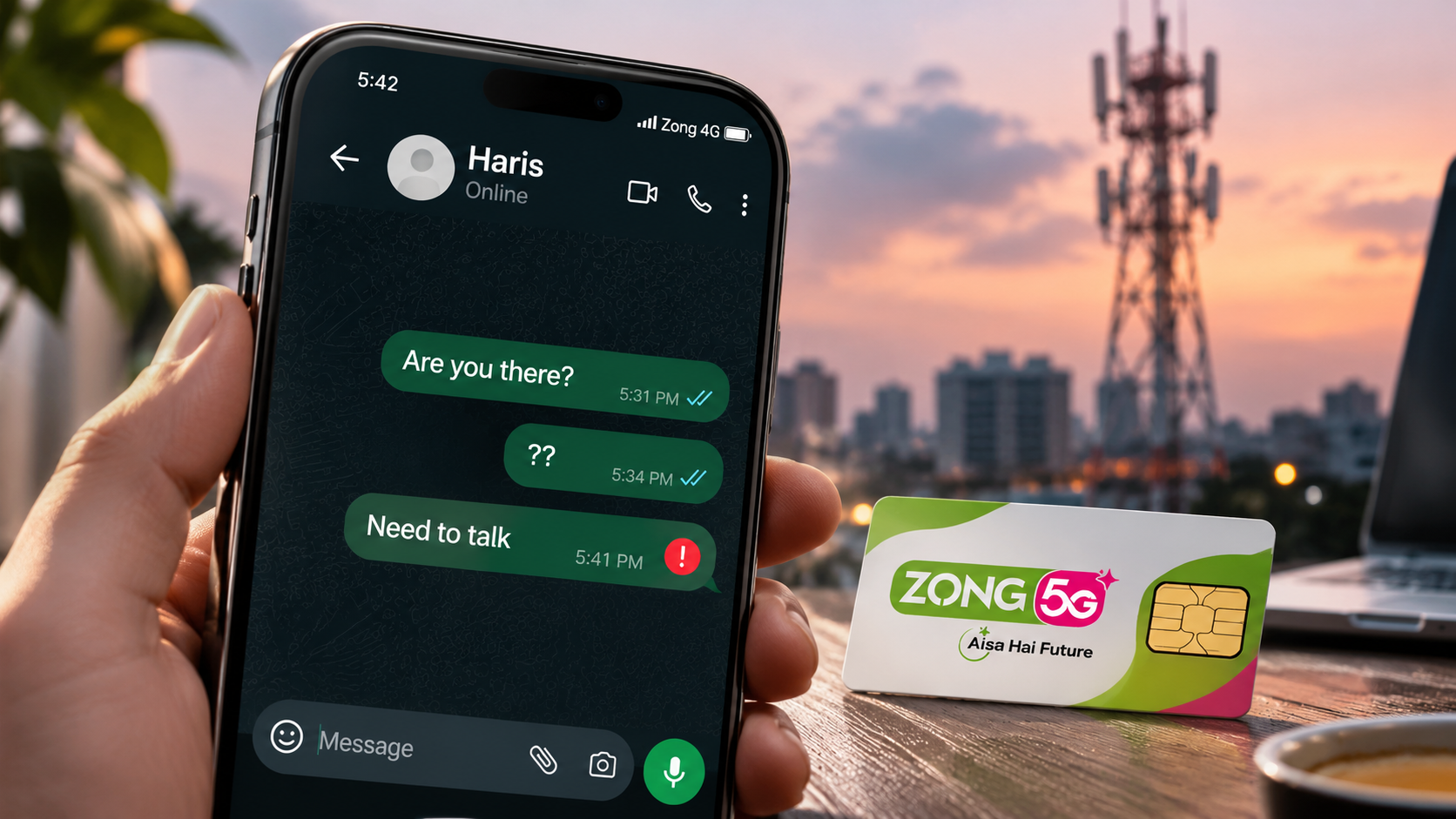
Lahore – Zong subscribers in Pakistan are reporting an increasingly frustrating problem: WhatsApp messages getting stuck, arriving late or failing to send despite active mobile internet packages.
The complaints raise questions about network reliability and what consumers should expect from a service they pay for.
Imagine being stranded somewhere and trying to send your location to a family member. Your mobile data is switched on, your internet package is active, and your phone displays a working 4G connection. Yet your WhatsApp message refuses to leave the screen.
For some Zong users in Pakistan, this is more than a hypothetical situation.
Over recent months, subscribers have complained about WhatsApp messages taking several minutes to send, incoming messages arriving late and the application occasionally losing connectivity even when other internet services continue to function.
What makes these complaints particularly troubling is that many users report having sufficient data and a seemingly stable network connection.
It raises a fundamental question: what is the value of a paid internet package if it cannot reliably deliver something as simple as a message?
Users Report WhatsApp Messages Getting Stuck on Zong
Complaints about WhatsApp messages getting stuck on Zong have surfaced repeatedly in online discussions since at least August 2026.
In an August 10 discussion on Reddit’s Pakistani technology community, one user reported that WhatsApp frequently failed to work properly over Zong mobile data but functioned when connected through a VPN or another mobile network.
Other participants described similar experiences.
A separate discussion published on September 1 highlighted another concerning experience. A subscriber said sending a WhatsApp message through Zong mobile data could take approximately 10 to 15 minutes.
By October, the complaints had continued.
In a discussion posted on October 17, a Zong subscriber described WhatsApp repeatedly losing connectivity every few minutes, preventing messages and media from being sent or received.
The individual claimed to have tested two Zong SIM cards, three different devices and alternative internet configurations without resolving the issue.
Several users responding to the discussion reported similar difficulties.
One particularly notable complaint described messages remaining stuck while ordinary web browsing continued without interruption.
These reports have not been independently verified through controlled network testing, and their scale remains unknown. However, the recurrence of similar complaints over several months suggests the issue warrants investigation rather than dismissal.
A Delayed Message Can Have Real Consequences
For someone casually messaging a friend, waiting several minutes might be an inconvenience.
For someone relying on WhatsApp during an urgent situation, the consequences could be considerably more serious.
A student trying to reach their parents, a delivery rider sharing their location or an employee coordinating an important assignment may all depend on timely communication.
Small businesses also increasingly rely on WhatsApp to receive orders, confirm payments and respond to customers.
When messages are delayed without warning, communication becomes unreliable.
Of course, WhatsApp is not a replacement for emergency telephone services. But it has become an important everyday communication tool for millions of people.
And when a service is widely used for work, education and family communication, persistent connectivity problems deserve serious attention.
The issue is not simply whether a message eventually reaches its destination.
It is whether the connection can be trusted when communication matters.
Zong’s Strong PTA Performance Makes the Complaints More Puzzling
Interestingly, the reported problems contrast with Zong’s strong performance in recent telecom quality assessments.
According to the Pakistan Telecommunication Authority’s Quality of Service survey for the second quarter of 2026, Zong met 128 of 132 assessed performance benchmarks across 11 major cities, achieving approximately 97 percent compliance.
The operator also performed strongly in several mobile broadband measurements, including upload speeds and latency.
However, the same assessment found that mobile broadband compliance across Pakistan’s major cellular operators stood at 85 percent, lower than the compliance recorded for coverage, voice and SMS services.
These findings demonstrate that mobile internet performance can vary across different measures.
They do not establish that Zong is responsible for the reported WhatsApp delays.
The survey covered April to June 2026, before many of the online complaints examined here. It was also not specifically designed to investigate the reported WhatsApp message-delivery problem.
Nevertheless, the contrast raises an important question about how consumers experience network quality.
A mobile connection can perform well in conventional speed tests while users encounter intermittent problems with particular applications.
For customers, the distinction matters.
Internet speed means little if the applications people actually depend on cannot function reliably.
Why Are WhatsApp Messages Delayed on Zong?
The exact technical cause of the reported WhatsApp connectivity issues remains unclear.
Several factors can potentially interfere with messaging applications, including unstable network connections, routing difficulties, domain-name resolution problems and congestion.
Some Zong subscribers have reported that switching to a VPN or changing DNS settings temporarily improves their WhatsApp connectivity.
While these experiences may provide useful clues, they do not establish the cause.
In particular, there is insufficient verified evidence to conclude that Zong is deliberately restricting WhatsApp traffic or that any particular filtering system is responsible.
A proper investigation would require controlled comparisons across different devices, locations, network providers and connection settings.
If the reported problem consistently appears on Zong mobile data but disappears on other connections under comparable conditions, that would justify further technical examination.
Until such testing takes place, speculation should not be presented as an established explanation.
Pakistan’s Mobile Internet Problems Are Already Under Scrutiny
Concerns about unreliable cellular services are not limited to Zong.
On September 10, 2026, the National Assembly Standing Committee on Information Technology and Telecommunication expressed dissatisfaction with the quality of mobile and internet services across Pakistan.
The committee questioned the Pakistan Telecommunication Authority over persistent connectivity problems and the enforcement of service standards.
It also decided to summon representatives of major cellular operators, including Jazz, Zong and Ufone, to explain continuing service-quality concerns.
According to the National Assembly’s official account of the meeting, PTA stated that operators are generally given 30 days to address identified deficiencies before further regulatory measures may be taken.
Although these proceedings did not specifically investigate WhatsApp message delays on Zong, they demonstrate that unreliable mobile connectivity is already a national consumer concern.
The latest complaints add another dimension to that debate.
Regulators should not assess connectivity solely by whether a mobile network can deliver fast download speeds or achieve satisfactory coverage measurements.
They should also consider whether customers can consistently use the communication services their internet packages are intended to support.
What Should Zong Do About These Complaints?
The first step should be acknowledging that repeated customer complaints deserve proper technical examination.
Zong should clarify whether it has received reports of WhatsApp message delays, whether such problems have been reproduced during testing and whether affected subscribers can expect a specific resolution.
Customers should also have access to straightforward complaint procedures that do not require extensive technical knowledge.
PTA, meanwhile, should consider whether application-specific reliability assessments could complement existing network quality surveys.
Testing how consistently mobile networks support widely used messaging services could help identify problems that ordinary speed tests might miss.
Affected subscribers can register complaints through Zong’s customer-service helpline at 310 or through the operator’s official complaint portal.
Unresolved telecom complaints can also be escalated through PTA’s Complaint Management System.
But the responsibility for investigating persistent network problems should primarily rest with service providers and regulators, not customers.
Consumers should not have to experiment with VPNs, repeatedly restart their phones or change technical settings simply to send an ordinary message.
Consumers Pay for Connectivity, Not Just Gigabytes
Pakistan’s telecom operators frequently promote larger internet bundles, faster speeds and improved network coverage.
These improvements are welcome, but the value of a mobile internet package ultimately depends on whether it works when needed.
A subscriber purchasing several gigabytes of data is not merely buying a numerical allowance.
They are paying for the ability to communicate, work, study and access digital services.
If WhatsApp messages repeatedly fail to send despite an active package, that expectation is not being met for the affected user, regardless of how much data remains available.
It would be inaccurate to describe the complaints as proof of a nationwide Zong outage. The available evidence does not establish that.
However, strong regulatory performance should not automatically invalidate the experiences of customers reporting recurring problems.
Both observations deserve consideration.
The real issue is whether reported failures are investigated transparently and whether customers receive the reliable service they reasonably expect.
Because when someone urgently needs to send a message, a strong mobile signal and an expensive internet package offer little reassurance if the message remains stuck.
The purpose of an internet connection is not simply to show that a network is available. It is to keep people connected when it matters.
Key Points:
- Zong subscribers have reported WhatsApp messages getting stuck, arriving late or failing to send despite active mobile internet packages.
- Similar complaints appeared in online discussions between August and October 2026.
- Some users reported that VPNs or DNS changes improved connectivity, although the cause remains unverified.
- Zong achieved approximately 97 percent compliance in PTA’s Q2 2026 Quality of Service assessment.
- The reported WhatsApp issues have not been established as a nationwide network outage.
- Pakistan’s parliamentary IT committee raised wider concerns about mobile network reliability in September 2026.
- Zong and PTA should investigate recurring complaints and provide greater transparency about application connectivity problems.
Read More:
For more such exclusive articles, follow Upfront .