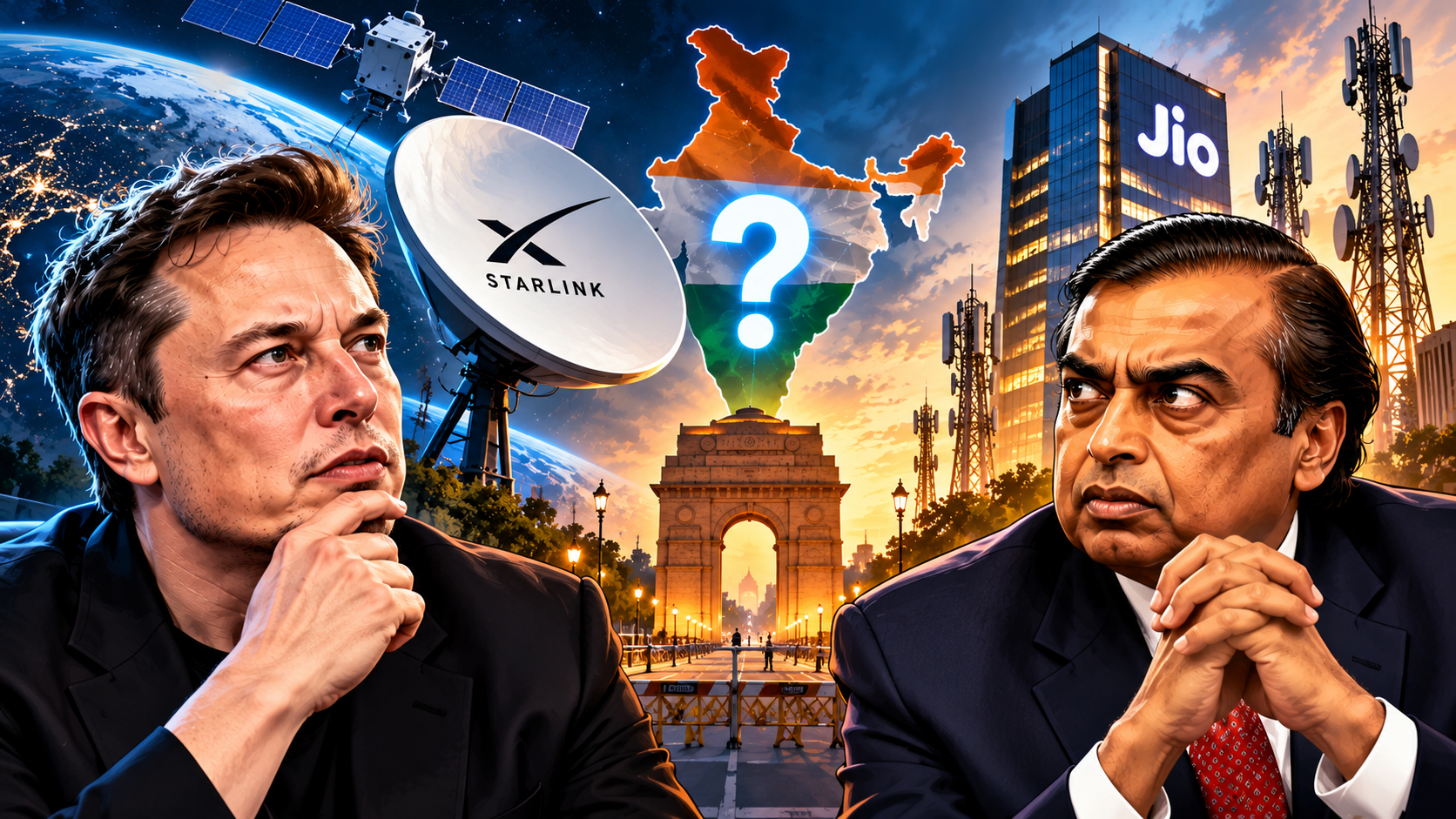
NEW DELHI – Elon Musk has stepped up his criticism of India’s regulatory process for Starlink India launch, questioning why SpaceX’s satellite internet service is still unable to begin commercial operations despite securing key approvals.
Musk has also taken direct aim at Reliance Industries chairman Mukesh Ambani. In a post on X, he sarcastically referred to him as “Prime Minister Ambani” and questioned whether Ambani was the “real boss” of India.
The comments have intensified a growing dispute over satellite internet, telecom competition and spectrum allocation in one of the world’s largest connectivity markets.
India’s government, however, has rejected Musk’s claims that business interests are blocking Starlink. Communications Minister Jyotiraditya Scindia said the country does not allow monopolies and maintained that satellite operators must meet the same regulatory requirements.
Why Has Starlink Not Launched in India?
Starlink has spent several years preparing to enter the Indian market.
The company has already secured a Global Mobile Personal Communications by Satellite, or GMPCS, authorization. India’s Department of Telecommunications lists Starlink alongside Jio Satellite Communications and OneWeb India as licensed GMPCS operators.
However, having a license does not automatically give an operator the right to use satellite spectrum.
India’s telecom rules require a separate frequency assignment. Operators must also comply with security, privacy, lawful interception and data-routing requirements.
The government says Starlink and the other licensed satellite operators are still going through security requirements and waiting for the spectrum framework to be finalized.
That is the main reason the Starlink India launch remains pending.
Musk Accuses Powerful Interests of Blocking Starlink
The dispute escalated this week when Musk accused unnamed “oligarchs” of trying to stop Starlink from entering India.
He argued that Starlink could expand internet access in areas that remain difficult to serve through traditional telecom infrastructure.
Musk later directed his criticism at Ambani, whose Reliance Jio is India’s largest telecom operator.
The SpaceX chief questioned whether Ambani was effectively the country’s “real boss”, escalating what had previously been a dispute over regulation into a public confrontation between two of the world’s most prominent business figures.
Musk has not provided evidence that Ambani personally blocked Starlink’s entry.
India Rejects Musk’s Monopoly Claims
The Indian government has rejected the suggestion that Starlink is being treated differently from its competitors.
The Communications Ministry said the regulatory framework for satellite communications is fair and non-discriminatory.
Officials said Starlink, Jio Satellite Communications and Bharti-backed Eutelsat OneWeb are broadly at the same stage of the regulatory process.
All three have to meet security requirements before they can receive satellite spectrum and begin commercial operations.
Scindia has also pushed back against claims of a protected monopoly, saying India does not permit monopolies in any sector.
This leaves two competing explanations for the delay.
Musk sees the process as an unnecessary barrier to competition, while Indian authorities describe it as a standard regulatory and security procedure.
The Bigger Fight Is Over Satellite Spectrum
The dispute goes back further than Musk’s latest posts.
Starlink and Reliance Jio previously disagreed over how satellite spectrum should be allocated.
Starlink supported an administrative allocation model. Reliance Jio argued that satellite spectrum should be auctioned, putting satellite operators on a similar footing to traditional telecom companies.
India ultimately chose administrative allocation under its telecommunications framework.
The issue matters because spectrum determines how satellite operators connect their networks to customers.
It also affects the cost and conditions under which companies can provide services.
India’s telecom regulator has continued working on the framework for assigning spectrum to satellite communication providers.
Jio and Airtel Are Not Simply Blocking Starlink
The situation is more complicated than a simple Starlink-versus-Jio battle.
Both Reliance Jio and Bharti Airtel have actually entered agreements with SpaceX related to Starlink.
Airtel announced an agreement with SpaceX in March 2025 to explore bringing Starlink services to Indian customers, including through Airtel’s retail network and business channels, subject to the necessary approvals.
Starlink and Jio have also agreed to work together on distribution.
That means India’s established telecom companies could potentially benefit from Starlink’s arrival while also competing with satellite internet services.
At the same time, Jio and Airtel are developing their own satellite connectivity strategies.
Jio Is Building Its Own Satellite Network
Reliance Jio is also preparing for the growth of satellite internet.
The company has showcased plans for a proposed 1,600-satellite low-Earth-orbit network designed to extend broadband coverage to remote villages, islands and border areas.
The proposed network would use 23 ground stations and integrate satellite connectivity with Jio’s existing terrestrial network.
Jio has not announced a specific launch date for its first satellite fleet.
Akash Ambani said the company was making rapid progress on its satellite plans but did not provide a timeline for deployment.
The development could eventually make Jio a direct competitor to Starlink in India’s satellite broadband market.
What Security Concerns Are Holding Up Starlink?
India’s satellite communications rules place significant emphasis on security.
Operators must establish authorized gateways in India and comply with conditions covering privacy, lawful interception and the routing of Indian traffic through domestic gateways.
These requirements are particularly important for a satellite network because communications can travel across borders and rely on infrastructure outside the country.
Indian officials say the remaining checks are part of the same process faced by other satellite operators.
Starlink, meanwhile, says it has already invested in the infrastructure needed to operate under India’s requirements.
The company has reportedly established more than 20 gateway sites and hundreds of antennas in India while preparing for commercial operations.
Why India Is So Important to Starlink
India represents a major opportunity for Starlink.
The country has more than a billion internet users and large areas where conventional fiber and mobile infrastructure can be difficult or expensive to deploy.
Satellite broadband could provide another option for remote communities, businesses, schools and other locations that lack reliable terrestrial connections.
It could also be useful during natural disasters when conventional communications infrastructure is damaged.
Musk has repeatedly pointed to these potential benefits while arguing for faster approval of Starlink in India.
Starlink India Launch Could Change the Telecom Market
A commercial Starlink India launch would introduce another major player into a telecom market dominated by Reliance Jio and Bharti Airtel.
The satellite service would not necessarily replace traditional mobile networks.
Instead, it could complement them by serving areas where fiber, towers and other infrastructure are harder to deploy.
The arrival of Starlink could also increase competition in India’s satellite broadband market as Jio, OneWeb and eventually other operators develop their own services.
For consumers, the biggest question will be whether satellite internet can offer competitive pricing and reliable speeds compared with India’s existing broadband options.
What Happens Next?
For now, Starlink’s Indian launch remains dependent on the completion of regulatory requirements.
India says Starlink must complete security compliance and obtain the necessary spectrum assignment before commercial operations can begin.
Musk continues to argue that the process has taken too long.
The government maintains that Starlink is being treated under the same rules as other satellite operators.
The disagreement has therefore become about more than one company’s launch.
It has exposed a much larger debate over competition, telecom regulation, satellite spectrum and the role of India’s biggest business groups in the country’s technology market.
Until the remaining approvals are completed, Indian consumers will have to wait to find out whether Starlink can become a serious new competitor in the country’s rapidly expanding internet market.
Key Points:
- The Starlink India launch has yet to begin commercially.
- Elon Musk has criticized the delay and questioned Mukesh Ambani’s influence.
- Musk has accused powerful business interests of blocking competition, without providing evidence against Ambani.
- India has rejected the allegations and says its satellite rules are fair.
- Starlink, Jio Satellite Communications and OneWeb have GMPCS authorizations.
- A license does not automatically grant the right to use satellite spectrum.
- Security compliance and spectrum assignment remain key requirements.
- Reliance Jio and Bharti Airtel have both reached agreements with SpaceX related to Starlink.
- Jio is also developing a proposed 1,600-satellite LEO network.
- The outcome could reshape India’s satellite internet and telecom competition.
Read More:
For more such exclusive articles, follow Upfront .