Connect with us

Sci&Tech

Claude Cowork expansion brings AI agents to mobile and web

Published

on

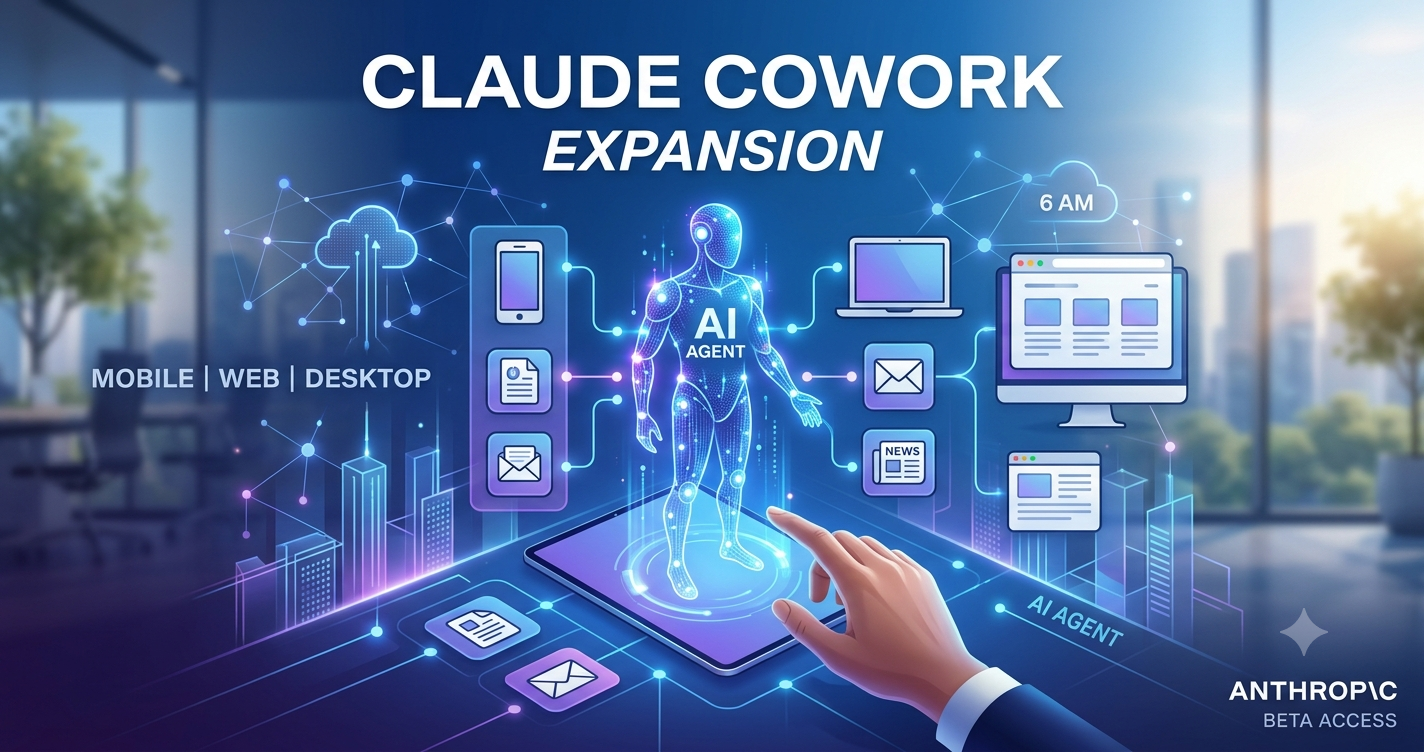
Claude Co-Work Expansion
The image is AI-generated and used for illustration purposes only

Key points: 

  • Multi-Device Support: Anthropic is launching the Claude Cowork expansion, bringing the AI agent to iOS, Android, and web browsers. 
  • Cloud-Powered Sessions: Therefore, tasks now run autonomously in the cloud, meaning operations continue even when laptops are closed. 
  • Non-Coding Focus: Newly released data reveals that over 90% of tasks are used for general business operations rather than programming. 
  • Rolling Beta: Consequently, the update is rolling out in beta over the coming weeks, starting with Claude Max subscribers. 

ISLAMABAD – The official Claude Cowork expansion has arrived to transform how professionals manage automated workflows across multiple devices. This update shifts the multi-step AI assistant from a desktop-only application into a flexible, cloud-based cross-platform tool.

As a result, users can now assign complex tasks, track active progress, and approve finished files from any web browser or mobile phone. The feature originally launched as a standalone desktop app. However, beta access is now rolling out directly inside the standard Claude apps for iOS and Android.

Seamless Background Monitoring and Cloud Control 

Because of this cloud migration, the Claude Cowork expansion completely untethers the AI from your local hardware. Sessions now run securely on Anthropic’s remote servers. For this reason, automated tasks will continue executing even if a user closes their laptop or goes entirely offline. For example, you can easily initiate a research project at your desk, leave the office, and monitor live progress directly from your smartphone. 

Furthermore, if the AI agent hits a bottleneck or requires specific human guidance, it sends an interactive notification directly to the user’s phone. The user can then instantly redirect the workflow or input required data. Nevertheless, Anthropic emphasizes that the human remains entirely in control, as no emails are sent or files finalized without explicit user approval. 

“The desktop application will still serve as the main hub for deep local work, as it retains direct access to local files,” Anthropic clarified. “However, the web and mobile expansion opens the tool to users who cannot install desktop apps.” 

AI Agents Pivot Toward General Administration 

This widespread rollout highlights a major shift in how tech companies position AI agents. While tools like OpenAI’s Codex started primarily as software development assistants, Anthropic is steering Cowork to be a general administrative partner. In addition, Anthropic released an aggregated study of 1.2 million Cowork sessions across 600,000 organizations to prove this trend. 

The data confirms that everyday office tasks dominate the platform. For instance, business operations accounted for 33.4% of usage, including compiling spreadsheets and formatting HR checklists. Meanwhile, content creation represented 16.4% of tasks. Finally, software development accounted for only 8.7% of activity. Therefore, the findings show that more than 90% of overall usage occurs outside of traditional programming. 

Project Technical Overview 

Attribute  System Details 
Feature Name  Claude Cowork 
Developer  Anthropic 
New Platforms  Web browsers (claude.ai), iOS App, Android App 
Core Infrastructure  Remote Cloud-Based Sessions (Runs Offline) 
Initial Access Tier  Claude Max Subscribers (Beta Phase) 
Primary Use Cases  Business Process Operations & Content Creation 

Frequently Asked Questions (FAQs) 

What does the Claude Cowork expansion allow users to do? 

It allows professionals to delegate multi-step administrative tasks to Claude and manage them across mobile devices and web browsers without needing the desktop app open or online. 

Can Claude Cowork run while my computer is turned off? 

Yes, because of the new cloud infrastructure, scheduled or active tasks run completely in the background even if your laptop is closed, turned off, or disconnected from the internet. 

Do I need to know how to code to use Claude Cowork? 

Not at all. While it shares an architecture with coding tools, company data shows over 90% of its use cases are for non-technical office work, like managing spreadsheets, organizing files, and drafting documents.

Read more: Google fixes Dialogflow CX vulnerability saving exposed AI chatbot data. 

Continue Reading

Sci&Tech

Google fixes Dialogflow CX vulnerability saving exposed AI chatbot data

Published

on

Key points:

  • Google has fixed a critical security vulnerability affecting its Dialogflow CX AI platform.
  • Researchers said the flaw could have allowed attackers to steal chatbot conversations and launch phishing attacks.
  • The vulnerability required the dialogflow.playbooks.update permission to be exploited.
  • Google said the issue has been fully mitigated and found no evidence of customer compromise.
  • Security experts have advised organisations to review Playbook updates, Code Blocks and system logs as a precaution.

KARACHI – Google has patched a critical security vulnerability in its Dialogflow CX artificial intelligence platform that researchers say could have allowed attackers to steal sensitive chatbot conversations and conduct phishing campaigns.

The flaw, dubbed “Rogue Agent” by cybersecurity firm Varonis, affected Dialogflow CX, Google’s enterprise platform used to build AI-powered customer service agents, healthcare assistants, financial services chatbots and other conversational AI applications.

How bad was the vulnerability?

According to Varonis Threat Labs, the vulnerability stemmed from a permission boundary issue that could have enabled attackers to inject persistent malicious code into AI agents through the platform’s Code Blocks feature.

Researchers said exploitation required the dialogflow.playbooks.update permission on a Dialogflow agent. Once obtained, an attacker could potentially modify the execution pipeline, allowing malicious code to intercept conversations, extract sensitive information and insert fraudulent prompts aimed at stealing user credentials.

What Google has to say about the vulnerability?

Google confirmed that the vulnerability has been fully addressed and said customers do not need to take any action.

The issue was privately disclosed to Google by Varonis in November 2025. Google released an initial patch in April 2026 before implementing a complete fix last month, resolving all affected components.

What is Dialogflow CX AI?

CX allows developers to add custom Python-based Code Blocks that process user input, interact with APIs and automate workflows. According to the researchers, these Code Blocks execute within Google’s Cloud Run environment, which allows outbound internet connectivity by default.

Varonis said that if an attacker gained permission to modify a Playbook’s Code Block such as through a compromised employee account they could replace part of the execution process with malicious code capable of accessing conversation history and session data or presenting fake authentication requests to users.

The researchers noted that although initial access would still be required, the necessary permission could be granted at the project level, meaning the attack was not limited to top-level administrators.

Were customers affected?

While Google said there is no evidence that customers were affected, Varonis recommended that organisations review Playbook update logs, inspect Code Blocks for unauthorised changes and investigate failed user requests that could indicate malicious activity.

What should organisations do to address this?

Security researchers also urged organisations to treat AI infrastructure as part of their overall cloud security strategy, warning that configuration weaknesses in AI services can create opportunities for attackers even when core platforms are secure.

Category Details
Company Google Cloud
Affected Product Dialogflow CX
Vulnerability Name Rogue Agent
Discovered By Varonis Threat Labs
Reported To Google November 2025
Initial Patch April 2026
Final Fix Implemented last month
Required Permission dialogflow.playbooks.update
Potential Impact Conversation theft, data exfiltration, phishing attacks, malicious code injection
Attack Vector Malicious modification of Dialogflow Playbook Code Blocks
Google’s Statement Issue fully mitigated; no known evidence of customer compromise.
Recommended Actions Review Playbook updates, inspect Code Blocks, monitor logs and investigate suspicious activity.
Current Status Fully patched by Google.

Continue Reading

Sci&Tech

Why cyber recovery is better then backups against ransomware

Published

on

Key points:

  • Cybersecurity experts say traditional backups alone are no longer sufficient against modern ransomware attacks.
  • Attackers increasingly target backup infrastructure to prevent organisations from recovering their data.
  • Cyber recovery focuses on restoring verified, uncompromised business services rather than simply recovering stored data.
  • Experts recommend immutable storage, isolated recovery environments, regular testing and risk-based protection strategies.
  • Wateen says its backup, disaster recovery and enterprise infrastructure solutions help organisations strengthen cyber resilience.

LAHORE – The rise of ransomware attacks has prompted cybersecurity experts to call for a shift from traditional backup strategies to comprehensive cyber recovery plans, warning that conventional backup systems are increasingly being targeted by attackers.

For decades, organisations have relied on backups as the primary method of protecting business data. However, cybersecurity professionals say threat actors now routinely compromise backup infrastructure alongside production systems, reducing the effectiveness of conventional recovery strategies during cyberattacks.

What do cybersecurity experts have to say?

Experts argue that while backups remain essential, they should no longer be viewed as a complete recovery solution. Instead, organisations should adopt cyber recovery frameworks that focus on restoring verified and uncompromised business services within an acceptable timeframe after an attack.

Unlike traditional backups, which primarily address data retention, cyber recovery is designed to ensure operational continuity under hostile conditions. The objective is not only to recover files but also to restore trusted systems that allow organisations to resume critical business operations.

According to cybersecurity specialists, an effective cyber recovery strategy should include immutable backup copies that cannot be modified or deleted, isolated recovery environments such as air-gapped infrastructure, and routine testing to verify that recovery processes function as expected.

What else do they recommend?

They also recommend prioritising protection for mission-critical systems rather than applying identical recovery policies across all data. This approach helps organisations reduce complexity while strengthening resilience where it matters most.

Experts further advise organisations to evaluate recovery performance using business-focused metrics such as Mean Time to Clean Recovery (MTCR) and Maximum Tolerable Downtime (MTD), alongside traditional recovery objectives.

What is going on with organisations?

Implementing these measures can be challenging in enterprise environments that depend on legacy infrastructure and complex operational processes. As a result, organisations are increasingly seeking technology partners capable of designing and deploying secure recovery architectures without disrupting existing operations.

Pakistan-based ICT company Wateen says it provides backup, disaster recovery, enterprise storage, virtualisation and compute infrastructure designed to support cyber recovery. According to the company, its solutions enable organisations to protect critical data in isolated environments, automate workload recovery and improve business continuity during cyber incidents.

Cybersecurity experts maintain that while backups remain an important part of data protection, true resilience depends on the ability to recover trusted systems quickly and reliably following a cyberattack.

Topic Details
Main Issue Ransomware increasingly targets backup infrastructure, making traditional backups insufficient on their own.
Traditional Backup Focuses on storing copies of data for recovery.
Cyber Recovery Focuses on restoring clean, verified systems and business operations after a cyberattack.
Key Threat Ransomware compromising both production systems and backup environments.
Recommended Protection Immutable backups, isolated recovery environments and air-gapped storage.
Recovery Validation Regular testing of backup integrity and application recovery.
Risk-Based Strategy Prioritise critical business systems instead of protecting every workload equally.
Recovery Metrics MTCR (Mean Time to Clean Recovery), MTD (Maximum Tolerable Downtime), RTO and RPO.
Implementation Challenge Legacy infrastructure, procurement cycles and operational complexity.
Wateen Solutions Backup & Recovery Platforms, Disaster Recovery, Enterprise Storage, Compute Infrastructure and Virtualisation.
Key Takeaway Businesses should combine backups with cyber recovery strategies to improve resilience against ransomware.

Continue Reading

Latest

Quantum sensor breakthrough explores dark matter

Published

on

QUANTUM SCENSOR BREKATHROUGH
Generated with AI

KARACHI -A major quantum sensor breakthrough has brought scientists one step closer to solving the biggest mysteries of the universe. Researchers successfully unveiled a new prototype device today. This advanced technology could soon help detect dark matter and ancient gravitational waves. 

The project relies on a highly advanced quantum system. The system utilizes two clouds of ultracold atoms to measure incredibly tiny forces. Until now, tracking these microscopic cosmic ripples was nearly impossible.  

According to the engineering team, this new device offers unprecedented sensitivity. The sensor can detect environmental shifts at a subatomic scale. This capability opens a brand-new window into deep space exploration. 

Unlocking the Puzzling Deep Universe 

The primary goal of this quantum sensor breakthrough is to study what we cannot see. Dark matter makes up most of the universe’s mass. Yet, it remains completely invisible to traditional telescopes. 

“We are building quantum detectors that could reveal some of the universe’s biggest secrets,” the lead researcher noted during the unveiling. 

By measuring how dark matter interacts with ultracold atoms, the sensor can map invisible cosmic structures. For a deeper look at international physics research initiatives, readers can view the latest physics tracking metrics on the official Stockholm International Peace Research Institute Portal. 

Mapping Ancient Waves From the Big Bang 

Beyond dark matter, this technology targets ancient gravitational waves. These waves are ripples in the fabric of space and time. They were created during the earliest moments of the universe.  

Current laser detectors can only spot massive cosmic collisions. However, this new device can find much smaller, older signals. Scientists believe these signals will help explain how the first galaxies formed. 

The technology is expected to scale rapidly over the next decade. Production teams are already designing a space-ready version of the sensor. Putting these devices into orbit will eliminate interference from Earth’s gravity. 

What Lies Ahead for Advanced Physics 

The scientific community is welcoming the discovery with great excitement. Teams around the world are preparing to test the prototype in different environments. Initial field tests will begin late next month. 

The research team will share their open-source data with global laboratories. This move aims to accelerate international development. 

To track all real-time updates and breaking physics press releases, be sure to bookmark our comprehensive International Relations Coverage Archive as this incredible quantum sensor breakthrough reshapes modern science. 

Continue Reading

About

Upfront influence about 20 million users and is the number one business and technology news network on the planet


© 2022 upfront. All Rights Reserved.

Trending

Copyright © 2026