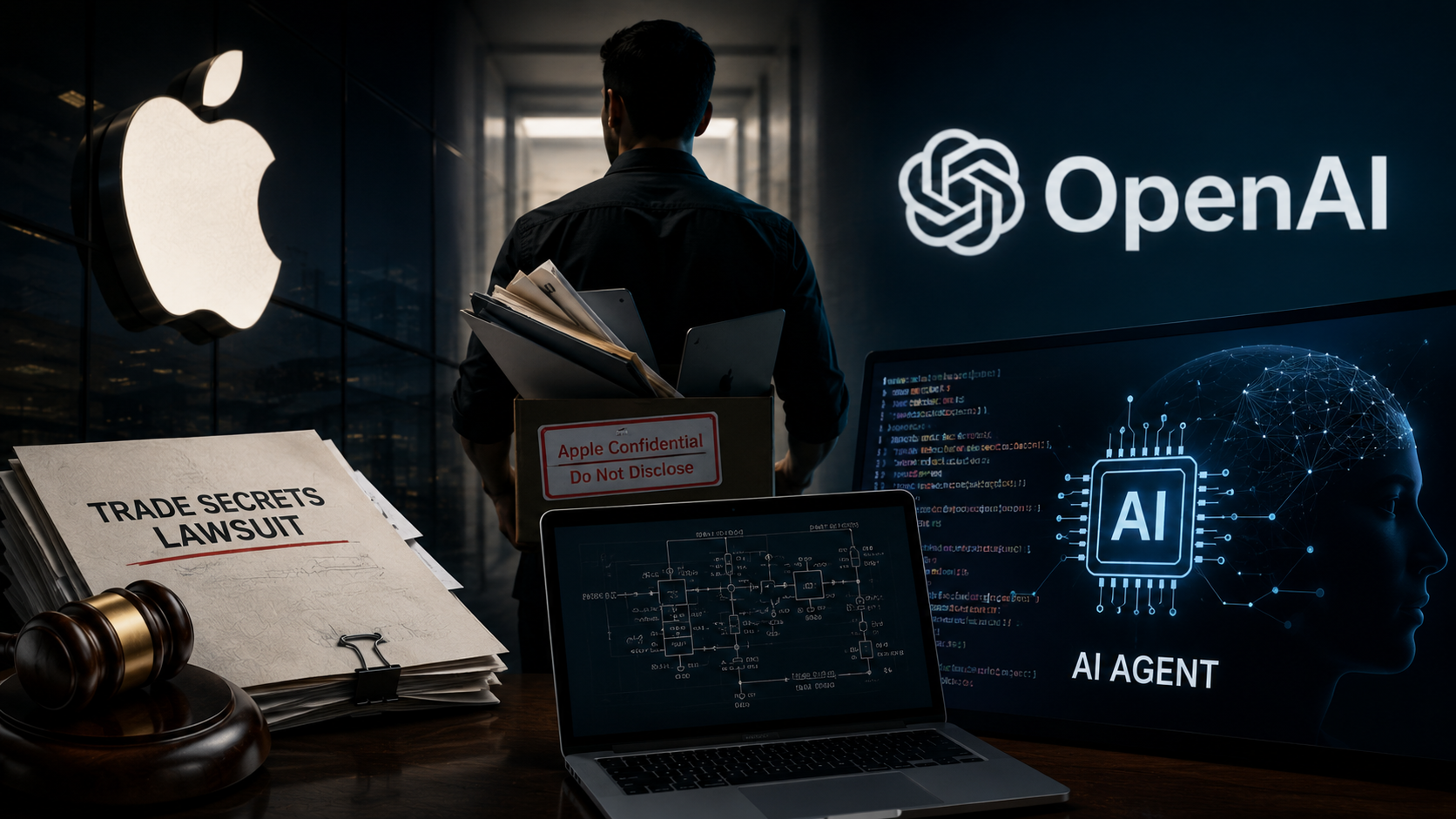
LAHORE – The Apple OpenAI trade secrets dispute has taken a new turn after Apple accused former engineer Chang Liu of using confidential company information while working at OpenAI.
In a new court filing, Apple alleged that Liu accessed a confidential Apple circuit schematic months after leaving the company. The company also claims he later used the material while working at OpenAI.
Apple says Liu used the schematic with LTspice, an electrical engineering simulation tool. It further alleges that he trained an AI agent to operate the software and analyse its results.
The allegations form part of Apple’s trade secrets lawsuit against OpenAI, Liu and former Apple executive Tang Yew Tan.
Apple Says Former Engineer Used Confidential Data
According to Apple’s latest filing, Liu downloaded a confidential power-converter circuit schematic in March 2026.
That was about two months after he left Apple to join OpenAI.
Apple alleges that Liu later used the schematic for a simulation with LTspice while working at OpenAI.
The company says Liu also described an AI agent that could operate LTspice, examine its results and adjust compensation parameters.
Apple claims this AI-assisted process reduced work that previously took about a day to roughly two hours.
The filing does not establish that OpenAI itself directed Liu to use Apple’s information. These are allegations made by Apple in an ongoing civil case.
Forensic Examination Found The Schematic
Apple says the new evidence came from a MacBook that Liu had retained after leaving the company.
The company recovered the Apple-issued laptop after filing its lawsuit. It then conducted a forensic examination of the device.
Apple says the examination uncovered evidence that Liu downloaded the confidential schematic in March.
According to the company, Liu used the schematic on a Mac mini. Data from that device later synchronised with the Apple-owned MacBook.
Apple says this connection helped investigators identify the alleged activity.
The company is now asking the court to allow it to inspect additional devices that remain in Liu’s possession.
Apple Raises Concerns About Evidence
Apple has made several additional allegations in its latest filing.
The company claims Liu and other OpenAI employees knew he still had access to Apple’s third-party cloud storage after leaving the company.
Apple also alleges that Liu learned about an internal investigation and then instructed an OpenAI colleague to destroy evidence.
According to Apple’s filing, the colleague indicated that she would comply.
Apple also pointed to Liu’s use of a tool at OpenAI that had the same name as an internal Apple engineering application.
The company says these discoveries strengthen its argument for obtaining access to additional devices quickly.
These claims remain disputed and have not been established by a court.
Apple Wants Faster Access To Devices
Apple is asking the US federal court for expedited discovery.
The process could allow Apple to obtain information and inspect relevant devices before the case reaches the normal discovery stage.
Apple had already requested expedited discovery earlier in the case. It has also sought a preliminary injunction that would prevent the defendants from using the trade secrets Apple says they obtained.
The latest allegations form part of Apple’s argument that the court should act more quickly.
The case, Apple Inc. v. Liu et al., was filed on July 10, 2026, in the US District Court for the Northern District of California. The lawsuit alleges trade-secret misappropriation and breach of contract.
What Is The Apple OpenAI Lawsuit About?
Apple filed the lawsuit against OpenAI, io Products and former employees Chang Liu and Tang Yew Tan.
The broader dispute concerns Apple’s allegations that former employees took or accessed confidential information before and after moving to OpenAI.
Apple has argued that the information could benefit OpenAI’s developing consumer hardware ambitions.
The company has also raised separate allegations involving Tan, a former senior Apple executive. Apple says he used internal project codenames during recruitment and sought information about unreleased Apple products.
OpenAI has rejected Apple’s accusations.
OpenAI Calls Apple’s Claims Meritless
OpenAI has asked the court to dismiss Apple’s lawsuit.
The company argues that Apple has not adequately identified protectable trade secrets or shown that OpenAI misappropriated them.
OpenAI has also disputed Apple’s account of Liu’s access to company information.
The AI company says Apple employees contacted Liu after his departure and asked him to help locate files. OpenAI argues that Apple’s own handling of former employees’ access contributed to the situation.
OpenAI has separately maintained that it does not want or need Apple’s trade secrets and is developing products independently.
The company has described Apple’s lawsuit as an attempt to interfere with competition and employee movement.
Why The AI Agent Allegation Matters
The latest allegation stands out because it involves more than simply accessing a confidential file.
Apple claims Liu used the circuit schematic as part of an engineering workflow involving an AI agent.
According to the filing, the agent could operate LTspice, inspect simulation results and adjust parameters.
If Apple’s allegations are eventually proven, the case could raise broader questions about how confidential engineering information can be used with AI tools.
Companies increasingly use AI agents to automate technical tasks. That creates new challenges around confidential data, employee access and intellectual property.
The case could therefore have implications beyond the dispute between Apple and OpenAI.
Apple And OpenAI Were Once Partners
The legal dispute marks a sharp change in the relationship between the two companies.
Apple and OpenAI previously worked together to bring ChatGPT features to Apple devices.
The relationship has become more complicated as OpenAI has expanded its ambitions beyond software and into consumer hardware.
OpenAI’s work with io Products has added another dimension to the dispute. Apple has raised concerns about former employees moving between the companies and allegedly taking knowledge with them.
OpenAI, however, says employees are free to leave Apple and that its own products are independently developed.
What Happens Next?
The court is now expected to consider Apple’s requests for expedited discovery and other relief.
Judge Edward J. Davila is scheduled to hear arguments on October 1, 2026, according to the filings.
The hearing could determine how quickly Apple gains access to additional evidence.
For now, neither Apple’s accusations nor OpenAI’s defence have been finally decided by the court.
The latest filing has nevertheless raised the stakes in the Apple OpenAI trade secrets battle. What began as a dispute over former employees and confidential information is now also raising questions about the use of AI agents in handling sensitive engineering work.
Key Points:
- Apple has accused former engineer Chang Liu of accessing confidential Apple information after joining OpenAI.
- Apple says Liu downloaded a confidential circuit schematic in March 2026.
- The company alleges he later used it with LTspice at OpenAI.
- Apple claims Liu trained an AI agent to operate LTspice and analyse its results.
- Apple says forensic analysis of an Apple-issued MacBook uncovered the activity.
- The company is seeking expedited discovery and access to additional devices.
- Apple has also made allegations involving evidence destruction and continued access to Apple’s cloud storage.
- OpenAI has rejected Apple’s claims and asked the court to dismiss the lawsuit.
- The lawsuit was filed on July 10, 2026, in the Northern District of California.
- A hearing on the dispute is scheduled for October 1, 2026.
- The allegations have not been proven in court.
Read More:
For more such exclusive articles, follow Upfront .