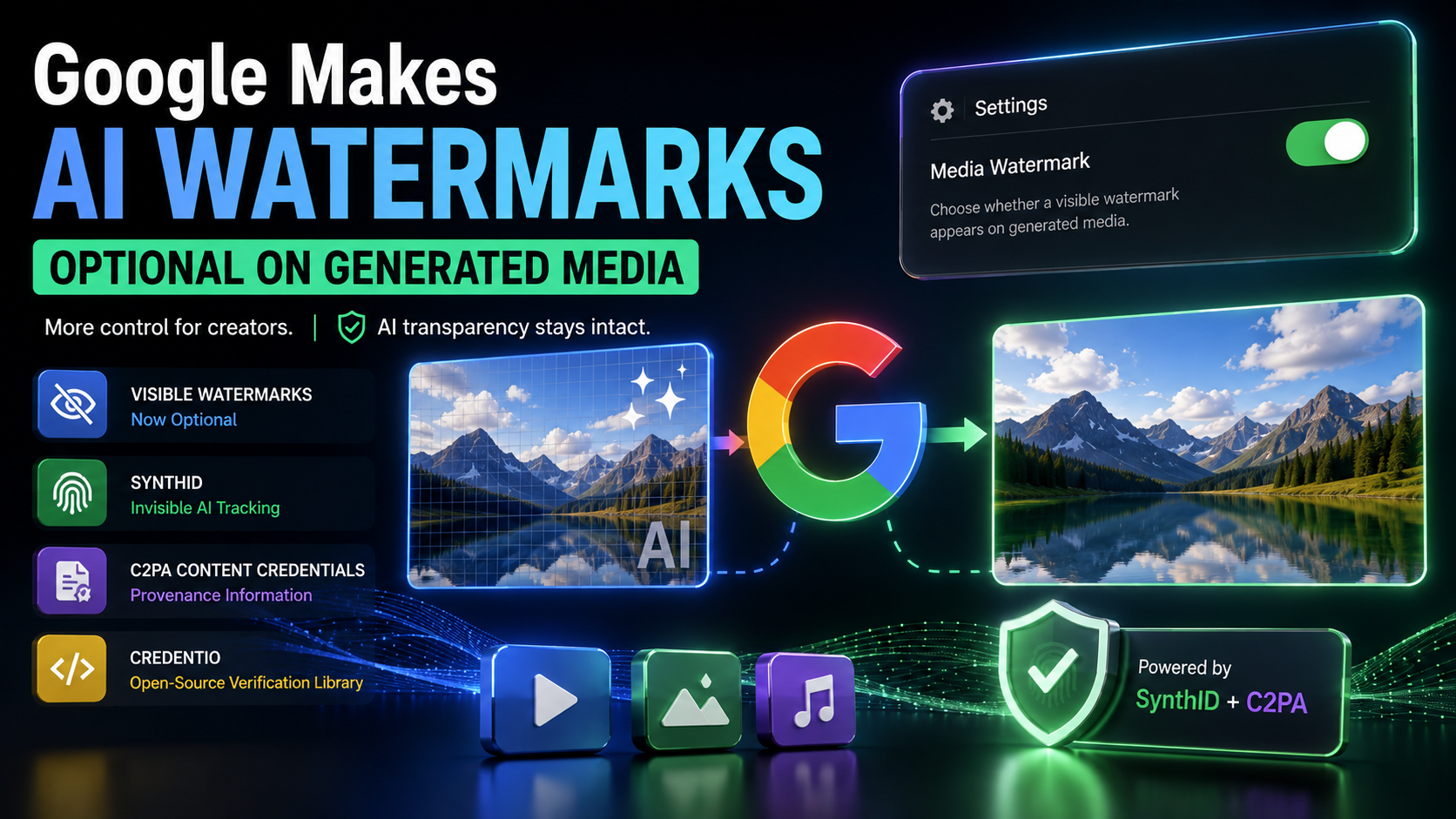
LAHORE – Google is giving users more control over Google AI watermarks, allowing them to turn off the visible watermark that appears on AI-generated images, videos and other media.
The change is rolling out across Google’s Gemini ecosystem, including Gemini and Flow, its AI filmmaking and video creation platform. However, switching off the visible mark does not remove Google’s underlying systems for identifying AI-generated content.
The move gives creators more flexibility when using AI-generated material for professional, creative or social media projects, while Google continues to maintain invisible provenance technology behind the scenes.
Google AI Watermarks Can Now Be Turned Off
Users receiving the new option can go to Settings > Media Watermark and choose whether the visible watermark appears on their generated media.
The feature is being introduced for content created through Google’s newer generative media tools, including Nano Banana and Gemini Omni. Google is also expanding its AI creation ecosystem through Flow, which is designed for generating and editing visual content.
The visible mark has often appeared as a small Google AI or sparkle-style symbol on generated content.
For creators, removing that visible element can make AI-generated material look cleaner when it is being incorporated into a larger design, video project or creative workflow.
Invisible SynthID Watermark Still Remains
Turning off the visible watermark does not mean the generated file becomes impossible to identify as AI-generated.
Google continues to use SynthID, an invisible watermarking technology that embeds an identification signal directly into AI-generated media.
Google says SynthID can be used to identify images, videos and audio created or edited with its AI models. The company has also designed the technology to remain detectable through many common changes to media.
This creates an important distinction between the two systems:
| Feature |
Visible watermark |
SynthID |
| Can users see it?
|
Yes
|
No
|
| Can users turn it off?
|
Yes, where the setting is available
|
No through the visible-watermark setting
|
| Main purpose
|
Immediate visual identification
|
AI-content verification
|
| Used with
|
Generated media
|
Google AI-generated or edited media
|
| Verification |
Simply visible |
Checked through supported Google tools |
Google’s Gemini verification tool can analyze supported images, videos and audio and tell users whether it detects a SynthID watermark.
C2PA Adds Another Layer of AI Verification
Google is also using C2PA Content Credentials, which work differently from SynthID.
Rather than embedding an invisible watermark into the media itself, Content Credentials can provide information about a file’s origin and editing history.
Google describes these credentials as a kind of digital record that can help establish whether AI was involved in creating or modifying content.
That gives Google’s system multiple layers of provenance. A viewer may no longer see an obvious AI symbol on an image, but verification tools can still provide information about how the content was produced.
Google Wants More Flexibility For Creators
The decision reflects a growing tension in generative AI.
Visible watermarks make it immediately clear that a piece of media came from an AI tool, but they can also interfere with designs, advertisements, videos and other professional work.
Google’s new approach separates those two concerns. Users can have a cleaner-looking final image or video while Google retains less visible methods for verifying its AI origin.
The move also comes as AI-generated content becomes increasingly difficult to distinguish from traditionally created media. Google has been expanding SynthID and Content Credentials as part of a broader effort to improve content provenance.
Google Expands AI Content Verification
Google has already made it possible for users to upload supported media to Gemini and ask whether it was generated or edited using Google AI.
The verification system checks for SynthID and can also use Content Credentials when they are available. Google says the feature covers images, videos and audio, although its SynthID verification is specifically designed to identify content created or edited by Google’s AI systems.
This distinction matters. A missing SynthID watermark does not automatically mean that content is human-made, because other AI systems use different identification technologies and some media may not contain detectable provenance information.
Google Also Pushes C2PA With Credentio
Google’s broader push for content provenance also includes Credentio, an open-source C++ library designed to validate C2PA Content Credentials.
The technology is intended to help developers verify content credentials locally rather than relying entirely on remote processing.
Google has increasingly positioned C2PA as an important part of its wider strategy for tracking the origin and editing history of digital media.
The company has also said its SynthID technology has been adopted beyond Google’s own ecosystem, reflecting a wider industry effort to establish common ways of identifying AI-generated content.
What Google’s Watermark Change Means
The decision to make Google AI watermarks optional does not mean Google is abandoning AI transparency.
Instead, it separates the visible branding users see from the underlying identification technologies.
Creators can now have more control over how their generated media looks, while invisible technologies such as SynthID and C2PA can continue providing provenance information.
That distinction could become increasingly important as AI-generated images, videos and audio become a normal part of online publishing.
For users, however, one thing remains important: a clean-looking image should not automatically be treated as human-created content simply because it has no visible AI watermark.
Key Points:
- Google is making visible AI watermarks optional for supported generated media.
- The setting is rolling out across Gemini and Flow.
- Users can disable the visible watermark through Settings > Media Watermark where the feature is available.
- Google’s invisible SynthID watermark remains in supported AI-generated content.
- C2PA Content Credentials can provide information about a file’s origin and editing history.
- Gemini can help users verify whether supported media contains Google’s SynthID.
- Turning off a visible watermark does not mean the media is no longer identifiable as AI-generated.
- Google’s approach gives creators greater visual flexibility while maintaining behind-the-scenes AI provenance systems.
Read More:
For more such exclusive articles, follow Upfront .