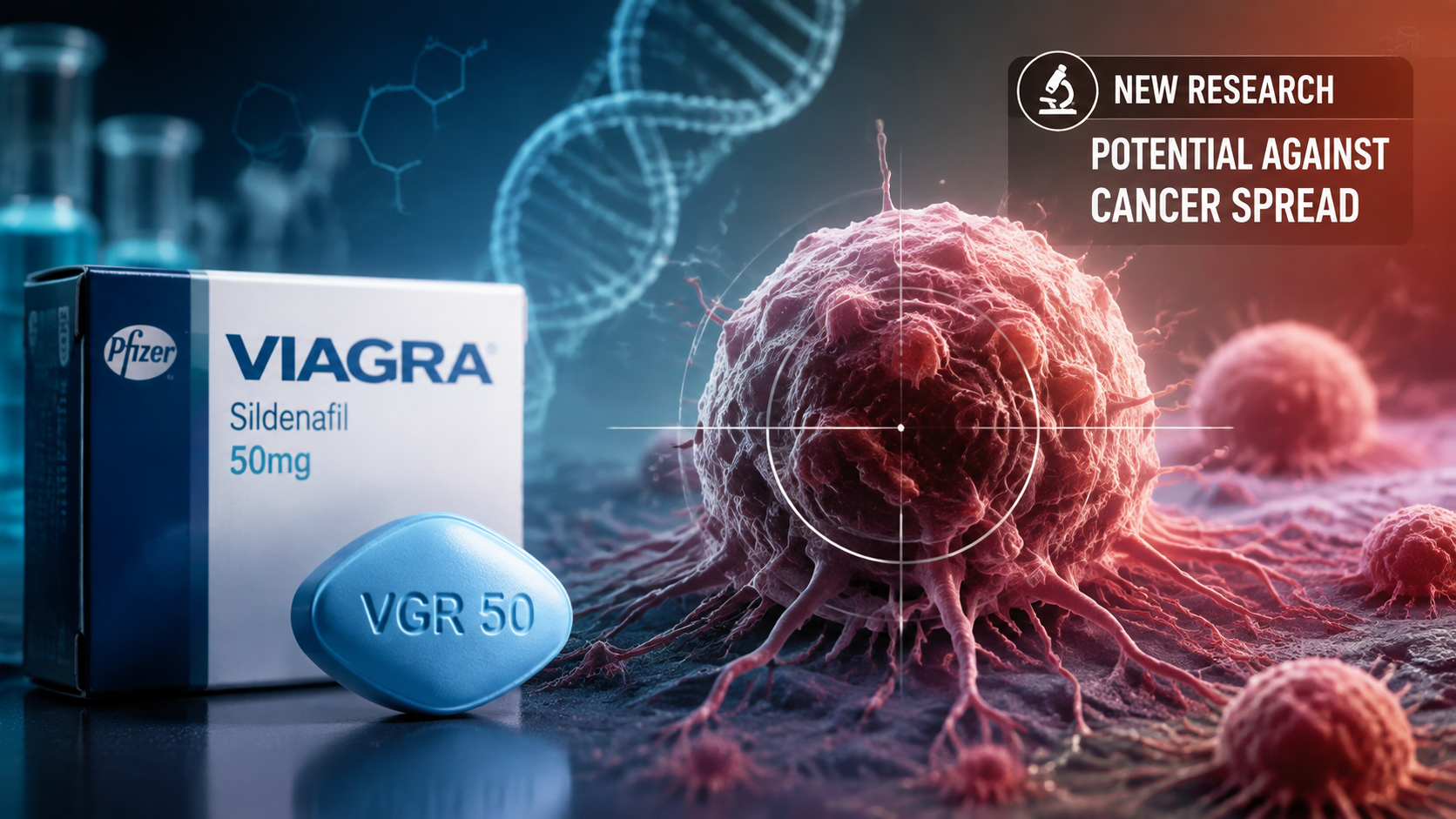
KARACHI – A new sildenafil cancer study has revealed that the active ingredient in Viagra may have another potential medical use beyond treating erectile dysfunction.
Researchers found that sildenafil could interfere with the ability of cancer cells to move and spread to other parts of the body, a process known as metastasis.
The findings, published in the peer-reviewed journal Cancer Research, suggest that sildenafil disrupted cholesterol movement inside cancer cells, limiting the supply needed for cancer cells to migrate.
However, researchers have stressed that sildenafil is not currently a cancer treatment, and more clinical studies are needed before doctors can consider its use against cancer.
Sildenafil Cancer Study Reveals Impact On Cancer Cell Movement
Scientists examined sildenafil across multiple mouse cancer models and human cancer-cell systems to understand how the drug affects tumour behaviour.
The research found that sildenafil, a PDE5 inhibitor, increased levels of a molecule called cGMP inside cancer cells.
Higher cGMP levels interfered with NPC1, a protein responsible for transporting cholesterol out of lysosomes, which are structures inside cells that help process materials.
As a result, cancer cells began storing excess cholesterol inside lysosomes while receiving less cholesterol in other areas where it was needed.
This shortage affected important cellular processes involved in movement, reducing the ability of cancer cells to migrate and potentially form new tumours in other parts of the body.
How Viagra Ingredient Sildenafil Could Affect Cancer Spread
The researchers focused on one of the most dangerous aspects of cancer: metastasis.
While many cancer treatments target the original tumour, preventing cancer cells from spreading remains one of the biggest challenges in improving survival rates.
The study suggests sildenafil may slow this process by disrupting the internal systems cancer cells use to move and survive.
By interfering with cholesterol transportation, the drug appears to weaken the structures that allow cancer cells to travel through the body.
However, scientists emphasised that these findings come from laboratory experiments and animal studies rather than confirmed human treatments.
Sildenafil And Statins Show Combined Effects In Research
Researchers also examined health-record data from cancer patients and observed improved survival rates among those who had used sildenafil.
The study found an additional benefit among patients who had also taken statins, medicines commonly prescribed to lower cholesterol levels.
Scientists believe the two drugs may work through different pathways.
Sildenafil appears to interfere with cholesterol movement inside cancer cells, while statins reduce the production of new cholesterol.
According to researchers, combining these effects produced stronger anti-metastatic results in their experiments.
However, the patient data remains observational, meaning it cannot prove that sildenafil directly improved survival.
Viagra Is Not A Confirmed Cancer Treatment Yet
Despite the promising findings, experts caution that the research does not mean Viagra can currently treat or prevent cancer.
The study provides early evidence from cancer-cell systems, animal models, and health-record analysis, but researchers still need large-scale clinical trials to determine whether sildenafil is safe and effective for cancer patients.
Doctors would need clear evidence about appropriate doses, possible side effects, and which cancer types could potentially benefit before recommending the drug for this purpose.
Future Of Cancer Research And Drug Repurposing
The sildenafil cancer study highlights the growing field of drug repurposing, where scientists explore whether existing medicines can help treat other diseases.
Since drugs like sildenafil have already undergone safety testing for their approved uses, researchers can investigate their potential applications in new areas.
Many scientists believe repurposing existing medicines could help speed up medical discoveries and provide new options for complex diseases.
For now, sildenafil remains an approved treatment for conditions such as erectile dysfunction and certain heart-related conditions, while its role in cancer research remains experimental.
Further studies will determine whether this unexpected connection between Viagra’s active ingredient and cancer biology can lead to future treatments.
Key Points:
- A new sildenafil cancer study suggests Viagra’s active ingredient may slow cancer cell spread.
- Researchers found sildenafil disrupted cholesterol movement inside cancer cells.
- The drug affected processes linked to cancer cell movement and metastasis.
- Studies in mice and human cancer-cell systems showed promising results.
- Patients who used sildenafil showed better survival outcomes in observational data, especially with statins.
- Scientists say sildenafil is not yet a cancer treatment and requires further clinical trials.
- The research highlights the potential of repurposing existing medicines for new medical uses.
Read More:
For more such informative content, follow Upfront .