Connect with us

Entertainment

Update on Paramount’s case and Warner Bros deal

Published

on

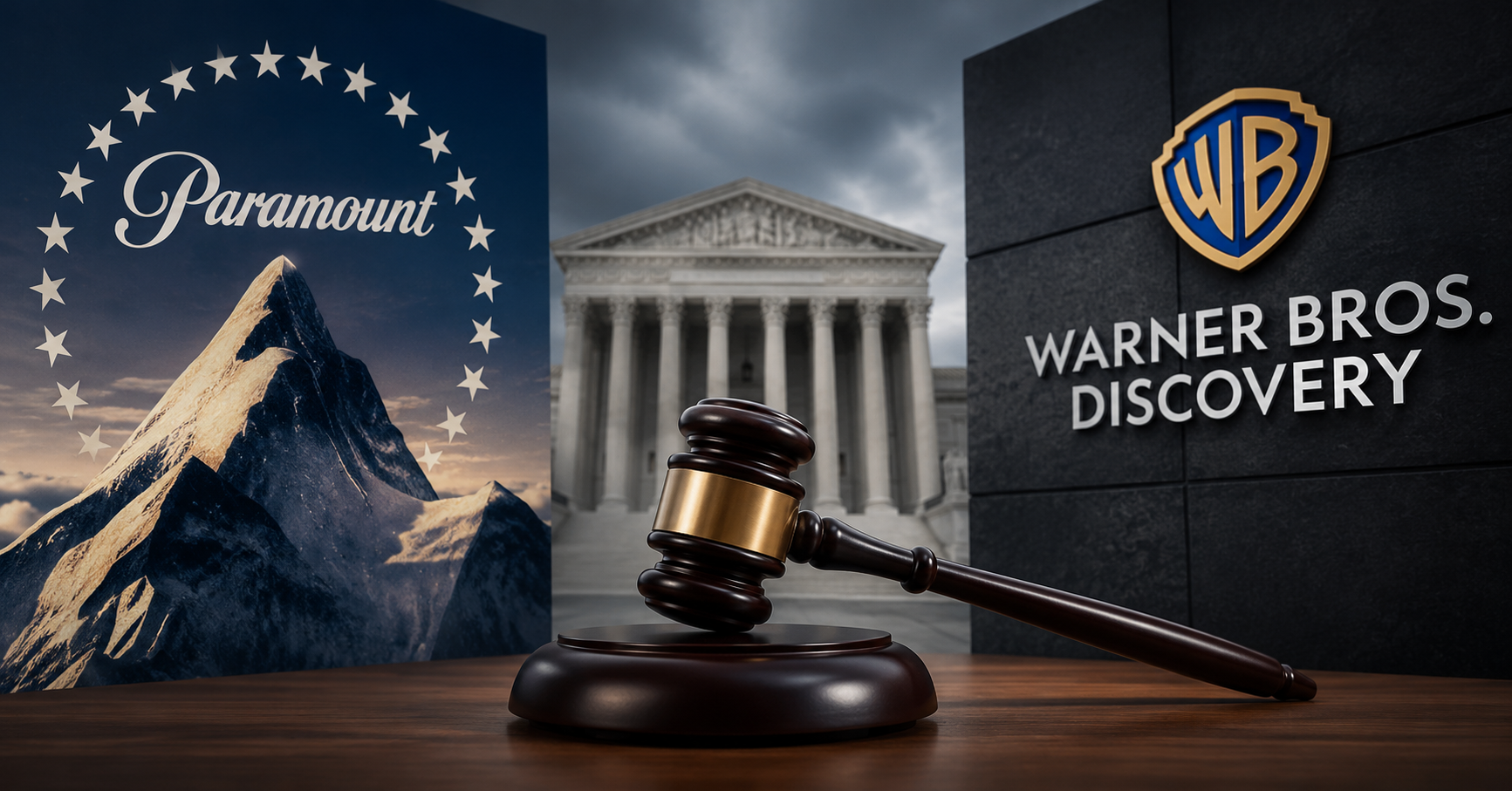
The image is AI-generated and used for illustration purposes only

KARACHI – A planned $111 billion acquisition of Warner Bros. Discovery by Paramount has encountered a major legal obstacle after a coalition of 12 US states, led by California, filed a lawsuit seeking to block the transaction on antitrust grounds.

The lawsuit threatens Paramount’s plan to complete the acquisition this month despite the company already securing regulatory approvals from more than a dozen countries and submitting merger documents to the US Department of Justice in December.

During a hearing on Friday, US District Judge Araceli Martínez-Olguín said she would decide by next Wednesday whether to issue a temporary restraining order preventing Paramount from finalising the acquisition while the case proceeds. The judge noted that Paramount had acknowledged it would not suffer significant harm if the merger were delayed briefly, suggesting the court may be open to temporarily freezing the transaction.

Delay Could Cost Paramount Millions

The legal challenge could carry significant financial consequences for Paramount. Under the merger agreement, if the acquisition is not completed by September 30, Paramount could be required to pay Warner Bros. Discovery shareholders approximately $650 million per quarter, equivalent to nearly $6.9 million per day, until the deal closes.

To avoid triggering those payments, Paramount requested that the court hold preliminary injunction proceedings by the end of August so a decision could be reached before the financial penalties take effect. However, the states have asked the court to begin those proceedings next year.

States Say Merger Would Hurt Competition

According to the lawsuit, combining Paramount and Warner Bros. Discovery would significantly reduce competition in theatrical film distribution and cable licensing.

The states argue that the merger would unite two of Hollywood’s five largest studios, resulting in:

  • Higher prices for consumers.
  • Fewer wide-release films.
  • Reduced variety and quality of entertainment.
  • Less competition across the film industry.

James Weingarten, representing the coalition of states, described the proposed acquisition as “the largest merger in Hollywood history.”

He argued that the combined company would control more than a quarter of box office revenues generated by blockbuster films, giving it enormous market influence.

Paramount Rejects Antitrust Claims

He also argued that if competition concerns eventually emerged, regulators could require the company to divest certain assets instead of blocking the transaction entirely. Paramount further challenged the government’s reliance on updated 2023 US merger guidelines, arguing that no American court has previously used those standards to presume an antitrust violation at the market concentration levels cited by the states.

Key Detail Information
Deal Value $111 billion
Companies Paramount and Warner Bros. Discovery
Lawsuit Filed By Coalition of 12 US states led by California
Main Allegation Merger would reduce competition in Hollywood
Judge US District Judge Araceli Martínez-Olguín
Expected Court Decision Next Wednesday on temporary restraining order
Potential Financial Penalty $650 million per quarter after September 30
Daily Delay Cost Approximately $6.9 million per day
States’ Concerns Higher prices, fewer films, reduced competition and content diversity
Paramount’s Position Merger is lawful and lawsuit was filed too late
Settlement Proposal 30 movies annually with a 45-day theatrical window
States’ Response Rejected behavioural remedies and favoured structural divestitures

States Oppose Behavioural Remedies

Before the lawsuit was filed, Paramount reportedly attempted to settle the dispute by offering behavioural commitments, including producing 30 films annually with a 45-day theatrical release window.

California Attorney General Rob Bonta, however, indicated that such commitments would be difficult to enforce and instead suggested that any acceptable settlement would likely require structural remedies, such as divesting a film studio, cable television assets or a news network.

Key Points:

  • 12 US states led by California have sued to block Paramount’s acquisition of Warner Bros. Discovery.
  • The lawsuit threatens Paramount’s plan to close the $111 billion deal in July.
  • A US judge is expected to decide next week on a temporary restraining order.
  • If the merger is delayed beyond September 30, Paramount could owe about $650 million per quarter to Warner Bros. Discovery shareholders.
  • States argue the merger would reduce competition, increase prices and limit movie choices for consumers.
  • Paramount says the lawsuit was filed too late and insists the merger is lawful.

Continue Reading

Editorial

Why HBO Max Canceled Titans and What It Means for DC’s Future

Published

on

Why HBO Max Canceled Titans and What It Means for DC’s Future
This Image is Ai generated and used for Illustration purposes only.

LAHORE – The cancellation of Titans by HBO Max marked the end of one of DC’s longest-running live-action superhero series. After four seasons, the show concluded its story as Warner Bros. Discovery began shifting its focus toward a new direction for DC entertainment. 

For many fans, the question remains: why did HBO Max cancel Titans despite having a dedicated audience and a successful run? 

The answer is not linked to a single issue. Instead, the decision came during a major transformation at Warner Bros. Discovery, where streaming strategies, DC leadership, production costs, and the future of superhero content were all being reconsidered. 

While Titans developed a loyal fan base, the series was released during a period when DC was moving away from its previous television universe and preparing for a more connected future under DC Studios. 

Why HBO Max Canceled Titans and What It Means for DC’s Future

This Image is Ai generated and used for Illustration purposes only.

Why HBO Max Canceled Titans After Four Seasons 

The decision to end Titans came shortly after Warner Bros. Discovery completed its merger and began reviewing the future of HBO Max content. 

The company started reducing spending, cancelling projects, and restructuring its streaming strategy as it aimed to make HBO Max more profitable. 

Unlike traditional television networks, streaming platforms no longer measure success only through popularity. They also consider: 

  • Production costs  
  • Subscriber growth  
  • Viewer completion rates  
  • Global audience reach  
  • Long-term franchise value  

Although Titans attracted viewers, maintaining an expensive superhero series became more complicated as Warner Bros. Discovery focused on efficiency. 


DC Studios Leadership Changes Changed the Future of Titans 

One of the biggest factors behind the cancellation was the major leadership change at DC. 

In 2022, Warner Bros. Discovery appointed James Gunn and Peter Safran to lead DC Studios and develop a new interconnected DC Universe. 

The new leadership planned to create a unified superhero franchise across films, television shows, animation, and other platforms. 

This created uncertainty for several existing DC projects, including Titans. 

The series existed separately from the upcoming DC Universe, meaning continuing it would have required maintaining two different versions of DC storytelling at the same time. 

For Warner Bros. Discovery, the priority became building a fresh starting point rather than expanding older universes. 


Titans Faced Challenges in the New Streaming Era 

When Titans launched in 2018, it was one of the major original shows for DC’s streaming service, DC Universe, before later moving to HBO Max. 

At the time, the series represented DC’s attempt to compete with Marvel’s expanding television presence. 

However, the streaming landscape changed significantly. 

By the time Titans reached its later seasons: 

  • Streaming platforms were reducing spending  
  • Superhero content became more competitive  
  • Audiences became more selective  
  • Studios started prioritizing major franchise connections  

The success of superhero projects was no longer guaranteed simply because they featured popular comic book characters. 


Viewership and Audience Engagement Played a Role 

Unlike traditional television, streaming platforms generally do not release complete audience numbers. This makes it difficult to judge Titans purely by ratings. 

However, entertainment analysts often look at indicators such as: 

  • Online discussions  
  • Social media engagement  
  • Search interest  
  • Audience retention  
  • International popularity  

Titans maintained a passionate fan community, especially among DC fans who appreciated its darker approach to characters like Nightwing, Raven, Starfire, and Beast Boy. 

However, the series did not reach the mainstream cultural impact achieved by major superhero shows such as Marvel’s streaming releases or other high-profile comic adaptations. 

For a costly superhero production, a dedicated fan base may not always be enough to justify additional seasons. 


Rising Production Costs Made Renewal More Difficult 

Superhero shows are among the most expensive television productions because they require: 

  • Visual effects  
  • Action sequences  
  • Costumes  
  • Stunt work  
  • Large-scale production designs  

As Titans expanded, the budget requirements likely increased alongside the complexity of its storytelling. 

Warner Bros. Discovery was already under pressure to reduce costs and improve streaming profitability after investing heavily in HBO Max content. 

Renewing an expensive series without a clear path to significant subscriber growth became a difficult business decision. 


Critical Reception Was Mixed Despite Strong Fan Support 

Titans received a mixed response throughout its run. 

Many fans praised: 

  • The darker tone  
  • Character development  
  • Performances  
  • Action sequences  
  • The introduction of Nightwing  

However, critics often pointed toward issues involving: 

  • Uneven storytelling  
  • Pacing problems  
  • Changes from comic book versions  
  • Inconsistent character arcs  

The series developed a loyal audience, but it did not achieve universal critical success that could strengthen its case for a long-term future. 


Competition From Other Superhero Shows Increased Pressure 

The superhero streaming market became increasingly crowded during Titans’ run. 

Viewers had access to: 

  • Marvel Studios series on Disney+  
  • DC projects on multiple platforms  
  • Amazon’s superhero content  
  • Animated comic adaptations  
  • New franchise-based streaming shows  

As more superhero content entered the market, audiences became less likely to follow every release. 

Studios began focusing on fewer projects with stronger franchise potential instead of maintaining multiple separate universes. 


What Titans Cancellation Means for DC’s Future 

The cancellation of Titans represents a broader change in DC’s entertainment strategy. 

Warner Bros. Discovery is moving toward a connected DC Universe where characters and stories can exist within a larger plan. 

While Titans ended, its success showed that audiences remain interested in younger DC heroes and team-based superhero stories. 

Characters from the Titans mythology still have significant potential, especially under a new DC structure. 

The challenge for DC is deciding how to bring these characters back while creating a consistent universe that can compete with Marvel. 


Could Titans Ever Return? 

A revival is unlikely in the immediate future because DC Studios is focused on building its new universe. 

However, entertainment history has shown that cancelled shows can return if audience demand remains strong. 

Examples from other franchises prove that fan campaigns, streaming performance, and changing business strategies can sometimes revive popular projects. 

For now, Titans remains complete after four seasons, but its characters could potentially appear in future DC projects. 


Key Points:

  • HBO Max canceled Titans after four seasons during Warner Bros. Discovery’s restructuring.  
  • DC Studios’ new leadership wanted to create a connected DC Universe.  
  • Production costs and streaming profitability influenced renewal decisions.  
  • Titans had a loyal fan base but limited mainstream impact compared with bigger superhero franchises.  
  • The cancellation reflects a wider shift in how studios approach superhero content.  


Why did HBO Max cancel Titans? 

HBO Max canceled Titans as Warner Bros. Discovery changed its streaming strategy and DC Studios moved toward a new interconnected DC Universe. 

Will Titans get a season 5? 

No official plans exist for Titans season 5. The series ended after its fourth season. 

Was Titans successful on HBO Max? 

Titans developed a dedicated fan base and performed well enough to continue for four seasons, but streaming profitability and DC’s restructuring affected its future. 

Is Titans connected to James Gunn’s DC Universe? 

No. Titans existed separately from the upcoming DC Universe being developed by DC Studios. 

Could Titans return in the future? 

A revival is possible but unlikely soon, as DC Studios is currently focused on establishing its new franchise direction. Keep following upfront.pk for further updates. 


Final Thoughts 

The end of Titans was not simply a result of poor performance. Instead, it reflected a major shift happening across Hollywood, where streaming companies are becoming more selective about expensive productions and franchises are being rebuilt from the ground up. 

For many fans, Titans proved that DC’s younger heroes could carry a successful live-action series. The question now is whether DC will bring these characters back in a new form or leave the Titans era behind. 

Did Titans deserve another season, or was its ending the right move for DC’s future? Share your thoughts. 

Read More: 

Continue Reading

Entertainment

Netflix officially begins Queenstown production in New Zealand

Published

on

KARACHI – Netflix has officially begun production on Queenstown, marking the streaming giant’s first original television series commissioned in New Zealand after more than a decade of offering content in the country.

The eight-episode drama is currently being filmed on location in Queenstown, one of New Zealand’s most popular luxury ski destinations on the South Island. Set against the backdrop of the town’s affluent ski-resort community, Queenstown follows a wealthy family whose internal conflicts spill over into the lives of the people who work for them.

The story explores themes of power, loyalty, family conflict and desire.

What is Queenstown centered on?

Netflix described the series as a drama centered on “a wealthy family at war with itself,” unfolding within the glamorous yet competitive world of Queenstown’s elite. The writer and creator of Queenstown is Chloe Stearns, who also serves as an executive producer. Moreover, Glendyn Ivin will direct the series and executive-produce it, while New Zealand filmmaker Roseanne Liang will direct selected episodes.

Read more: 350,000 Google Career Certificates Open to Pakistanis

The cast of Queenstown

The cast is led by Emmy Award nominee Rufus Sewell, alongside Frances O’Connor, Alycia Debnam-Carey, and New Zealand actor Te Kohe Tuhaka. Amanda Duthie, Netflix’s Content Director for Australia and New Zealand, described the project as a significant milestone for the company.

Read more: PTA SIM Card Fines Imposed on Mobile Operators

She said that producing the first locally commissioned Netflix series in New Zealand represents an important step for the platform and praised the drama as a compelling story about class, family, and power set in the world of a luxury ski resort. On the other hand, Executive producers Jodi Matterson and Libbie Doherty also expressed confidence in the project, calling creator Chloe Stearns an exceptional new storytelling talent and predicting the series would become a favourite among audiences.

Where is the production of Queenstown taking place

Furthermore, Netflix’s original productions in the region have so far largely focused on Australia, producing successful titles including Heartbreak High, Boy Swallows Universe, and Apple Cider Vinegar.  The production has received support from the New Zealand Film Commission and the country’s Screen Production Rebate programme.

Read more: PTA recommends giving licenses to Starlink, OneWeb: PTA Chairman

Netflix has not yet announced an official release date for Queenstown.

Category Details
Series Title Queenstown
Platform Netflix
Type Original Drama Series
Episodes 8
Significance Netflix’s first original series commissioned in New Zealand
Filming Location Queenstown, South Island, New Zealand
Story Power struggles, family conflict, loyalty and desire among a wealthy family and their employees
Creator & Writer Chloe Stearns
Lead Directors Glendyn Ivin and Roseanne Liang
Main Cast Rufus Sewell, Frances O’Connor, Alycia Debnam-Carey, Te Kohe Tuhaka
Executive Producers Chloe Stearns, Glendyn Ivin, Jodi Matterson, Libbie Doherty, Jeremy Platt and Erika North
Production Support New Zealand Film Commission and Screen Production Rebate
Release Date Not announced

Key Points:

  • Netflix has started production on Queenstown, its first original series commissioned in New Zealand.
  • The drama consists of eight episodes and is being filmed in Queenstown.
  • The story revolves around a wealthy family and the people working for them amid power struggles, loyalty and desire.
  • Rufus Sewell, Frances O’Connor, Alycia Debnam-Carey and Te Kohe Tuhaka lead the cast.
  • The series is created by Chloe Stearns and directed by Glendyn Ivin and Roseanne Liang.

Continue Reading

Entertainment

Odyssey AI-generated movie released costing few thousand dollars

Published

on

The image is AI-generated and used for illustration purposes only

LOS ANGELES – Fountain O, an artificial intelligence-focused film production company, has announced its second AI-generated feature film, Odysseus: The Fall, as it continues to explore the use of generative AI in full-length filmmaking.

The project is directed by filmmaker Ash Koosha, whose previous AI-generated feature, Dreams of Violets, premiered at the Tribeca Film Festival. According to the company, the new film was produced on a budget in the “mid-five figures” and offers a fresh interpretation of the Greek hero Odysseus.

The announcement comes shortly before the theatrical release of Christopher Nolan’s The Odyssey, another adaptation of the classic Greek tale.

AI and traditional filmmaking

Koosha said he hopes the release of Nolan’s film will encourage audiences to compare conventional filmmaking with AI-assisted production. He described AI as a creative tool that lowers the barriers to filmmaking rather than replacing storytellers.

According to Fountain O, Odysseus: The Fall was produced using AI-generated actors, virtual sets and digital cameras. However, the screenplay, visual direction and character performances were developed under human creative supervision.

Read more: Did Tom Holland get ignored by Erling Haaland?

A different take on Odysseus

The company described the 135-minute feature as a psychological retelling of Odysseus’ journey home, focusing on memory, guilt and redemption instead of presenting a traditional heroic adventure. Koosha said compelling stories would always depend on human creativity regardless of the technology used during production.

Read more: Kashmiri Churiyan and all you need to know about it before Eid

AI tools used in production

Fountain O said the film was produced using several AI platforms, including Kling for video generation, Google Gemini for research, Claude AI for language editing and Google Nanobanana for image generation. The company also relied on its own proprietary production software.

Executive chairman Tom Rogers said the project aims to demonstrate how AI can expand access to filmmaking while allowing audiences to compare AI-assisted productions with traditional big-budget movies.

Read more: OpenAI retires ChatGPT Atlas browser

Release plans

Fountain O announced that Dreams of Violets will be available to rent through the company’s website from July 17, while Odysseus: The Fall is expected to be released later this summer. The company has not announced any theatrical release or streaming distribution agreement for either film.

Key Points:

  • Fountain O has announced its second AI-generated feature film, Odysseus: The Fall.
  • The movie is directed by Ash Koosha, whose previous AI film Dreams of Violets premiered at the Tribeca Film Festival.
  • The film reimagines the story of the Greek hero Odysseus through a psychological narrative.
  • AI-generated actors, sets and cameras were used, while the script and creative direction remained human-led.
  • The announcement comes ahead of Christopher Nolan’s The Odyssey, which is based on the same Greek myth.
  • Fountain O plans to release Odysseus: The Fall later this summer through its own platform.
  • No streaming or theatrical distribution deal has been announced.

Continue Reading

About

Upfront influence about 20 million users and is the number one business and technology news network on the planet


© 2022 upfront. All Rights Reserved.

Trending

Copyright © 2026