Connect with us

Education

Germany study visa: Student enrollment rises 14 percent

Published

on

pakistani-students-moving-to-germany-growth-2026
This Image is Ai generated and used for Illustration purposes only.

Key Points:

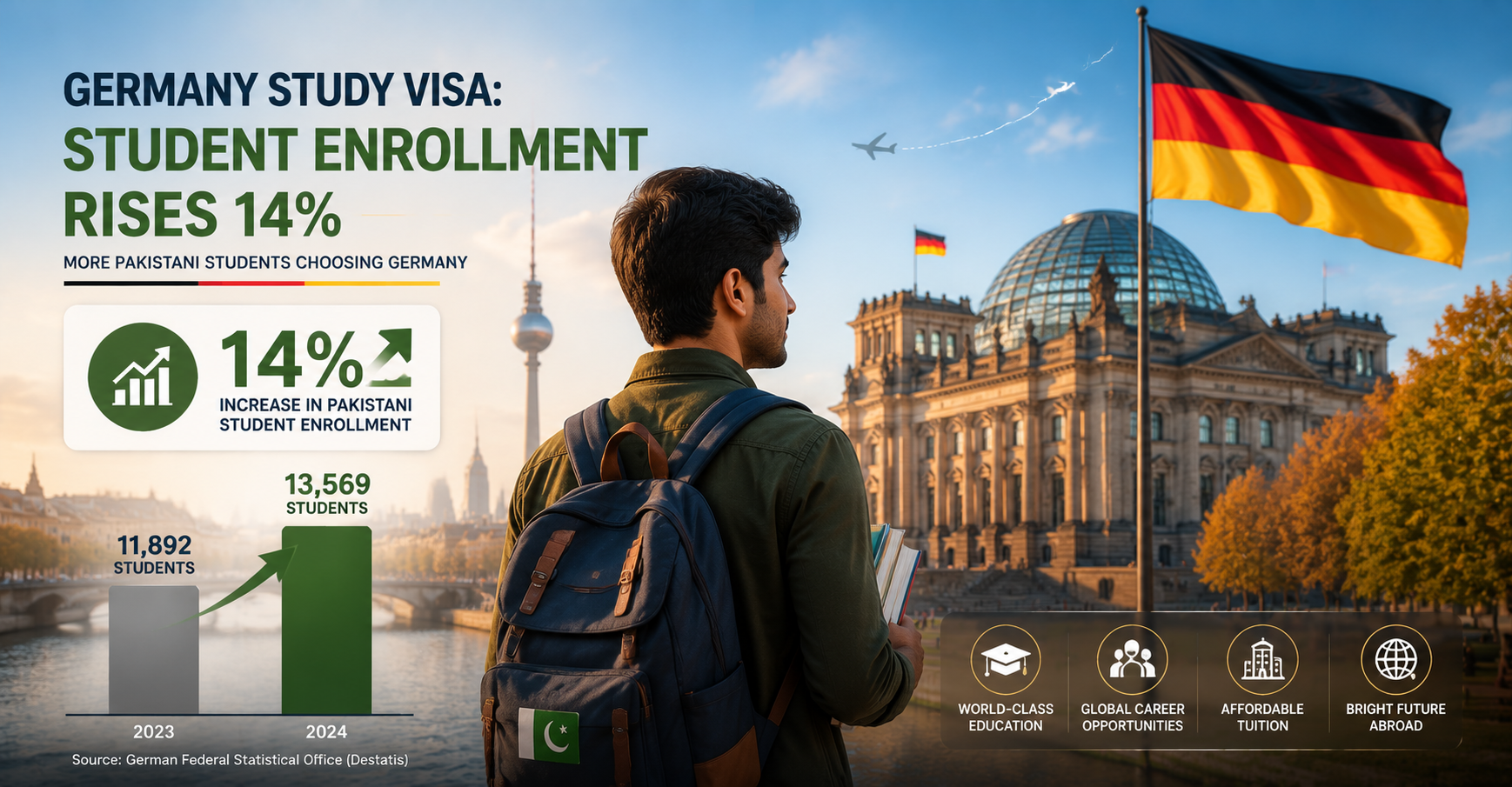
  • Enrollment Surge Recorded: The total number of Pakistani students moving to Germany has expanded by 14 percent over the past two years.

  • Academic Talent Praised: Germany’s Head of Consular Affairs in Islamabad, Kai Rutzberger, highly commended the intelligence and professional ambition of the applicants.

  • Fraud Warning Issued: Crucially, the embassy warned applicants against hiring unofficial consultants, clarifying that major German universities never utilize admission agents.

  • Official Portals Emphasized: Prospective applicants must rely strictly on official embassy channels and university websites to complete their visa documentation safely.

ISLAMABAD – A notable shift in international education trends has emerged as the volume of Pakistani students moving to Germany shows strong upward momentum. According to Kai Rutzberger, Germany’s Head of Consular Affairs in Islamabad, student numbers spiked by 14 percent compared to the previous two years.

Rutzberger strongly praised the incoming scholars, describing them as highly intelligent individuals who excel at premier universities while aggressively pursuing global career paths. Furthermore, German officials highlighted a significant rise in language proficiency, noting that an increasing number of local applicants are successfully mastering the German language before departure.
pakistani-students-moving-to-germany-growth-2026

This Image is Ai generated and used for Illustration purposes only.

Embassy Warns Against Third-Party Admission Agents

Despite the positive growth, consular authorities issued a strict advisory regarding the university application process. Specifically, Rutzberger clarified that reputable German higher education institutions do not collaborate with middle-men or external agencies to grant admissions.

Consequently, applicants must avoid paying unauthorized consultants who falsely promise guaranteed placement. Instead, the embassy urges students to manage their applications independently, verifying all institutional prerequisites through verified, direct channels to protect themselves from financial scams.

German Academic Migration Indicators

Migration Metric Current Status & Trend (Data Up to July 2026)
Two-Year Growth Rate 14% increase in student visa arrivals
Language Trend Growing proficiency in the German language
Admission Channel Direct university application only (No agents permitted)
Primary Resource Official German Embassy Islamabad website

Streamlined Visa Compliance and Procedures

To facilitate smooth transitions, the German Embassy maintains updated visa regulations directly on its digital portal. Officials stress that reviewing these public guidelines remains the most effective way to avoid administrative delays.

Therefore, students must systematically gather required documentation, satisfy specific academic criteria, and adhere strictly to the formal visa timeline. By bypassing unverified third parties and utilizing official embassy checklists, candidates can efficiently navigate the immigration process while securing legitimate access to Germany’s research sectors.

Why are more Pakistani students moving to Germany?

Applicants are increasingly drawn to Germany due to its world-class research facilities, tuition-free public universities, and strong post-graduation career opportunities.

Can an educational agent guarantee admission to a German university?

No. The German Embassy explicitly stated that top-tier German universities do not work with agents. Any claims of guaranteed admission through a consultant are fraudulent.

Where can students find reliable information on German study visas?

Complete, verified instructions regarding documentation, financial requirements, and interview scheduling are available exclusively on the official website of the German Embassy in Islamabad.

Read More : Pakistan wins three medals in Physics Olympiad.

Continue Reading

Education

Pakistan wins three medals in Physics Olympiad

Published

on

Physics Olympiad: Pakistan Wins Three Medals
The image is AI-generated and used for illustration purposes only

Key Points:

  • Medal Haul Achieved: The national team recorded a brilliant Pakistan International Physics Olympiad success by winning three Bronze Medals. Additionally, they secured two Honorable Mentions at the 56th IPhO in Colombia.

  • Top Performers Honored: Bronze medals went to Zulfiqar Ali, Ali Hamdan Alvi, and Daniyal Shahzad Hamid. Meanwhile, Hazza Mahmood and Abdullah Ejaz earned Honorable Mentions.

  • Rigorous Talent Pipeline: The Higher Education Commission (HEC) and PIEAS selected the students. Furthermore, they prepared them through the National Science Talent Contest (NSTC).

  • Historical Milestone: This triumph increases Pakistan’s historical tally to 144 medals. Consequently, it marks a significant achievement across various International Science Olympiads.

ISLAMABAD – Pakistan has achieved an outstanding milestone in global science education. Specifically, the nation is celebrating a major Pakistan International Physics Olympiad success at the 56th International Physics Olympiad (IPhO). The competition took place in Bucaramanga, Colombia. Ultimately, the event concluded with the Pakistani delegation securing three Bronze Medals and two Honorable Mentions.

Physics Olympiad: Pakistan Wins Three Medals

The image is AI generated and used for illustration purposes only

The three prestigious bronze medals were claimed by three talented students. First, Zulfiqar Ali won from Government City Boys School in Dera Ghazi Khan. Next, Ali Hamdan Alvi succeeded from FG Sir Syed College in Rawalpindi. Finally, Daniyal Shahzad Hamid triumphed representing The Science School in Rawat, Islamabad. Furthermore, Hazza Mahmood of Aitchison College and Abdullah Ejaz from Siddeeq Public School received Honorable Mentions. This demanding global event drew over 400 exceptional young minds from more than 90 countries.

Elite Selection Process and Rigorous Training Camp Framework

The exceptional journey to this global accolade began locally through the 22nd National Science Talent Contest (NSTC). This specialized talent hunt runs under the umbrella of the STEM Careers Program. Therefore, it functions as a collaborative initiative between the Higher Education Commission (HEC) and PIEAS.

To ensure optimal performance on the global stage, the selected finalists underwent intense preparation. Specifically, they participated in multiple rounds of intensive residential training camps held at the PIEAS campus. During these academic camps, the young physicists received advanced theoretical instruction. Moreover, they gained experimental guidance from premier national and international experts. Consequently, this comprehensive preparation allowed the group to match the performance of international peers. The team was led by PIEAS mentors Prof. Dr. Muhammad Irfan and Dr. Muhammad Waseem.

Pakistan International Science Olympiad Performance Metric

Competitive Metric Status & Historical Output (Up to July 2026)
56th IPhO Medal Count 3 Bronze Medals, 2 Honorable Mentions
Historical Medal Tally 144 Medals won across all International Science Olympiads
Total Global Representatives More than 365 Pakistani students sent abroad since inception
National Training Impact Over 5,000 students trained across 256 advanced camps
Physics Program Center Pakistan Institute of Engineering and Applied Sciences (PIEAS)

Institutional Backing and Long-Term Socio-Economic Focus

Operating under the institutional supervision of the Pakistan Atomic Energy Commission (PAEC), PIEAS actively conducts the NSTC on an annual basis. The nationwide search targets high-potential students from diverse backgrounds. For example, it includes students studying in Class 9, Class 10, O-Level, F.Sc, and A-Level frameworks across 19 major Pakistani cities.

The overarching educational framework relies on dedicated home institutes to manage distinct disciplines. For instance, NIBGE-C handles Biology. Meanwhile, the HEJ Research Institute of Chemistry at the University of Karachi oversees Chemistry. Similarly, COMSATS University Islamabad manages Mathematics. Pakistan first entered the International Physics Olympiad in 2001. Subsequently, the state expanded its participation into Mathematics in 2005. This was followed by entry into Biology and Chemistry in 2006. Through these systematic pipelines, PAEC continues to cultivate technical expertise to support the country’s socio-economic development.

What recent milestone marks the Pakistan International Physics Olympiad success?

The national team successfully won three Bronze Medals. In addition, they secured two Honorable Mentions while competing against 400 participants from 90 countries at the 56th IPhO in Colombia.

Which institutional bodies manage this science talent pipeline?

The program runs as a joint effort between the Higher Education Commission (HEC) and PIEAS. Furthermore, it operates under the broader supervision of the Pakistan Atomic Energy Commission (PAEC).

How long has Pakistan competed in these international science contests?

Pakistan initiated its participation in the Physics Olympiad back in 2001. Subsequently, the state expanded its footprint into Mathematics in 2005, followed by Biology and Chemistry in 2006.

Read More: MUN NOVA and Upfront here’s what you need to know

Continue Reading

Education

Shariah crypto debate: Mufti Muneeb Clarifies Stance

Published

on

pakistan-cryptocurrency-shariah-debate-mufti-muneeb
This Image has been generated using Ai

Key Points:

  • Mufti Muneeb Steps In: Senior Islamic scholar Mufti Muneeb-ur-Rehman has taken center stage by clarifying that he has not issued a final religious ruling on digital currencies.

  • Gold Stance Made Clear: While remaining neutral on crypto, Mufti Muneeb explicitly categorized modern gold trading practices as wrong.

  • Contrasting Fatwa: Concurrently, prominent scholar Mufti Muhammad Taqi Usmani officially declared cryptocurrency purchases and trading impermissible under Islamic law.

  • Regulator Engagement: Following the decree, Pakistan Virtual Assets Regulatory Authority (PVARA) Chairman Bilal Bin Saqib met with Mufti Taqi Usmani to advocate for nuanced, tech-specific evaluations.

LAHORE – A major discussion regarding digital finance has emerged as the Pakistan cryptocurrency Shariah debate gains significant momentum across the country. In a recent interview, senior Islamic scholar Mufti Muneeb-ur-Rehman shifted the conversation by clarifying that he has not yet issued a definitive religious verdict declaring cryptocurrency either permissible or impermissible.

However, Mufti Muneeb explicitly categorized modern gold trading practices as wrong. Addressing broader Islamic investments, Mufti Muneeb emphasized that Muslims must strictly invest in businesses free from prohibited activities like alcohol, pork, and narcotics. He noted that because modern financial markets remain highly complex, scholars must utilize rigorous Shariah screening criteria to properly evaluate compliance.
pakistan-cryptocurrency-shariah-debate-mufti-muneeb

Contrasting Edicts and Regulatory Dialogues

The theological landscape grew more defined after renowned scholar Mufti Muhammad Taqi Usmani issued a detailed fatwa against virtual currencies. Specifically, the decree declared cryptocurrency trading and purchases impermissible under Islamic law.

According to the fatwa, digital tokens and stablecoins fail to meet the foundational Shariah definition of wealth ($maal$). Consequently, the ruling considers these assets to be entries of virtual numbers, making their use for commercial payments invalid.

Timeline of Key Developments

[July 2026] ➔ Mufti Taqi Usmani issues detailed fatwa declaring crypto impermissible. 
 │  
[July 2026] ➔ PVARA Chairman Bilal Bin Saqib holds constructive meeting with Mufti Usmani. 
 │ 
[Current] ➔ Mufti Muneeb-ur-Rehman's prominent position adds a new layer to the debate. 

Technical Regulation Versus Traditional Jurisprudence

This strict religious ruling prompted immediate action from state regulators working to integrate fintech into the formal economy. Specifically, Pakistan Virtual Assets Regulatory Authority (PVARA) Chairman Bilal Bin Saqib held a constructive meeting with Mufti Taqi Usmani to discuss the legal framework.

During the dialogue, Saqib argued that blockchain-based assets, stablecoins, and tokenized real-world assets represent a wide spectrum of distinct technologies. Therefore, he maintained that they deserve separate technical and Shariah evaluations rather than a single blanket prohibition. Ultimately, the newly highlighted perspective from Mufti Muneeb-ur-Rehman adds a highly anticipated layer of complexity to the ongoing state discussions surrounding non-fiat financial assets.

Did Mufti Muneeb-ur-Rehman ban cryptocurrency?

No. Unlike his definitive stance against gold trading, Mufti Muneeb clarified that he has withheld a final, clear religious ruling regarding the permissibility of cryptocurrency.

What is the core issue in the Pakistan cryptocurrency Shariah debate?

The central conflict revolves around whether digital currencies qualify as wealth ($maal$) under Islamic law, or if they are simply speculative, fictitious numbers lacking intrinsic value.

What was the conclusion of the meeting between PVARA and Mufti Taqi Usmani?

While the religious decree remains unchanged, both sides agreed on the fundamental goal of protecting citizens from financial fraud. The PVARA chief advocated for continued dialogue to evaluate different blockchain applications individually.

Read More : Mufti Taqi Usmani declares crypto haram in new Fatwa.

Continue Reading

Education

BSEK declares Karachi Board Matric Science Group result 2026

Published

on

Key Points: 

  • Official Release: The Board of Secondary Education Karachi (BSEK) announced the SSC Part 2 Science Group results on Friday, July 10, 2026. 
  • Pass Percentage: The annual examinations recorded an overall passing rate of 80.87%. 
  • Top Performance: Muhammad Azlan Syed secured the first position overall by scoring an impressive 1040 marks. 
  • Access Methods: Consequently, students can now verify their scores online via roll number, search the official gazette, or use the SMS service. 

LAHORE – The Board of Secondary Education Karachi (BSEK) has officially declared the highly anticipated Karachi Board Matric Science Group Result 2026. Under the direct supervision of Chairman Professor Sharaf Ali Shah, the annual examination metrics were compiled at the board’s main office. According to the official statistics released by the department, a total of 175,200 students actively participated in the examination cycle. 

Out of the total appearing candidates, 141,868 students successfully cleared their papers, whereas 29,655 candidates were unable to secure passing marks. Additionally, official records indicate that 952 students remained completely absent during the testing session. Therefore, the overall transition into higher secondary education remains robust with a clear majority passing through. 

Official Merit List and Position Holders 

Following the general statistical summary, Controller of Examinations Ahmed Khan Chhutto unveiled the highly competitive merit list for the top-performing students. The board announced that special certificates and prestigious academic awards will be presented to these high achievers during an upcoming official ceremony. 

Top 3 Position Holders 

Position  Student Name  Total Marks  Percentage  Final Grade 
1st Place  Muhammad Azlan Syed  1040  94.55%  A1 Grade 
2nd Place  Rida Ramdan  1034  94.00%  A1 Grade 
3rd Place  Aisha Adnan  1033  93.91%  A1 Grade 

Multiple Channels for Verification 

Because high web traffic can occasionally slow down digital platforms, BSEK has provided several official pathways for students to view their scores seamlessly. 

Verification by Roll Number 

Students can immediately view their transcript by visiting the official BSEK portal (www.bsek.edu.pk). First, navigate directly to the dedicated results tab. Next, select the “SSC Part 2 Science Group Result 2026” option from the drop-down menu. Finally, input your unique roll number and click submit to render the mark sheet. 

Verification by Name and Gazette Download 

Alternatively, individuals can search for details using their full name, father’s name, or associated academic institution. For this method, the complete Karachi Board Matric Result Gazette 2026 will be made available in a downloadable PDF format directly on the BSEK website. 

Verification via Mobile SMS 

Furthermore, for students facing internet connectivity issues, the board activates an offline SMS service. To use this feature, simply type your roll number according to the official BSEK format and send it to the designated shortcode provided by the board to receive an instant message response. 

What is the overall pass percentage for the 2026 Matric Science Group? 

The overall pass percentage for this batch stands at 80.87%, with over 141,868 students successfully clearing their matriculation requirements. 

How can I check my BSEK Karachi result if the official website is down? 

If the website experiences heavy traffic delays, you can download the official PDF gazette to search by name or text your roll number to the official BSEK SMS code. 

Who topped the Karachi Board Matric Science Group exams this year? 

Muhammad Azlan Syed clinched the first position overall by obtaining 1040 marks, finishing with an exceptional aggregate of 94.55%.  

Read More : Lahore orders urgent repair of 135 dangerous school buildings  

Continue Reading

About

Upfront influence about 20 million users and is the number one business and technology news network on the planet


© 2022 upfront. All Rights Reserved.

Trending

Copyright © 2026