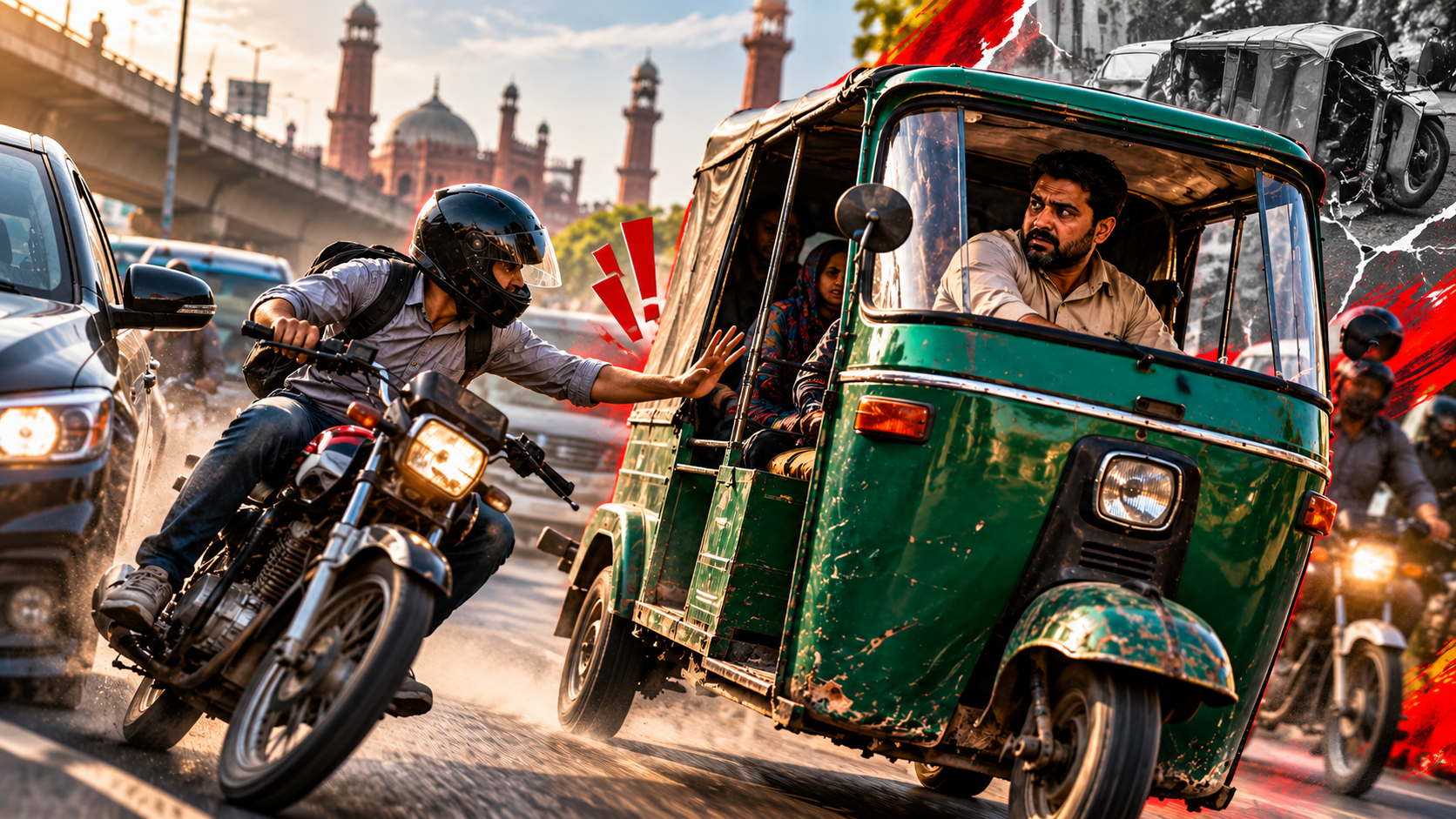
LAHORE – If you ride a bike in Pakistan, chances are you have had a close call with a rickshaw or Chingchi. Rickshaw accidents in Pakistan have become a major road-safety concern, especially for motorcyclists who have little protection in a crash.
However, the frustration surrounding three-wheelers raises a bigger question: are rickshaws really the problem, or is Pakistan failing to make its roads safer for everyone?
At first glance, the answer may seem obvious. Yet the available data tells a more complicated story. Motorcycles are involved in a huge share of road crashes, while medical research has also documented serious injuries involving Qingqi rickshaws.
More importantly, the real problem appears to involve reckless driving, poor training, overloading, weak enforcement and badly designed roads.
Why Are Rickshaw Accidents in Pakistan Becoming Such a Concern?
Spend a few minutes on almost any major Pakistani road and the problem becomes easy to understand.
A rickshaw stops suddenly to pick up a passenger. A Chingchi cuts across two lanes. A motorcycle tries to squeeze past. A car brakes to avoid the resulting chaos.
Sometimes everyone gets away with a scare.
Sometimes they do not.
For bikers, the risk is especially serious because they have little protection between their bodies and the road.
A car driver may leave a minor collision with a damaged bumper. A motorcyclist can be thrown directly onto the road.
This difference helps explain why many bikers have such a strong reaction to rickshaws and Chingchis.
Yet the data demands a more careful argument.
A rickshaw being involved in a crash does not automatically mean its driver caused it.
That distinction is important when discussing road safety.
Pakistan’s Road Accident Numbers Are Alarming
Punjab’s road safety figures show that the problem extends far beyond rickshaws.
Rescue 1122 data recorded 482,870 road traffic crashes across Punjab in 2025. The crashes resulted in 4,791 deaths and nearly 570,000 injuries. Fatalities increased by 19 per cent compared with 2024.
Lahore recorded 88,743 crashes, the highest number among Punjab’s districts.
Motorcycles were involved in approximately 75 per cent of crashes across the province. Cars accounted for 8.6 per cent, while rickshaws accounted for 4.7 per cent.
Punjab’s 2025 Road Accident Picture
| Category |
Figure |
| Road crashes |
482,870 |
| Deaths |
4,791 |
| Injuries |
Nearly 570,000 |
| Lahore crashes |
88,743 |
| Motorcycle involvement |
75% |
| Car involvement |
8.6% |
| Rickshaw involvement |
4.7% |
These figures reveal something important.
Rickshaw accidents in Pakistan are part of a much bigger road-safety crisis.
Motorcycles are actually far more heavily represented in the crash data.
That means any serious road-safety policy must protect bikers while also addressing dangerous behavior among every category of road user.
Chingchi Rickshaws Have a Documented Safety Problem
The concerns surrounding Chingchis are not based only on frustrated motorists.
Medical researchers have studied injuries linked to Qingqi motorcycle rickshaws in Pakistan.
A study at Mayo Hospital in Lahore examined 356 patients injured in Qingqi-related road crashes over six months.
Researchers found that overturning accounted for 47.2 per cent of the serious injuries studied. Head-on collisions accounted for another 38.4 per cent.
The study also recorded 46 pedestrians among the injured.
Three patients suffered mangled limb injuries that required amputation.
The research found lower-limb injuries to be the most common injury pattern.
Head and spinal injuries were also recorded.
These findings show why rickshaw accidents in Pakistan cannot simply be dismissed as minor traffic incidents.
Some crashes can leave victims with permanent disabilities.
Pakistan’s Road Accident Numbers Are Alarming
Punjab’s road safety figures show just how serious the wider problem has become.
According to Rescue 1122 data, 482,870 road traffic crashes were recorded across Punjab in 2025. These crashes resulted in 4,791 deaths and nearly 570,000 injuries.
Meanwhile, Lahore recorded 88,743 crashes, the highest number among Punjab’s districts.
Motorcycles were involved in approximately 75 per cent of crashes across the province. By comparison, cars accounted for 8.6 per cent and rickshaws accounted for 4.7 per cent.
These figures provide important context. Although rickshaw accidents in Pakistan remain a concern, the data does not show that rickshaw drivers cause most crashes.
Instead, motorcycles clearly represent the biggest category in the available figures. Therefore, any serious road-safety policy must protect bikers while also addressing dangerous behaviour among every category of road user.
Overloading Makes the Problem Worse
Research from Karachi provides another important warning.
A study examining 486 Qingqi-related injuries found that collisions with moving vehicles were the most common cause, accounting for 56 per cent of cases.
Overloading with more than two passengers was recorded in 28.5 per cent of cases.
Researchers identified overloading and rollover during turning as the most common contributing factors, together accounting for 61 per cent in their analysis.
The victims included passengers as well as other road users.
Students represented 21 per cent of the injured people in the study, while laborers and daily wage workers accounted for 45 per cent.
This matters because rickshaws are not simply vehicles.
For many people, they are essential public transport.
Making them safer therefore protects both passengers and everyone travelling around them.
So Why Do Bikers Blame Rickshaws?
There is a simple reason for much of the anger.
Bikers have far more to lose in a collision.
For instance, a sudden rickshaw turn can leave a motorcycle rider with almost no time to react. As a result, the rider may fall directly into the path of another vehicle.
At the same time, many motorists complain about three-wheelers that stop suddenly, change lanes without warning or overtake from dangerous positions.
Other common complaints include:
- stopping suddenly to pick up passengers
- changing lanes without indicators
- overtaking from dangerous positions
- making sudden turns
- driving against traffic
- carrying more passengers than permitted
- ignoring traffic signals
- stopping in moving lanes
- driving aggressively in congested areas
Nevertheless, it would be unfair to suggest that every rickshaw driver behaves this way.
The bigger concern is that even a relatively small number of reckless drivers can create serious risks on crowded roads.
But Rickshaw Drivers Are Not the Only Problem
This is where the conversation needs some honesty.
Pakistan’s traffic culture has problems across almost every category of road user.
Motorcyclists speed.
Cars change lanes without indicators.
Pedestrians cross busy roads wherever they find a gap.
Drivers use mobile phones.
Motorcyclists sometimes ride against traffic.
Traffic signals are ignored.
So blaming one category of driver will never solve rickshaw accidents in Pakistan.
The objective should be to make dangerous behavior unacceptable regardless of who is responsible.
Enforcement Data Shows Another Warning Sign
Punjab Transport Company’s enforcement data provides another important piece of the puzzle.
During 2025, the organisation issued 48,202 challans to public-service vehicle operators for violations involving route permits, fitness certificates, driving licences, illegal public-service vehicles, overcharging and other issues.
Among them, motorcycle rickshaws received 15,687 challans, while four-stroke rickshaws accounted for another 9,144.
These numbers do not prove that the drivers involved caused crashes. However, they do show that compliance among public-service vehicles remains a significant concern.
More importantly, the figures suggest that enforcement alone cannot be the answer. Drivers also need proper training so they understand why certain behaviours are dangerous.
Should Pakistan Ban Chingchi Rickshaws?
The easiest answer is yes.
The practical answer is much more complicated.
Millions of Pakistanis use rickshaws because they are affordable and flexible.
They operate in places where formal public transport does not always reach.
Remove them without creating alternatives and the passengers do not disappear.
They still need to reach work.
They still need to reach schools and colleges.
They still need to visit hospitals and markets.
The demand for cheap transport remains.
If thousands of rickshaws disappear overnight, that demand could shift towards motorcycles, vans or other informal transport.
That may simply create a different safety problem.
Pakistan Already Has Rules for Qingqi Rickshaws
This is perhaps the most overlooked part of the debate.
Pakistan does not have to invent an entirely new system.
The Supreme Court ruled in 2017 that Qingqi rickshaws operating on public roads must comply with legal safety and registration requirements.
The court directed authorities to ensure that approved Qingqis have fitness and roadworthiness certificates, registration, route permits and licensed drivers.
It also set a maximum seating capacity of four passengers excluding the driver.
The problem, therefore, is not simply the absence of rules.
It is whether those rules are consistently enforced.
How Can Pakistan Reduce Rickshaw Accidents?
Simply banning rickshaws may sound like an easy solution. In reality, it would create another problem.
Millions of Pakistanis rely on rickshaws because they are affordable and flexible. In many areas, they also fill gaps left by formal public transport.
Therefore, removing them without providing alternatives would not eliminate the demand for cheap transportation.
Instead, reducing rickshaw accidents in Pakistan requires a combination of education, enforcement and better infrastructure.
The first step should be compulsory training for commercial drivers.
Education Could Save More Lives Than a Ban
There is a tendency to believe that punishment alone changes behavior.
It rarely does.
A driver who does not understand why a particular maneuver is dangerous may repeat it after paying a fine.
Training can change that.
Imagine a mandatory road-safety programme where every commercial rickshaw driver learns what happens when a motorcycle enters a blind spot.
Show them crash footage.
Show them injury data.
Teach them how quickly a motorcycle can disappear from their mirrors.
Then test whether they have actually learned the lesson.
That is not an unrealistic solution.
It is an investment in lives.
Motorcyclists Need Education Too
The same standard must apply to bikers.
The statistics make that unavoidable.
Motorcycles accounted for around 75 per cent of road crashes in Punjab in 2025, according to Rescue 1122 data.
Motorcyclists need better awareness about speed, helmets, wrong-way driving, lane discipline and dangerous overtaking.
A safer road cannot be built by teaching only one group.
Everyone has to change.
The Real Enemy Is Reckless Driving
This is where Pakistan’s road debate often goes wrong.
We blame the vehicle instead of the system.
A rickshaw is not dangerous simply because it has three wheels.
A motorcycle is not dangerous simply because it has two.
A car is not automatically safe because it has four.
The real danger appears when vehicles, people and infrastructure interact badly.
A poorly trained driver in a poorly maintained vehicle, operating on a badly designed road while ignoring traffic rules, is a recipe for disaster.
That driver could be behind a steering wheel, a motorcycle handlebar or a rickshaw.
Pakistan Cannot Afford to Treat Traffic Deaths as Normal
Nearly 4,800 people died in road crashes across Punjab in 2025.
Hundreds of thousands were injured.
Those are not just statistics.
Every number represents someone who did not return home, someone who spent months recovering or someone whose life changed permanently after a crash.
The anger of Pakistani bikers is therefore understandable.
When someone suddenly cuts across your path, you are not simply annoyed.
You are aware that a mistake could put you in an ambulance.
But anger should lead to better policy, not blanket hatred of an entire profession.
Pakistan Does Not Need a War Against Rickshaws
The debate around rickshaw accidents in Pakistan should ultimately be about one thing: saving lives.
That does not necessarily require banning rickshaws. Instead, authorities should make sure that the people operating them are properly trained, licensed and held accountable.
At the same time, vehicles must remain roadworthy, passenger limits must be enforced and proper stopping points should be created.
Motorcyclists and car drivers must also follow the same rules.
After all, the person riding a motorcycle, the family inside a car and the passengers sitting in a rickshaw all have something in common.
They are all trying to get home safely.
Pakistan’s goal should therefore not be fewer rickshaws. It should be fewer reckless drivers, safer roads and fewer families waiting for someone who never comes home.
Key Points:
- Rickshaw accidents in Pakistan are part of a much wider road-safety crisis.
- Punjab recorded 482,870 road crashes in 2025 and 4,791 deaths.
- Around 75 per cent of Punjab crashes involved motorcycles.
- Rickshaws accounted for 4.7 per cent of crashes in the cited Punjab data.
- A Lahore study recorded 356 Qingqi-related injury cases over six months.
- Overturning and head-on collisions were major causes of serious injuries in that study.
- Karachi research linked Qingqi injuries with collisions, overloading and rollovers.
- Punjab Transport Company issued 15,687 challans to motorcycle rickshaws in 2025.
- The Supreme Court has already established safety, registration, fitness and licensing requirements for Qingqi rickshaws.
- Better training, licensing, enforcement, vehicle inspections and road design could reduce crashes without eliminating an important source of affordable transport.
Read More:
For more such exclusive articles, follow Upfront .