Connect with us

Sci&Tech

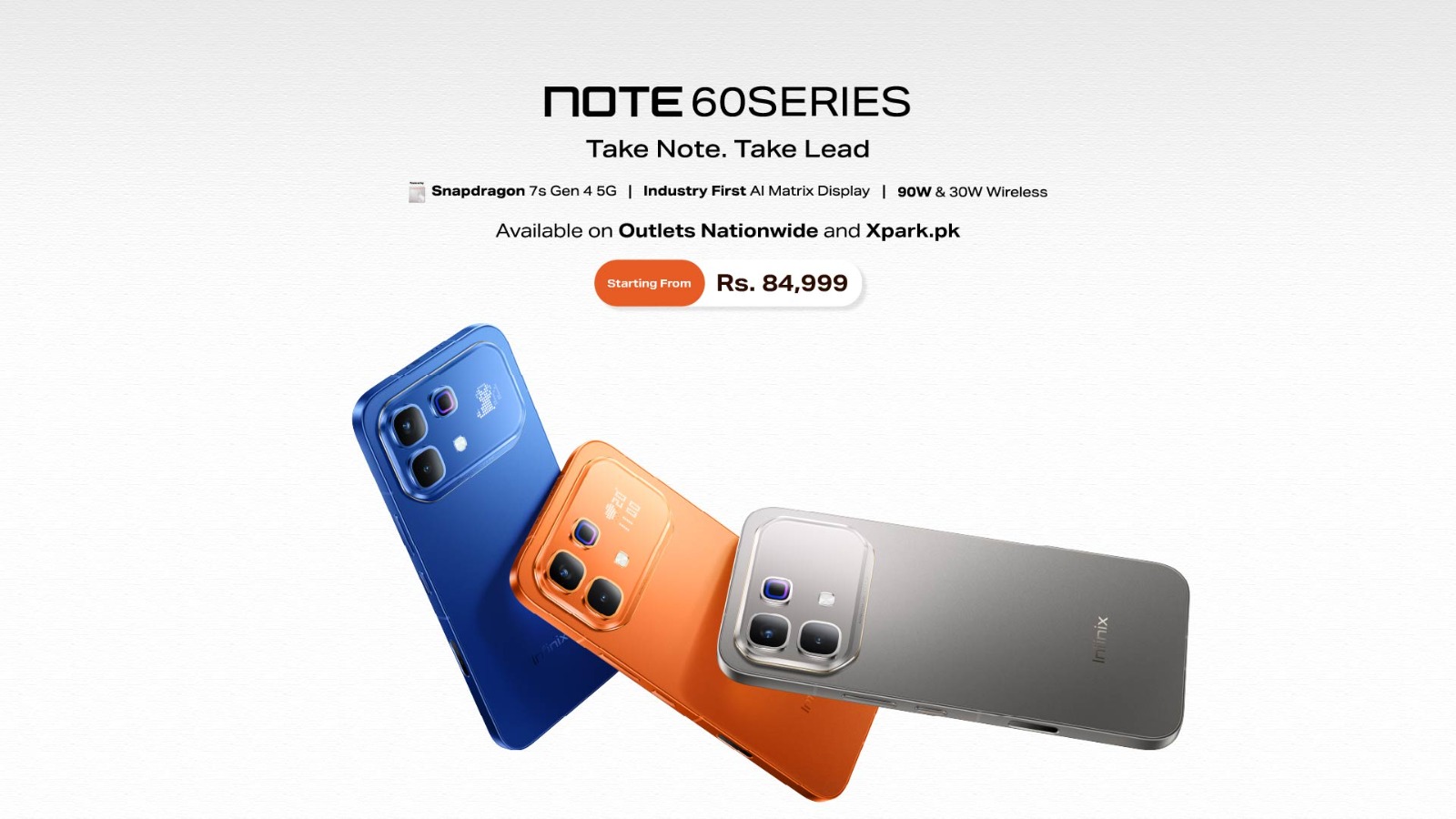
Infinix launches Note 60 series with Snapdragon integration, now available nationwide and on Xpark.pk

Published

on

Lahore – Infinix, a top smartphone brand in Pakistan, proudly introduces the highly awaited NOTE 60 Series. It features their first Snapdragon 7s Gen 4 processor and 5G connectivity—a significant upgrade that boosts performance, provides ultra-fast speeds, and sets new standards for smartphones. The Infinix NOTE 60 Series, priced at PKR 84,999/-, is now available nationwide at retail outlets and online on Xpark.pk.

At the heart of the NOTE 60 Series lies cutting-edge performance, powered by the advanced Snapdragon 7s Gen 4 chipset, marking a significant milestone as one of the first Infinix devices to integrate Snapdragon technology. Paired with 5G connectivity, the NOTE 60 Series ensures faster speeds, enhanced efficiency, and seamless multitasking, aligning perfectly with Pakistan’s growing 5G ecosystem and the evolving digital needs of modern users.

The NOTE 60 Series introduces the revolutionary AI Matrix Display, redefining how users interact with their smartphones. This intelligent interface goes beyond conventional notifications, offering personalized visual cues, customizable signatures, intuitive icons, and interactive features such as Pixel Pets and Matrix Miniplay games.

From subtle reminders to dynamic expressions, the AI Matrix Display transforms everyday interactions into a more engaging and meaningful experience.
Enhancing the overall user experience, the NOTE 60 Series is equipped with exceptional charging capabilities that keep up with fast-paced lifestyles. Featuring 90W ultra-fast wired charging, the device powers up in minutes, minimizing downtime and ensuring users stay connected throughout the day.

Complementing this is the convenience of 30W wireless charging, offering a seamless and cable-free power experience. Together, these advanced charging solutions provide both speed and flexibility, making the NOTE 60 Series a reliable companion for users who are always on the move.

Speaking on the launch, Simong Feng CEO Infinix Pakistan, said, “With the NOTE 60 Series, we are introducing a device built for Pakistan’s fast-evolving digital landscape—one that keeps pace with today’s youth while empowering them to do more and lead with confidence. With 5G connectivity and AI-driven experiences, it enables users to stay ahead, express themselves, and take control of their everyday journey in a more connected world”

With the NOTE 60 Series, Infinix continues its commitment to delivering innovation that is accessible, relevant, and impactful. As Pakistan moves towards a more connected and digitally empowered future, the NOTE 60 Series stands as a reliable companion for those ready to take the lead.
The Infinix NOTE 60 Series is now available nationwide, inviting users to experience a new era of intelligent performance and self-expression.


Sci&Tech

All about OnePlus, Realme software merger with Oppo’s ColorOS

Published

on

The image is AI-generated and used for illustration purposes only

KARACHI – OnePlus, Oppo and Realme could move towards closer software integration, with OxygenOS and Realme UI expected to be unified under Oppo’s ColorOS platform, according to a new report.

The development follows a decision announced in 2021, when OnePlus co-founder Pete Lau said OxygenOS and ColorOS would be merged, bringing an end to OnePlus’ separate software development from Oppo.

According to the report, Oppo now plans to extend the integration by bringing Realme UI onto the same platform. If implemented, all three brands would share ColorOS as their common software base, a move reportedly aimed at reducing research and development costs and streamlining operations.

The report also claims that Realme could withdraw from the Chinese market to focus on international markets.

It further suggests that OnePlus and Realme are moving towards closer integration, with India expected to remain the only market where both brands continue operating independently. In other regions, the distinction between the two brands could become less significant.

The report adds that OnePlus is expected to concentrate its smartphone business on India and China.

Recent developments have fuelled speculation about the company’s strategy. OnePlus Germany has been directing customers to Oppo products, while most devices listed on the OnePlus UK website are currently unavailable.

In India, Oppo already manages after-sales services for OnePlus customers, reflecting the closer operational ties between the two companies.

The report does not specify how the reported changes could affect the United States market, where OnePlus has maintained a limited presence and Oppo has yet to establish a significant consumer footprint.

Neither Oppo, OnePlus nor Realme has officially commented on the reported plans.

Continue Reading

Sci&Tech

Has Android 17 brought LHDC bluetooth audio support to Google Pixel phones

Published

on

The image is AI-generated and used for illustration purposes only

KARACHI – Google has introduced support for the LHDC (Low Latency High-Definition Audio Codec) on Pixel smartphones with Android 17, giving users another option for high-quality wireless audio playback over Bluetooth.

LHDC is a Bluetooth audio codec developed to deliver higher-quality sound while maintaining low latency. Although the technology has been available since 2018 and is already supported by several Android brands, Android 17 marks its arrival on Google’s Pixel devices.

The codec was certified by the Japan Audio Society (JAS) for Hi-Res Audio Wireless in 2024, joining other high-quality Bluetooth codecs such as LDAC and aptX Adaptive.

High-quality audio over Bluetooth

LHDC supports multiple audio modes, including playback at up to 24-bit/96kHz on Google Pixel devices. Some Android smartphones from other manufacturers can support playback up to 24-bit/192kHz using compatible hardware.

However, despite its Hi-Res certification, LHDC does not provide true lossless high-resolution audio over Bluetooth. Bluetooth bandwidth limitations mean audio must still be compressed before transmission.

Like other advanced Bluetooth codecs, LHDC uses variable bitrates that can range from around 160 kbps to 1,000 kbps. The bitrate automatically adjusts depending on the quality of the wireless connection to reduce interruptions during playback.

Performance depends on connection quality

The quality of Bluetooth audio is influenced by environmental conditions, including wireless interference and the distance between connected devices.

As a result, LHDC can lower its bitrate in crowded or signal-heavy environments to maintain a stable connection. While this helps prevent audio dropouts, it may also reduce overall sound quality compared to ideal listening conditions.

Device compatibility

To use LHDC, both the smartphone and the connected audio device must support the codec.

Android smartphones from several Chinese manufacturers already offer LHDC support, and Android 17 now extends compatibility to Google’s latest Pixel devices. However, Samsung Galaxy smartphones and Apple’s iPhone lineup currently do not support the codec.

Similarly, not all wireless earbuds are compatible. Products such as the OnePlus Buds Pro series and Nothing Ear (2) support LHDC, while Google’s own Pixel Buds Pro 2 do not.

Users can verify or manually select the Bluetooth codec through Android’s Developer Options, although the operating system typically chooses the most suitable codec automatically.

Streaming and audio sources

LHDC can be used with locally stored FLAC files as well as high-resolution music streaming services. Even when listening to standard CD-quality or high-bitrate compressed audio, the codec can help preserve audio quality by reducing unnecessary recompression during Bluetooth transmission.

While Android 17’s addition of LHDC does not replace existing codecs such as LDAC or LC3, it expands compatibility with a wider range of wireless headphones and earbuds, offering Pixel users another option for high-quality Bluetooth audio.

Continue Reading

Sci&Tech

RAM, SSD price surge threatens cheaper PCs and smartphones

Published

on

KARACHI – Consumer memory and storage prices rose sharply during the second quarter of 2026 as ongoing supply constraints continued to affect key components used in smartphones, personal computers and other electronic devices.

According to data released by market research firm Sigmaintell, prices of several dynamic random-access memory (DRAM) and storage products recorded substantial quarter-on-quarter increases, extending a trend that began in the second half of 2025.

The average price of a 16Gb DRAM component rose from $19.20 in the first quarter to $28.50 in the second quarter, an increase of nearly 49 per cent. Meanwhile, the price of a 16GB DDR4 module climbed 51pc to $207.10 from $137.

Low-power memory products used in smartphones saw even steeper increases. A 32Gb LPDDR component rose 75pc to $45.90, while a 96Gb LPDDR5X component surged 89pc to $145.90, marking the largest increase among the DRAM products tracked in the report.

Storage products also recorded significant price increases. The cost of a 512GB PCIe Gen 4 NVMe SSD rose 54pc to $126.30, while 256GB UFS 3.1 storage more than doubled in price, increasing 103pc to $62.70. The price of a 16GB eMMC 5.1 component rose 69pc to $22.60.

The sharpest overall increase was reported for uMCP memory and storage packages, widely used in smartphones and tablets, whose price rose 107pc from $72.50 to $150.40.

Industry analysts attribute the shortages to a shift in manufacturing priorities by memory producers, many of whom have redirected production capacity towards higher-margin products such as high-bandwidth memory (HBM), server DRAM and enterprise-grade solid-state drives used in artificial intelligence data centres and cloud infrastructure.

The reallocation of production capacity has reduced supplies of consumer-focused memory products, including DDR, LPDDR and NAND flash components, contributing to sustained price increases across the electronics sector.

Manufacturers have already passed some of the higher costs on to consumers through increased prices for laptops, smartphones and gaming devices. Analysts warn that the supply-demand imbalance could persist for several years, with some forecasts suggesting shortages may continue until 2028.

As a result, memory and storage prices are expected to remain elevated, adding further pressure to the cost of consumer electronics worldwide.

Continue Reading

About

Upfront influence about 20 million users and is the number one business and technology news network on the planet


© 2022 upfront. All Rights Reserved.

Trending

Copyright © 2026