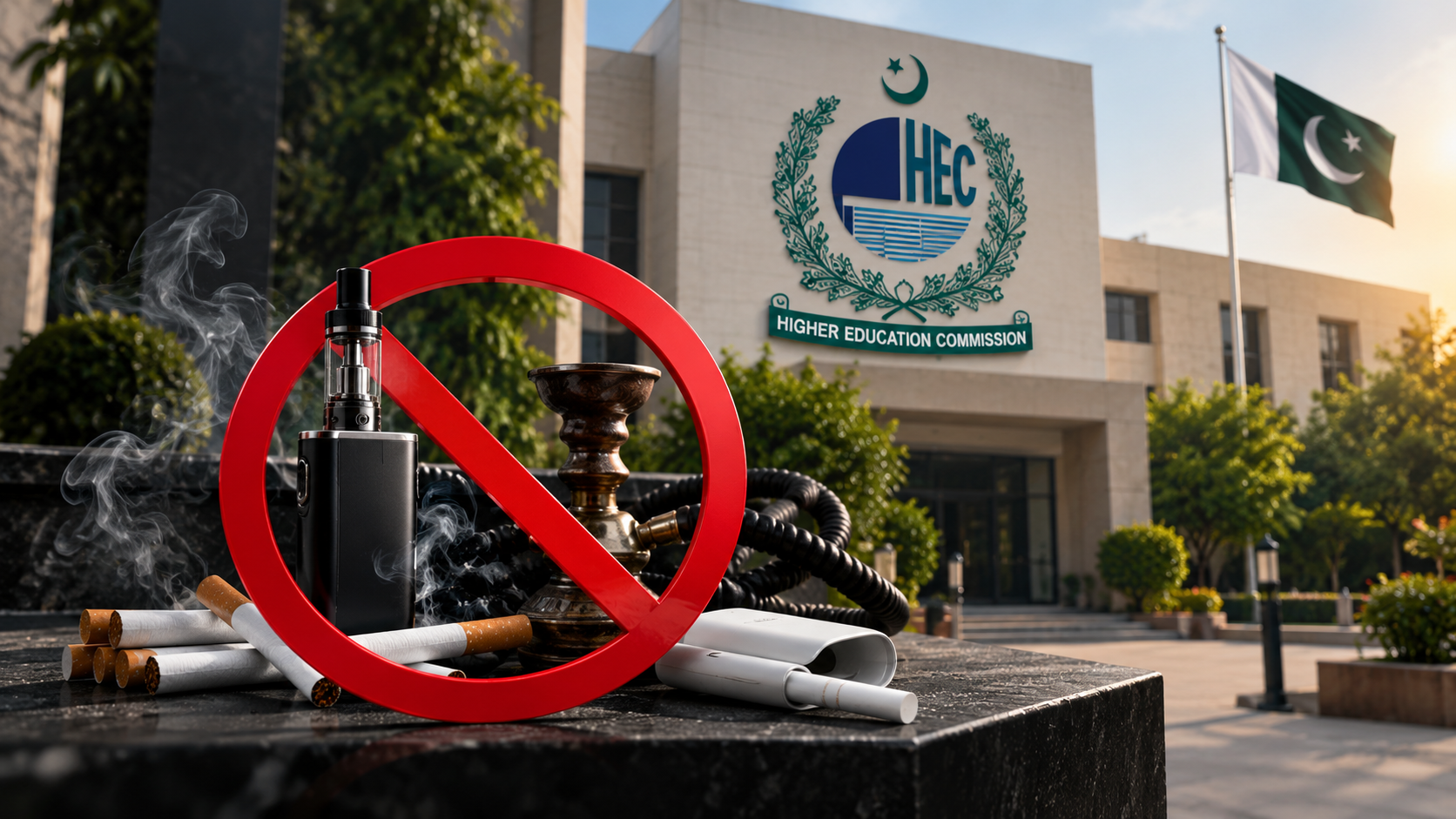
ISLAMABAD – The Higher Education Commission (HEC) has announced strict restrictions on smoking across its offices in Pakistan, extending the prohibition beyond indoor workplaces to guest houses and open areas within its premises.
The HEC smoking ban covers traditional cigarettes, electronic cigarettes, vapes, hookahs (sheesha), heated tobacco products and other forms of smoking.
The commission has warned that individuals violating the restrictions will face action, signaling a stricter approach towards maintaining smoke-free environments at its facilities.
The announcement comes as HEC continues engaging with universities across the country to strengthen existing restrictions on tobacco and nicotine products.
HEC Smoking Ban Covers More Than Just Cigarettes
The latest directions make clear that the prohibition is not limited to conventional tobacco smoking.
Employees, visitors and other individuals entering HEC premises are required to comply with restrictions covering several smoking products.
These include:
- Traditional cigarettes and other smoking tobacco products.
- Electronic cigarettes and vaping devices.
Unlike restrictions limited to enclosed workplaces, the latest HEC directions also cover outdoor spaces within the commission’s premises.
This means individuals cannot use cigarettes, vapes or sheesha in open areas simply because they are outside an office building.
HEC guest houses are also included in the prohibition.
What Happens If Someone Violates the HEC Smoking Ban?
The Higher Education Commission has warned that action will be taken against anyone found violating the restrictions.
The announcement applies to the commission’s offices and other covered facilities across Pakistan.
However, HEC has not publicly specified a new fine amount or a detailed disciplinary procedure for violations of this particular directive.
Individuals visiting or working at HEC facilities are therefore expected to follow the restrictions regardless of whether they are inside a building or in an open area within its boundaries.
The commission has called for cooperation in maintaining a clean and healthy environment.
HEC Contacts University Heads Across Pakistan
The smoking restrictions are part of HEC’s wider efforts to promote tobacco-free educational environments.
HEC Executive Director Professor Dr. Zia Ul Haq said the commission was in contact with the heads of higher education institutions (HEIs) across Pakistan.
According to him, the vast majority of these institutions have already prohibited various forms of smoking on their campuses.
The commission’s communication with university administrations is intended to reinforce measures aimed at reducing tobacco and nicotine use.
However, the latest announcement should not be interpreted as a newly introduced blanket smoking ban covering every university campus in Pakistan.
The restrictions announced for HEC’s own premises are distinct from the existing policies implemented by individual higher education institutions.
Are Cigarettes and Vapes Already Banned in Pakistani Universities?
HEC introduced its Policy on Drug and Tobacco Abuse in Higher Education Institutions in 2021 to address tobacco use and drug-related concerns across the country’s higher education sector.
The policy places responsibilities on public and private institutions to implement preventive measures, promote awareness and enforce relevant restrictions.
Several universities have introduced additional campus-level rules to prohibit smoking and vaping.
For example, the University of the Punjab has directed academic departments, administrative offices and campus authorities to maintain smoke-free and vape-free premises.
Its restrictions extend to classrooms, hostels, cafeterias, playgrounds, parking areas and other university facilities.
The university has also directed relevant authorities to monitor violations and take action under applicable rules.
Such measures demonstrate how higher education institutions are implementing tobacco-control policies within their campuses.
Why Is HEC Taking Action Against Vapes and Sheesha?
The inclusion of electronic cigarettes, vapes and sheesha reflects increasing concern about tobacco and nicotine consumption, particularly among young people.
Although vaping devices differ from conventional cigarettes, they can expose users to nicotine and other potentially harmful substances.
Nicotine dependence remains a significant public health concern, especially among adolescents and young adults.
Smoking and secondhand tobacco smoke are also associated with serious health risks, including cardiovascular and respiratory diseases.
By covering both conventional smoking products and newer alternatives, HEC aims to encourage healthier environments within its facilities.
The restrictions also support broader efforts to discourage tobacco and nicotine use in educational institutions.
HEC Pushes for Tobacco-Free University Campuses
The latest announcement follows recent discussions on strengthening tobacco-control measures in Pakistan’s higher education sector.
On October 20, 2026, HEC and the Health Services Academy organized a workshop titled “Protecting the Next Generation: Tobacco-and Nicotine-Free Campuses.”
The event brought together health experts, academic representatives and young participants to discuss strategies for reducing tobacco and nicotine use in educational institutions.
Participants raised concerns about vaping and other emerging nicotine products and discussed how universities could improve awareness and enforcement.
The workshop highlighted the need for practical measures that help maintain healthier educational spaces.
HEC’s latest smoking restrictions reinforce this broader focus on reducing exposure to tobacco and nicotine products.
Does the HEC Smoking Ban Apply to Everyone in Pakistan?
No. The latest announcement directly concerns HEC offices, guest houses and open areas within its own premises.
It does not mean that smoking or vaping has suddenly been prohibited in every public or private location across Pakistan.
Universities and other institutions remain subject to their applicable laws, HEC policies and institution-specific restrictions.
The distinction is important because different premises may have separate enforcement arrangements and penalties.
For visitors and employees at HEC facilities, however, the latest directions leave little room for confusion.
Smoking and vaping are prohibited throughout the covered premises, including outdoor areas.
HEC Calls for Cooperation on Smoke-Free Environment
The Higher Education Commission has urged individuals to support its efforts to maintain clean, healthy and smoke-free workplaces.
The commission has also reiterated its engagement with university leadership on discouraging smoking and nicotine use.
While the immediate HEC smoking ban applies to its own facilities, its wider initiatives continue to focus on encouraging tobacco-free environments across the higher education sector.
Employees and visitors are expected to comply with the latest restrictions, while institutions remain responsible for implementing their respective campus rules.
For now, HEC has made its position clear: cigarettes, vapes, sheesha and other smoking products are not permitted within its covered premises.
Key Points:
- HEC has announced strict smoking restrictions across its offices in Pakistan.
- The ban covers cigarettes, e-cigarettes, vapes, sheesha and heated tobacco products.
- Guest houses and open areas within HEC premises are also covered.
- The commission has warned that violators will face action.
- No new specific fine amount has been announced for this directive.
- HEC Executive Director Professor Dr. Zia Ul Haq said the commission is engaging with university heads.
- Most higher education institutions have already introduced smoking restrictions, according to HEC.
- The new office-wide directions are separate from HEC’s existing 2021 tobacco-control policy for universities.
Read More:
For more such exclusive articles, follow Upfront .