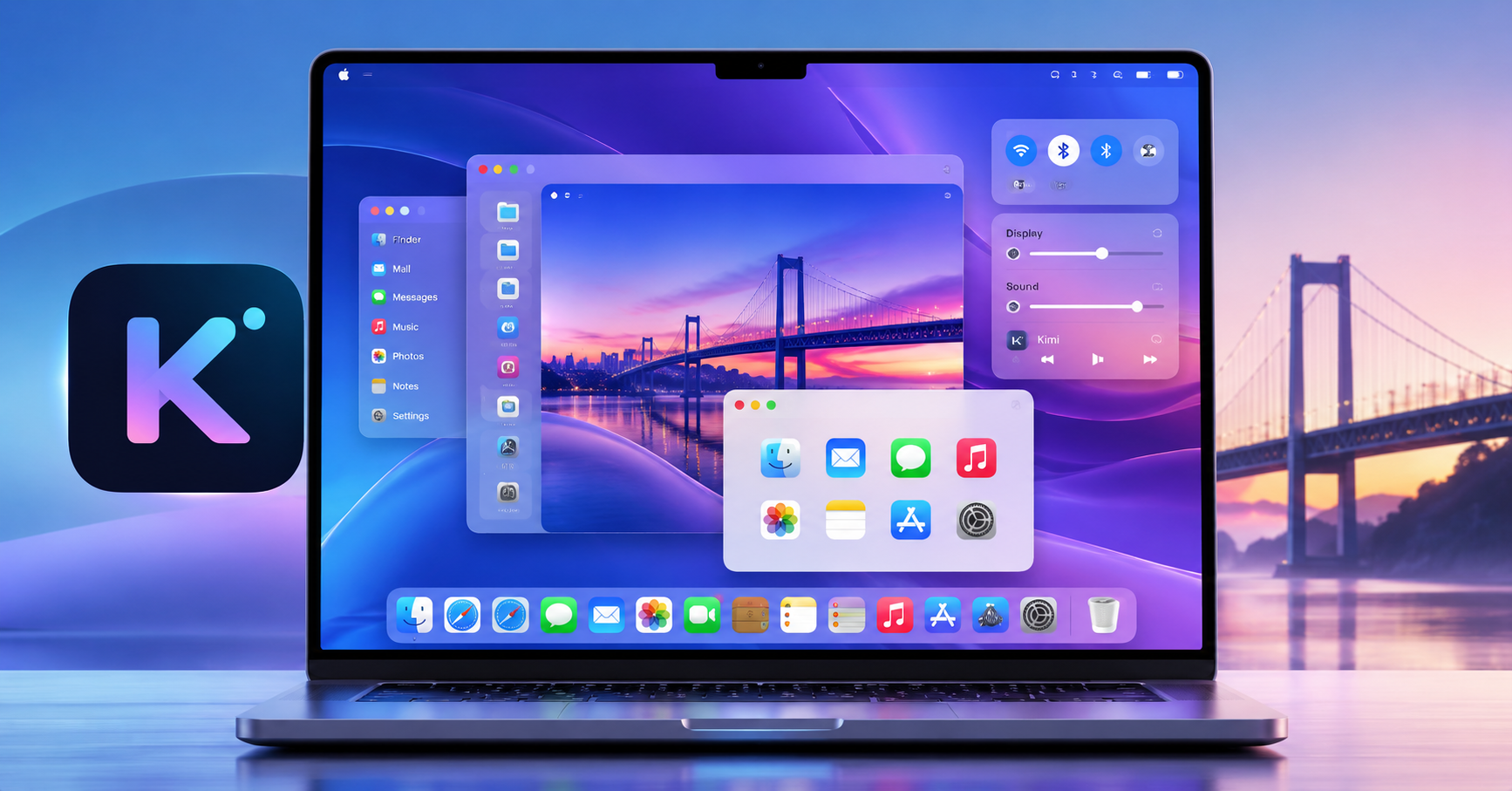
BEIJING – China’s latest artificial intelligence model, Kimi K3, is drawing global attention after successfully creating a functional macOS-style web application from a single user prompt, highlighting the rapid progress of AI-assisted software development.
The project was demonstrated by technology analyst Max Weinbach, who tasked Kimi K3’s Agent Swarm with recreating Apple’s upcoming macOS 27 “Golden Gate” interface. The request included Apple’s new Liquid Glass design language along with native-style applications that could run entirely within a web browser.
According to Weinbach, the AI completed the project in approximately three hours and 20 minutes, consuming nearly 60% of his monthly Kimi credits during the process.
Read more: How Is Load-Shedding Poisoning Pakistan’s Economy?
The completed demonstration showcased a browser-based operating system that closely resembles Apple’s macOS experience. It featured a desktop interface, windows, and working applications designed to imitate Apple’s upcoming visual style.
Browser-Based Simulation, Not Apple’s Operating System
Despite its realistic appearance, the project is not an actual version of macOS. Instead, it is a web application that recreates the look and feel of Apple’s desktop operating system inside a browser. It does not contain Apple’s proprietary operating system, kernel, or native system software.
The demonstration serves as an example of how advanced AI models can generate complete software experiences without replicating the underlying operating system.
Read more: China, South Korea and Singapore emerge as Asia-Pacific’s EV leaders
What Is Kimi K3?
Kimi K3 is the newest flagship AI model developed by Chinese startup Moonshot AI. The model is designed for complex coding tasks, long-running software projects, and autonomous AI workflows. One of its standout features is a one-million-token context window, allowing it to process significantly larger amounts of information than many competing AI models.
It also introduces an Agent Swarm system, enabling multiple AI agents to divide and complete different parts of a project simultaneously before combining the final output.
Strong Coding Performance
Beyond the macOS-style demonstration, Kimi K3 has also gained recognition for its programming capabilities. According to AI benchmarking platform Arena, the model currently ranks first in its Frontend Code Arena, achieving a 76% pairwise win rate against competing AI models on frontend coding tasks.
The results suggest that modern AI systems are increasingly capable of planning, writing, debugging, and assembling complete software applications from a single instruction rather than generating isolated snippets of code.
Read more: Suzuki Pakistan unveils new Fronx XUV at PAPS 2025
AI Coding Continues to Advance
The macOS-inspired demonstration has renewed discussion across the technology industry about the pace of AI development.
Recent generations of AI coding assistants are moving beyond simple code generation, increasingly handling entire software development workflows with minimal human intervention. However, the experiment also highlights the significant computing resources and processing time still required for complex projects.
Key Points:
- China’s Moonshot AI has launched Kimi K3, its latest flagship AI model.
- The AI generated a functional macOS-style web application from a single prompt.
- The project took around 3 hours and 20 minutes to complete.
- It consumed nearly 60% of the user’s monthly Kimi AI credits.
- The application recreates Apple’s Liquid Glass-inspired interface inside a web browser.
- The software is not Apple’s actual macOS and does not include its operating system.
- Kimi K3 features a one-million-token context window and an Agent Swarm system.
- The model currently leads Arena’s Frontend Code Arena with a 76% pairwise win rate.