Editorial
How Is Load-Shedding Poisoning Pakistan’s Economy?

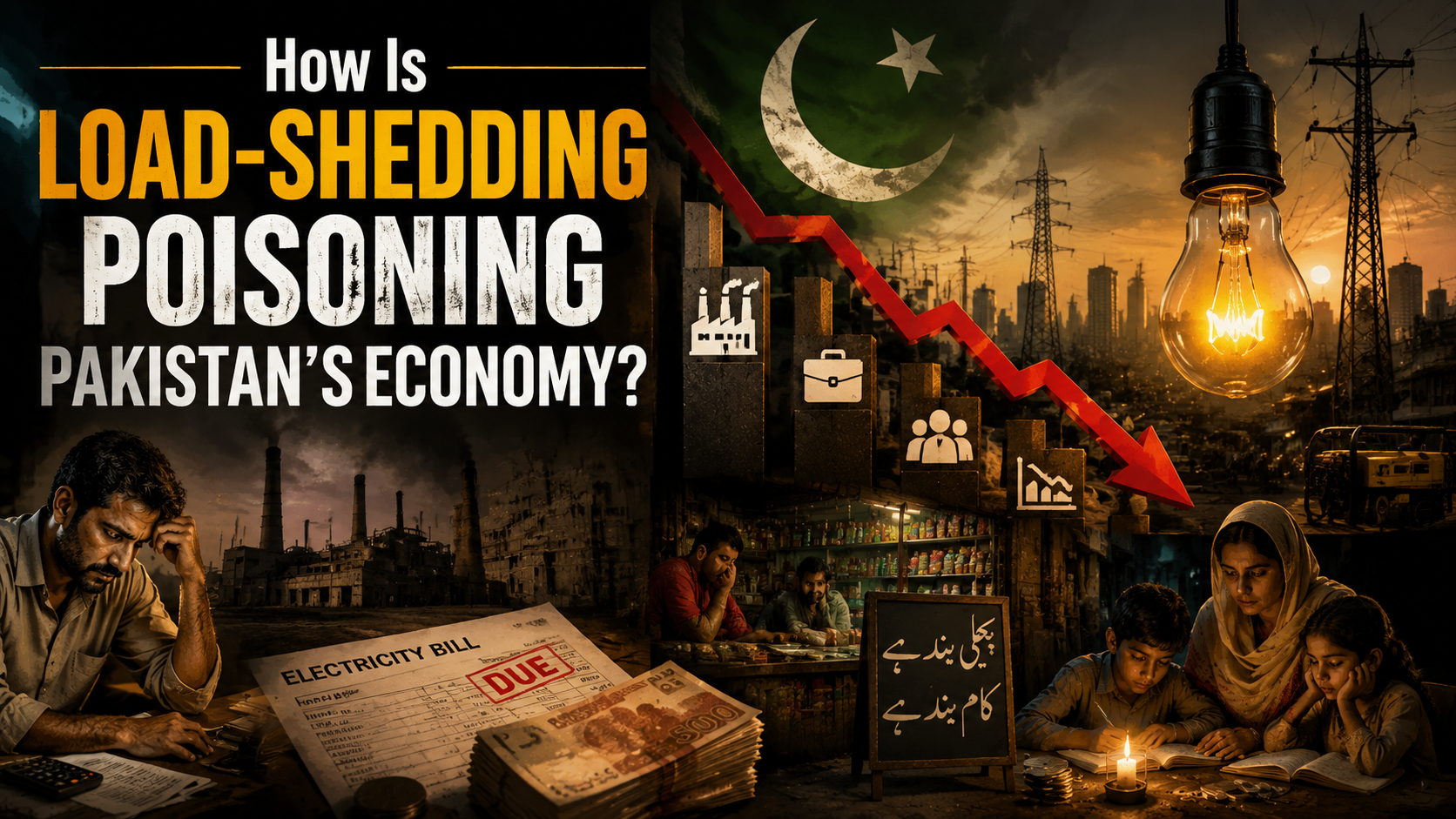
LAHORE – A few hours without electricity may appear to be a temporary inconvenience, but load-shedding poisoning Pakistan’s economy has become a serious national challenge. Behind every power outage is a chain reaction that affects factories, businesses, workers, students, healthcare services, and ordinary households.
Pakistan’s electricity crisis is no longer limited to homes facing darkness. Instead, it has become an economic issue that affects production, investment, employment, and the cost of living.
Whenever a factory stops operating, valuable production hours are lost. Similarly, when a small business struggles without electricity, daily income declines. At the same time, companies that depend on generators face higher costs, which eventually increase prices for consumers.
Although Pakistan has expanded its electricity generation capacity, problems such as circular debt, transmission losses, expensive fuel, and weak distribution systems continue to create power shortages.
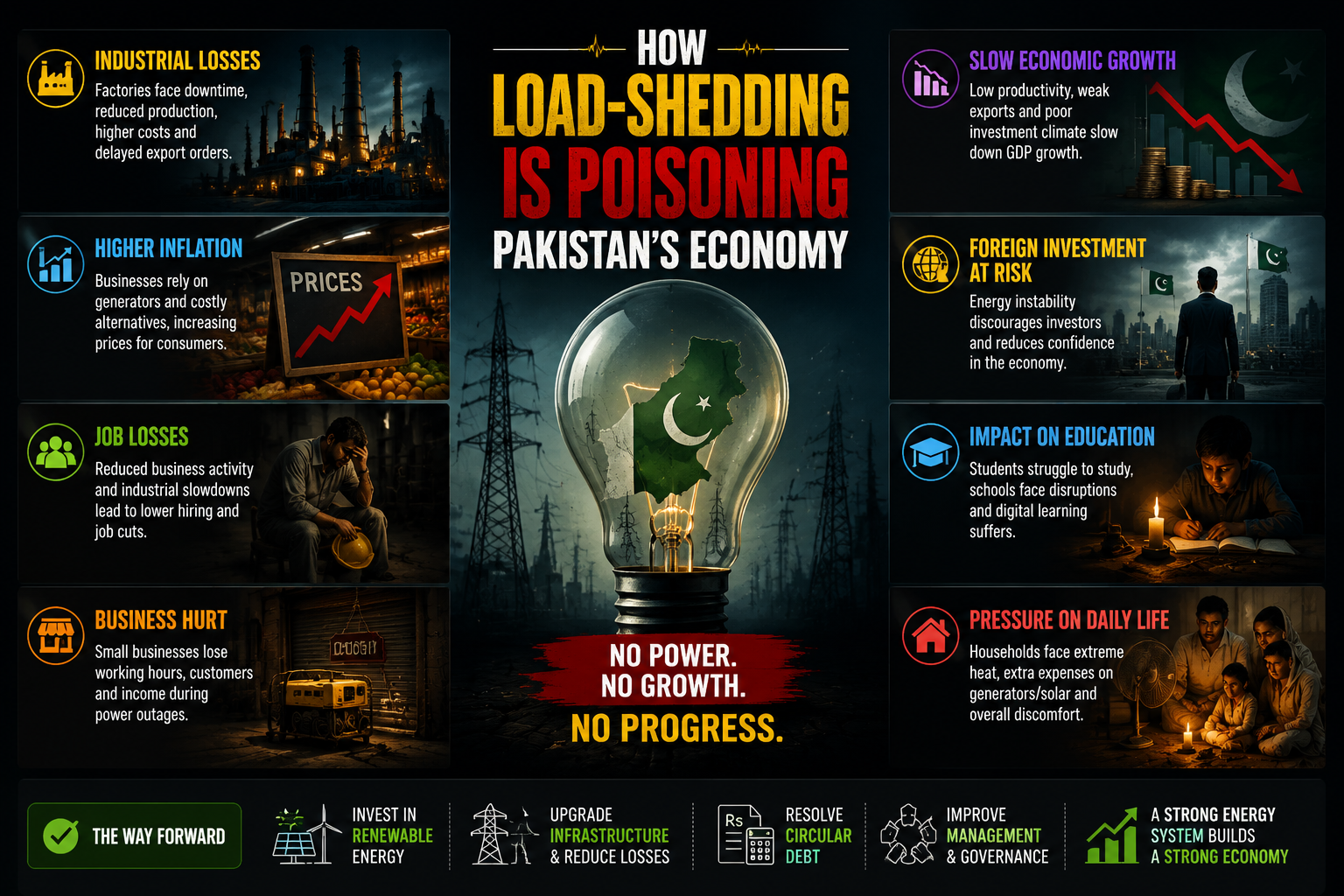
This Image is Ai generated and used for Illustration purposes only.
Why Does Load-Shedding Continue in Pakistan?
Load-shedding occurs when electricity demand exceeds supply or when technical and financial problems prevent the smooth distribution of power.
Several factors contribute to Pakistan’s energy crisis, including:
- Circular debt in the power sector
- High electricity generation costs
- Transmission and distribution losses
- Electricity theft
- Aging infrastructure
- Growing electricity demand
- Slow energy sector reforms
Over the years, Pakistan has invested in increasing electricity production. However, generation alone cannot solve the crisis because the country also needs an efficient transmission and distribution network.
Furthermore, financial problems within the power sector make it difficult to maintain a stable and affordable electricity supply.
How Is Load-Shedding Poisoning Pakistan’s Industrial Growth?
Are Electricity Shortages Reducing Factory Production?
The industrial sector is among the biggest victims of Pakistan’s electricity crisis.
Factories depend on continuous power to operate machinery, complete orders, and maintain production schedules. However, frequent outages force many industries to reduce working hours or rely on expensive backup energy sources.
As a result, industries experience:
- Lower production capacity
- Higher operational costs
- Delayed export shipments
- Reduced competitiveness
- Financial losses
Pakistan’s textile sector, which plays an important role in exports, has repeatedly highlighted energy shortages as a major challenge.
Moreover, when industries cannot operate efficiently, the impact spreads throughout the economy. Lower production affects exports, government revenue, and employment opportunities.
Therefore, industrial losses remain one of the clearest examples of how load-shedding poisoning Pakistan’s economy is affecting national progress.
How Does Load-Shedding Affect Small Businesses in Pakistan?
Are Small Businesses Struggling Because of Electricity Shortages?
Small businesses often face the greatest pressure during power outages because many cannot afford expensive backup solutions.
For shopkeepers, restaurants, workshops, and home-based businesses, electricity is directly connected to daily earnings.
Power shortages create several challenges:
- Reduced working hours
- Lost customers
- Higher fuel expenses
- Equipment problems
- Lower profits
For example, a bakery cannot prepare products without electricity, while a workshop cannot operate machines during prolonged outages.
Meanwhile, small businesses are already dealing with inflation and increasing costs. Therefore, unreliable electricity creates additional financial pressure for entrepreneurs.
How Is Load-Shedding Increasing Inflation in Pakistan’s Economy?
Why Are Electricity Shortages Making Life More Expensive?
One of the biggest economic effects of load-shedding is its impact on prices.
When businesses experience power cuts, many depend on diesel generators and alternative energy sources. Consequently, their production expenses increase.
These additional costs often reach consumers through higher prices of:
- Food items
- Manufactured products
- Industrial goods
- Services
Moreover, electricity is connected with almost every part of the economy. Therefore, an unstable power supply makes controlling inflation more difficult.
In this way, load-shedding poisoning Pakistan’s economy does not only affect businesses but also reduces the purchasing power of ordinary citizens.
How Is Load-Shedding Affecting Jobs and Employment?
Can Electricity Shortages Increase Unemployment?
A weak energy system creates serious challenges for Pakistan’s employment market.
When industries face production problems, companies may delay expansion, reduce working hours, or cut jobs.
This situation especially affects workers in:
- Manufacturing industries
- Textile factories
- Small businesses
- Daily wage sectors
Furthermore, daily wage workers often experience immediate financial losses because fewer working hours directly affect their income.
A reliable electricity system is essential because businesses cannot expand and create jobs without stable infrastructure.
How Is Load-Shedding Slowing Pakistan’s Economic Growth?
Can Pakistan’s Economy Grow Without Reliable Electricity?
Economic growth depends on productivity, and productivity depends heavily on energy availability.
When electricity shortages disrupt businesses, Pakistan faces:
- Lower industrial output
- Reduced exports
- Less investment
- Higher production costs
- Weak business confidence
As a result, power shortages become a major barrier to economic development.
Although other economic factors also influence GDP growth, a stable electricity system remains one of the most important foundations for long-term progress.
Is Load-Shedding Affecting Foreign Investment in Pakistan?
Can Investors Trust an Economy With Energy Problems?
Foreign investors usually consider energy reliability before entering a market.
Companies need confidence that factories, offices, and supply chains can operate without frequent disruptions.
However, repeated electricity shortages create concerns regarding:
- Production delays
- Increased costs
- Business uncertainty
- Lower profitability
Consequently, improving Pakistan’s energy system is not only necessary for citizens but also important for attracting international investment.
How Does Load-Shedding Affect Education in Pakistan?
The impact of electricity shortages extends beyond businesses and industries.
Students often struggle during:
- Exam preparation
- Online classes
- Evening study hours
Similarly, schools and universities face difficulties with:
- Computer labs
- Digital learning facilities
- Classroom conditions during extreme weather
As a result, students without reliable electricity access often face additional educational challenges.
How Does Load-Shedding Affect Healthcare Services?
Healthcare facilities require uninterrupted electricity for essential operations.
Power shortages can disrupt:
- Emergency services
- Medical equipment
- Laboratories
- Vaccine storage
- Patient care systems
Although many hospitals use backup generators, prolonged outages increase operational expenses.
Therefore, reliable electricity is not only an economic requirement but also a matter of public health and safety.
How Does Load-Shedding Change Daily Life in Pakistan?
For ordinary citizens, electricity shortages affect almost every aspect of daily life.
Families experience problems with:
- Cooling during hot weather
- Food preservation
- Remote work
- Online education
- Household appliances
Additionally, many households spend extra money on:
- Solar panels
- UPS systems
- Batteries
- Generators
These expenses reduce savings and create further financial pressure, especially for middle and lower-income families.
Can Pakistan Stop Load-Shedding From Poisoning Its Economy?
Pakistan needs long-term energy reforms instead of temporary solutions.
Improve Transmission and Distribution
Upgrading outdated infrastructure and reducing electricity losses can improve supply reliability.
Expand Renewable Energy
Increasing solar and wind energy projects can reduce dependence on expensive imported fuels.
Resolve Circular Debt
Addressing financial problems within the power sector is necessary for creating a sustainable energy system.
Improve Energy Sector Management
Better governance, reduced electricity theft, and stronger planning can help build a more reliable electricity network.
Key Points:
- Industrial losses: Electricity shortages reduce factory production, increase costs, and affect exports.
- Business problems: Small businesses lose working hours, customers, and income due to frequent power outages.
- Higher inflation: Companies pass increased energy costs to consumers, making products and services more expensive.
- Employment challenges: Reduced industrial activity affects jobs and income opportunities.
- Slower economic growth: Power shortages reduce productivity, investment, and GDP growth potential.
- Foreign investment concerns: Energy instability makes Pakistan less attractive for some investors.
- Education disruption: Students face difficulties with studying, online learning, and digital access.
- Healthcare risks: Hospitals require stable electricity to provide uninterrupted services.
- Household pressure: Families spend more on alternative energy solutions during prolonged outages.
- Need for reform: Pakistan requires better infrastructure, renewable energy expansion, and stronger power sector management.
Conclusion: Can Pakistan’s Economy Recover Without Fixing Its Energy Crisis?
Load-shedding poisoning Pakistan’s economy is not simply about electricity disappearing for a few hours. Its effects continue through lost production, higher prices, fewer job opportunities, and weaker economic confidence.
Pakistan’s economic future is closely connected with its ability to build a reliable and affordable energy system.
Ultimately, solving the electricity crisis means more than keeping homes powered. It means protecting businesses, creating jobs, attracting investment, and giving the economy a chance to grow.
When Pakistan loses electricity, it does not only lose power. It loses valuable economic opportunities.
Read More:
Stay Connected with Upfront
Get the latest news, technology, business, sports and entertainment stories from Upfront.
Add Upfront as a preferred source on GoogleAdd Upfront to your preferred sources to see more of our stories across Google Search.