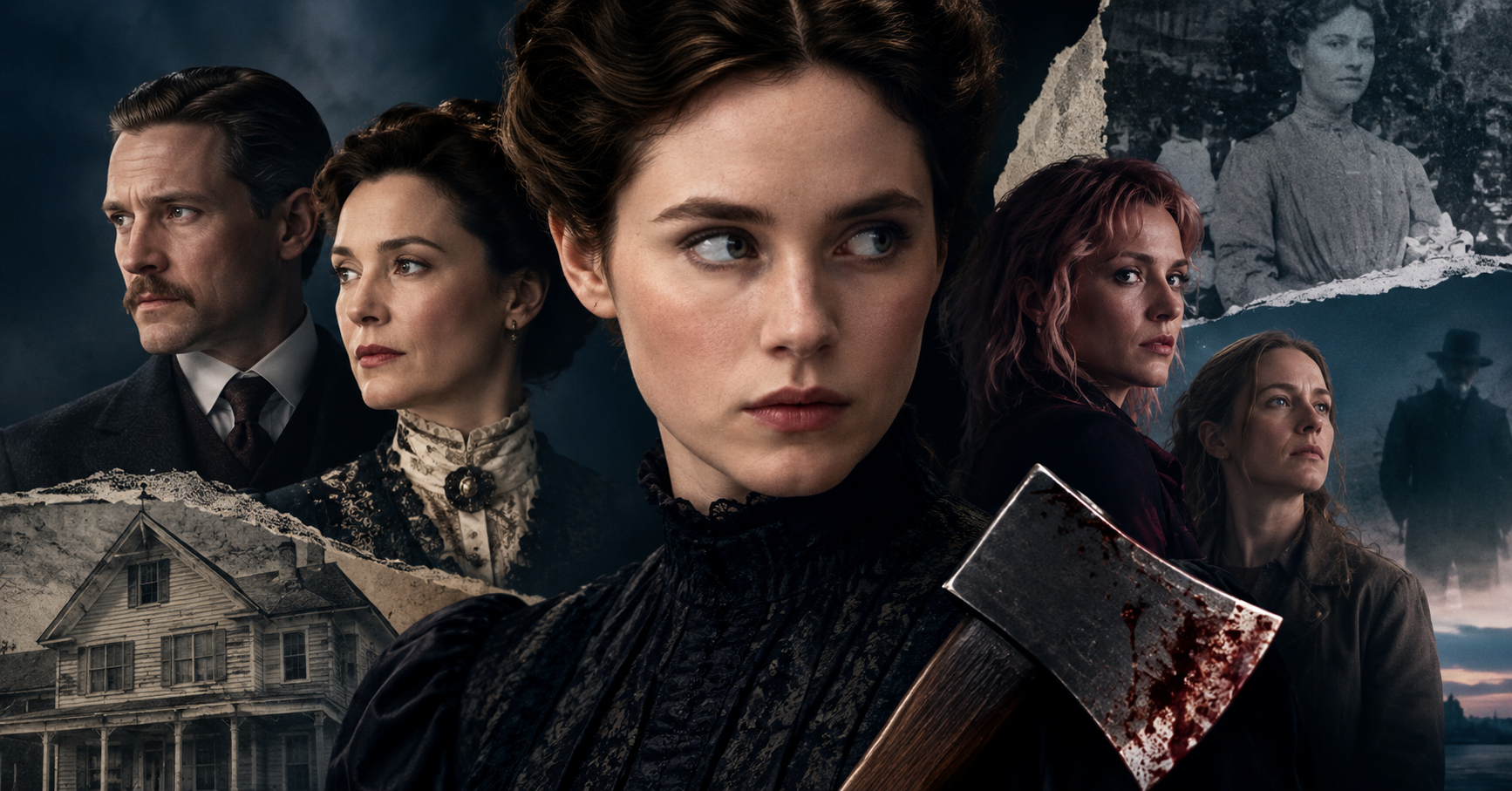
CALIFORNIA – Netflix’s Monster: The Lizzie Borden Story revisits one of the most notorious murder cases in American history, but its eight-hour narrative struggles to give the story a clear purpose beyond the killings themselves.
Created by Ryan Murphy and Ian Brennan, the latest instalment in the Monster franchise stars Ella Beatty as Lizzie Borden. Vicky Krieps, Rebecca Hall, Charlie Hunnam and Sarah Paulson also feature in the series.
The story is based on the August 1892 murders of Andrew Borden and his wife, Abby. Lizzie was accused of killing her father and stepmother but was acquitted at trial and maintained that she was not responsible.
The Netflix series, however, does not spend much time questioning Lizzie’s guilt. It presents her as the person behind the killings and instead focuses on the circumstances that lead her towards violence.
A troubled family life
The series portrays Andrew and Abby as deeply unpleasant figures within the Borden household.
Charlie Hunnam plays Andrew, while Rebecca Hall portrays Abby. Their characters are presented as cruel and abusive towards Lizzie and the household staff, giving the audience an immediate explanation for Lizzie’s growing resentment.
The approach makes it easier to understand why Lizzie might consider escaping her family situation through violence. However, the broad portrayal leaves little room for ambiguity or complexity.
The story gains another major character with the arrival of Maggie, played by Vicky Krieps.
Maggie works as a maid for the Borden family and quickly develops a close relationship with Lizzie. Their relationship becomes a central part of the series as Maggie introduces Lizzie to a world beyond the restrictions imposed by her family.
Through Maggie, Lizzie begins to question her circumstances and consider whether killing her parents could provide a way out.
An eight-hour story
Once the series establishes Lizzie’s family situation and her relationship with Maggie, however, it faces a narrative problem.
The central conflict is established relatively early, leaving the series with several hours to fill before reaching its conclusion.
Some scenes repeat information that has already been established, while others slow the narrative without adding much to the central story. Lizzie and Maggie’s romantic relationship also receives extended attention, with the series drawing on the visual language of historical romantic dramas.
Other storylines are introduced but receive limited development.
The result is a series that sometimes appears uncertain about whether it wants to remain a historical crime drama, a romantic story or something more ambitious.
A wider story about women and violence
The series attempts to broaden Lizzie’s story by connecting her with other notorious female killers from different periods.
One of them is Elizabeth Báthory, the 16th-century Hungarian countess associated with legends of bathing in the blood of young women. The series uses flashbacks to connect Báthory with Lizzie and Maggie.
It later introduces Aileen Wuornos, the American serial killer played by Sarah Paulson.
Wuornos becomes particularly fascinated with Lizzie, treating her as a symbolic figure whose experiences represent the pressures placed on women by society.
The series therefore tries to establish a connection between women who committed very different crimes under very different circumstances.
That connection is one of the show’s central themes, but it is not always developed convincingly.
Lizzie Borden, Elizabeth Báthory and Aileen Wuornos had different backgrounds, motives, methods and historical circumstances. Bringing them together under a broad discussion of women and violence can make the series’ larger argument feel underdeveloped.
Lizzie as a feminist symbol
The series also expands Lizzie’s character beyond the historical murder case, presenting her as a figure connected to female independence and the women’s suffrage movement.
That interpretation gives the character a broader cultural significance, but the series does not always establish the transition clearly.
The result is a story that moves between murder, romance, historical biography and social commentary without settling comfortably into any one of them.
There are moments when the approach works, particularly when the series explores Lizzie’s restricted life and her relationship with Maggie. But the larger historical comparisons often distract from the central story.
Strong performances, uneven storytelling
The cast provides much of the series’ appeal.
Beatty carries the story as Lizzie, while Krieps gives Maggie a significant role in Lizzie’s transformation. Hall and Hunnam embrace the exaggerated nature of their characters, while Paulson takes a noticeably broader approach to Aileen Wuornos.
The performances, however, cannot always overcome the uneven pacing and shifting focus.
By the final episode, the series tries to give Lizzie’s life a larger meaning. Her wealth and notoriety become part of an attempt to suggest that the legacy of her crimes could be transformed into something positive.
Yet the idea arrives after a season that has struggled to define exactly what it wants Lizzie’s story to represent.
Monster: The Lizzie Borden Story has an inherently compelling historical subject and a strong cast. Its difficulty lies in the decision to stretch that story across eight episodes while attaching several larger themes to it.
The series has plenty of material to work with. What it lacks is a consistently focused argument about what the Lizzie Borden case means beyond the murders themselves.
Key points:
- Netflix’s Monster: The Lizzie Borden Story retells the notorious 1892 murders of Lizzie Borden’s father and stepmother.
- The series treats Lizzie as responsible for the killings, despite the real-life Borden maintaining her innocence.
- Ella Beatty plays Lizzie, with Vicky Krieps, Rebecca Hall and Charlie Hunnam among the supporting cast.
- The series connects Lizzie’s story with historical and modern female killers, including Elizabeth Báthory and Aileen Wuornos.
- The attempt to turn the story into a wider commentary on women and society often leaves the series without a clear central focus.