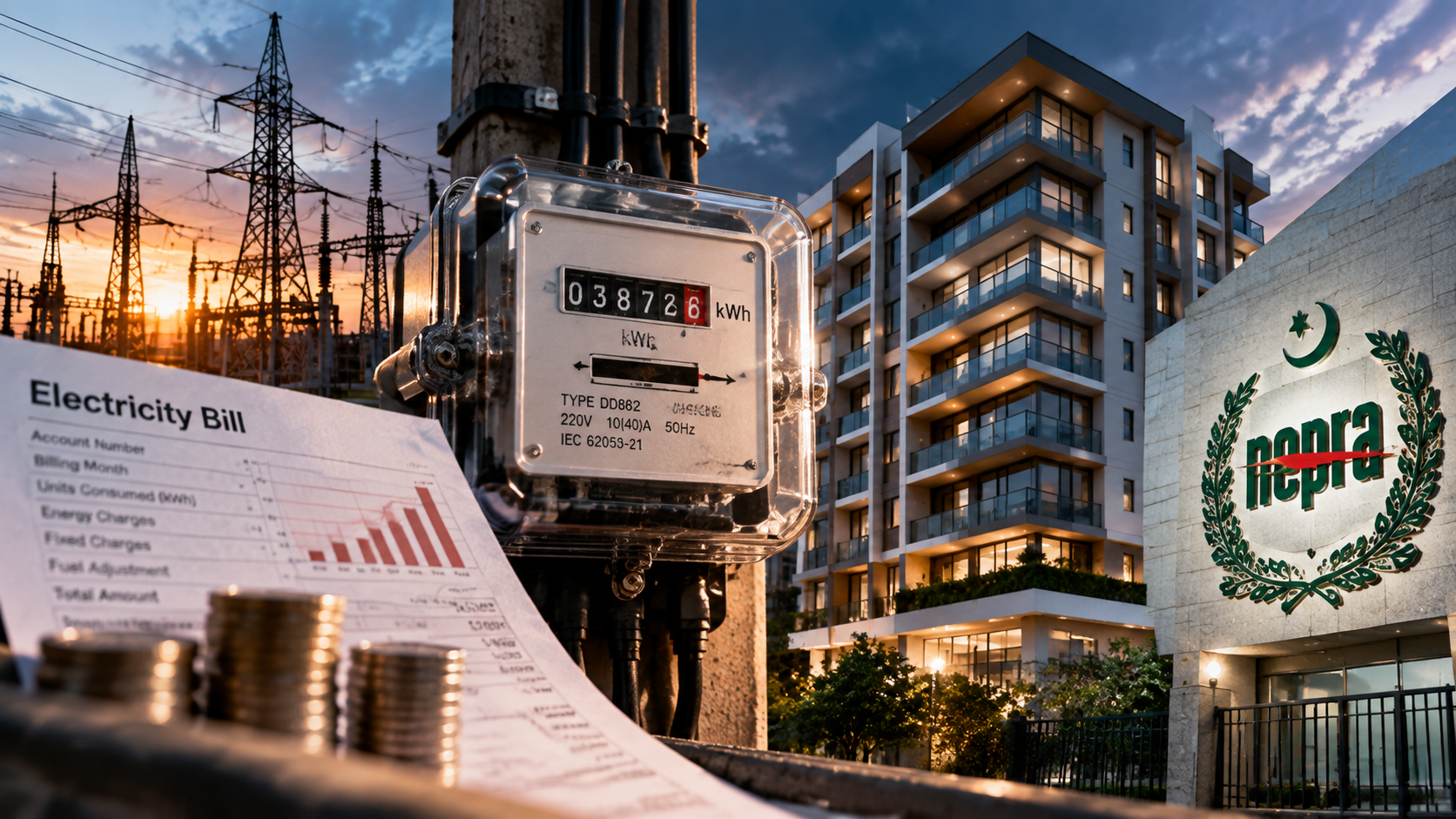
LAHORE – Electricity consumers could face additional costs under proposed reforms by the National Electric Power Regulatory Authority (NEPRA), which include changes to NEPRA electricity grid sharing charges, dedicated equipment costs and temporary connection rules.
The regulator has proposed amendments to the Consumer Service Manual that would revise procedures for electricity connections involving high-rise buildings, industrial units, commercial users and temporary disconnections.
The proposals are currently open for public feedback, with stakeholders given 30 days to submit their comments until October 25.
New Grid Sharing Charges Proposed for Large Consumers
One of the major changes proposed by NEPRA involves introducing grid sharing charges for certain multi-storey buildings.
Under the proposed framework, buildings requiring a dedicated transformer above 500 kVA would have to pay grid sharing charges, including residential buildings.
Currently, buildings up to ground plus three floors are generally not classified as high-rise structures for this purpose.
The proposed changes aim to revise the way distribution companies recover infrastructure-related costs from consumers who require additional grid capacity.
Multiple Electricity Connections for Industrial and Commercial Users
NEPRA has also proposed greater flexibility for large industrial and commercial consumers seeking multiple connections at the same location.
Under the proposed rules, a distribution company may provide up to three connections at the same premises, with a combined load of up to 15 MW under the same tariff category.
However, this would only be allowed if the existing grid infrastructure has enough capacity and the connection remains technically feasible.
Consumers requiring more than 5 MW would be responsible for full grid sharing and transmission-related costs.
The proposed charges include:
- Rs8.948 million per MW for grid sharing
- Rs0.855 million per MW for land costs based on load requirements
Consumers requiring more than 15 MW would need a dedicated grid station and transmission line.
Refund Proposal for Consumers Shifted to Dedicated Grid Stations
NEPRA has proposed that consumers who initially pay grid sharing, transmission line and land-related charges but later move to a dedicated grid station should receive refunds for earlier payments.
The move aims to create a clearer framework for large electricity users requiring significant power capacity.
Changes Proposed for Dedicated Transformers and Feeders
The proposed amendments also cover dedicated transformers, 11 kV feeders and rehabilitation costs.
Under the new framework:
- Connections up to 1 MW would require payment of relevant equipment and rehabilitation charges.
- Consumers requiring between 1 MW and 2.5 MW would pay rehabilitation costs based on actual expenses.
- Consumers would also be responsible for meeting required technical standards.
The changes are aimed at ensuring that infrastructure costs are properly allocated among users.
New Rules for Temporary Electricity Disconnections
NEPRA has also proposed changes for consumers who temporarily disconnect their electricity supply.
Under the proposed rules, consumers would need to apply for reconnection before the approved disconnection period ends.
If they fail to do so, the connection would automatically become active after the temporary period expires, with applicable charges imposed.
Consumers would still be allowed to request temporary disconnections multiple times, but before applying again they would have to clear fixed and other applicable charges for at least one month.
Proposed Changes to Electricity Detection Bills
The regulator has also suggested a uniform mechanism for detection bills in cases involving suspected meter manipulation, billing irregularities or technical violations.
Under the proposed rules, distribution companies could recover charges for up to 12 months in cases involving:
- Bluetooth-based meter reading reversals
- Security-related meter breaches
The proposed detection bills would be calculated according to the consumer’s approved load rather than previous or future electricity consumption.
For domestic consumers, the maximum detection period would remain limited to six months.
NEPRA Seeks Public Feedback Before Final Decision
The proposed amendments are not final and will only be implemented after reviewing feedback from stakeholders.
Consumers, businesses and industry representatives can submit their comments before the October 25 deadline.
The final decision will determine how electricity infrastructure costs, additional connections and billing procedures are managed across Pakistan.
Key Points :
- NEPRA has proposed new electricity grid sharing charges for certain consumers.
- Multi-storey buildings requiring transformers above 500 kVA may fall under the new charging system.
- Large industrial and commercial users may get multiple connections at the same premises.
- Consumers requiring over 5 MW could bear full grid sharing and transmission costs.
- NEPRA proposed changes to temporary disconnections and detection bills.
- Domestic consumers could face detection bills for a maximum of six months.
- Stakeholders can submit comments on the proposals until October 25.
Is this conversation helpful so far?
Read More:
For more such exclusive articles, follow Upfront .