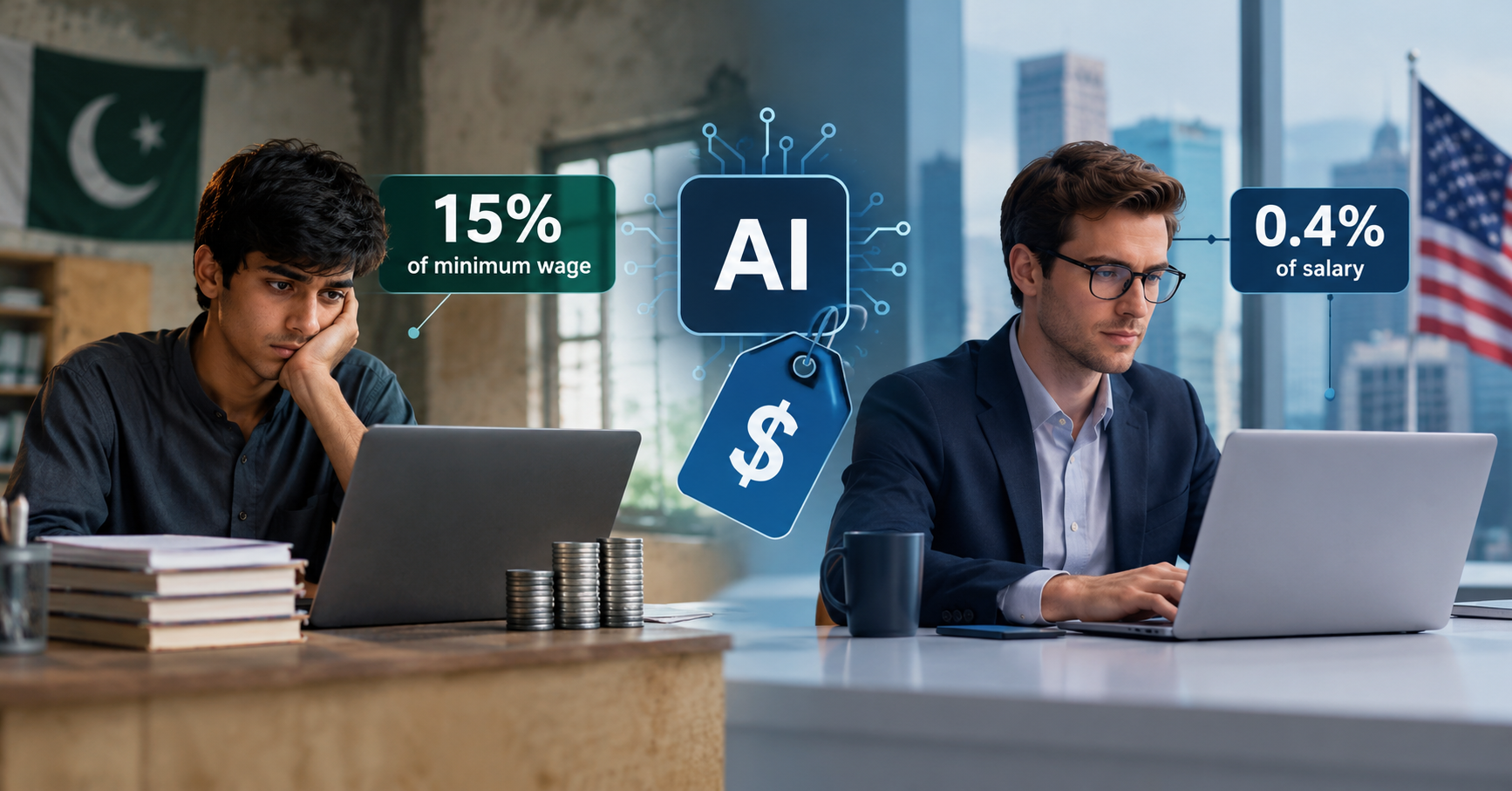
LAHORE – Artificial intelligence tools may be becoming cheaper globally, but their cost remains relatively high for Pakistani workers because most services are priced in US dollars while local wages are considerably lower, according to an analysis by Densight Labs.
The analysis estimates that an AI subscription costing about Rs6,000 a month would account for 15pc of Punjab’s Rs40,000 minimum wage.
By comparison, the same monthly cost would represent about 0.4pc of an illustrative $5,000 monthly salary in the United States. Based on this comparison, Densight Labs estimates that AI tools can be around 3,700pc more expensive relative to income in Pakistan.
The analysis highlights the difference in purchasing power as a potential barrier to wider AI adoption among Pakistani workers and businesses.
Read more: Islamabad internet disruption after optical fiber cable cut
AI takes longer to pay for itself
According to the analysis, an AI subscription can take around 25 times longer to recover its cost when used by a junior worker in Lahore than by a US office worker.
A junior employee earning Rs60,000 a month would need to save about 48 minutes of work each day to recover the cost of a Rs6,000 monthly AI subscription.
For a department head earning Rs500,000 a month, however, the required productivity gain would be much smaller, at around six minutes a day.
The figures suggest that the financial case for AI can vary significantly depending on an employee’s salary and the type of work involved.
Densight Labs says AI can make more financial sense when employees perform higher-value or repetitive tasks.
For example, if AI makes 30pc of a department head’s work 25pc faster, an employee earning Rs500,000 a month could save an estimated Rs37,500 worth of working time.
Against a Rs6,000 monthly subscription, the analysis puts the potential return at roughly six times the subscription cost.
The calculation is based on the assumptions used in the analysis and does not represent a guaranteed financial return.
AI can also reduce training time
The analysis also points to productivity gains among new employees.
It cites research involving more than 5,000 support workers, which found that employees using AI became 34pc more productive. The research also found that workers with two months of experience using AI reached the productivity level of employees with six months of experience.
For a worker earning Rs60,000 a month, Densight Labs estimates that reducing the training period by four months could recover about Rs120,000 in output.
That compares with about Rs72,000 in subscription costs over a year at Rs6,000 a month.
Read more: NEPRA proposes new electricity charges for grid sharing
Automation could lower the cost of routine work
AI may also offer savings when companies use it to automate repetitive processes.
The analysis estimates that a minimum-wage worker costs about Rs9 to process an invoice. At the cost assumptions used in the report, AI could perform the same extraction for less than Rs3.
Under such a model, employees could focus on exceptions and more complicated cases rather than routine data extraction.
However, the financial benefit would depend on the accuracy of the AI system, implementation costs and the amount of human oversight required.
AI adoption also carries risks
The analysis cautions that AI does not automatically improve productivity.
It cites research showing that consultants using AI for tasks outside the technology’s capabilities were 19pc less likely to produce the correct answer.
It also refers to an MIT estimate that only around 5pc of organisations have turned enterprise AI into measurable financial gains.
These findings suggest that businesses need to consider how and where they deploy AI rather than assuming that subscriptions will automatically generate savings.
Falling AI costs may not close Pakistan’s gap
The cost of AI technology has declined rapidly. Densight Labs estimates that the price of a fixed level of AI performance has fallen by about 13 times a year since 2023.
However, lower global prices do not necessarily translate into equally affordable tools for Pakistani workers because subscriptions remain linked to international pricing while salaries are paid in rupees.
The issue could become more important for Pakistan’s services sector. The country’s call centre and business process outsourcing exports crossed $300 million during the first 11 months of the 2025-26 fiscal year, according to the analysis.
As AI becomes more capable, companies that rely heavily on labour-intensive services could face pressure to automate some tasks.
For Pakistani businesses, the analysis suggests that the financial question should therefore focus on the specific task being automated or accelerated.
Rather than providing an AI subscription to every employee, companies could assess whether a particular tool can save enough time or money to cover its own cost.
Read more: Punjab explores AI to modernise legal and regulatory systems
Key points:
- AI subscriptions can consume a much larger share of Pakistani workers’ incomes than those of US workers, according to Densight Labs.
- A Rs6,000 monthly AI subscription equals about 15pc of Punjab’s Rs40,000 minimum wage.
- The same subscription represents about 0.4pc of an illustrative $5,000 monthly US salary.
- The analysis estimates that AI tools can take about 25 times longer to pay for themselves for junior workers in Lahore.
- AI adoption can still provide financial benefits when it targets senior employees, repetitive tasks or employee training.
- Densight Labs says falling AI costs alone may not resolve the affordability gap for Pakistani workers.