Connect with us

Sci&Tech

realme C85 Pro Launches in Pakistan with 7000mAh Battery and 4000-nit Sunlight Display

Published

on

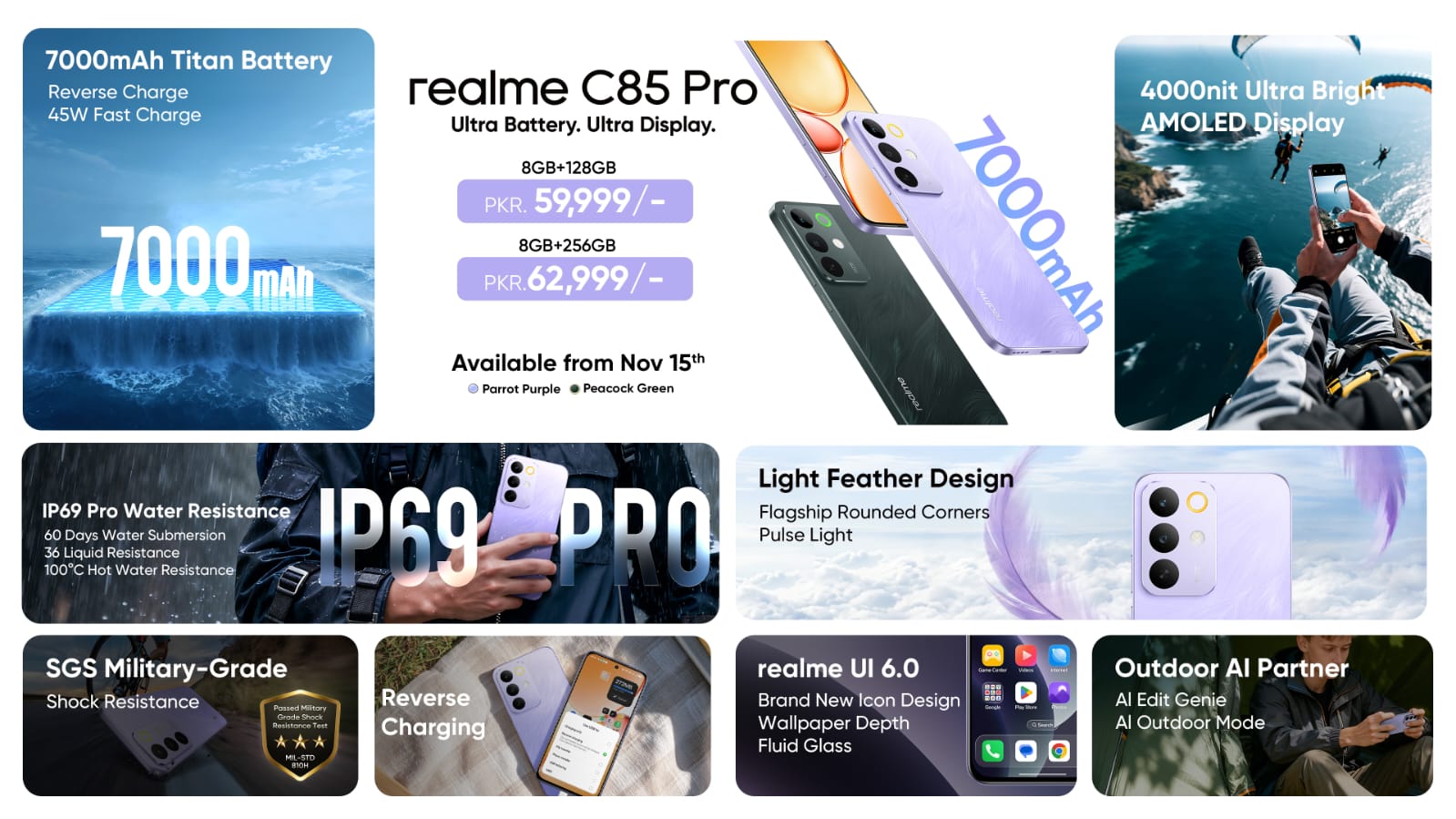
LAHORE – The realme C85 Pro has officially made its debut in Pakistan with a grand launch event that celebrated power, endurance, and innovation. Showcasing the brand’s signature fusion of performance and design, the event highlighted how the C85 Pro redefines the smartphone experience for users who demand more, from ultra battery life, ultra display brilliance, and IP69 Pro durability to unmatched all-around performance. Launched on November 10, the realme C85 Pro, featuring the segment’s best display among 7000mAh battery phones, will be available nationwide starting November 15, giving users the chance to experience unmatched power, clarity, and toughness in one sleek device.

The realme C85 Pro is built for those who never stop, from riders navigating long routes to creators capturing life on the go. Featuring 24GB Dynamic RAM and up to 256GB storage, it combines ultra battery, ultra display, and ultra protection into one powerful, elegant device. The smartphone comes in two variants, both delivering the same flagship-grade experience with only a difference in storage capacity: 8GB + 128GB priced at PKR 59,999, and 8GB + 256GB priced at PKR 62,999. With its blend of power, performance, and style, the realme C85 Pro offers incredible value for those who never slow down.

Power That Goes the Distance

At its core, the realme C85 Pro features a massive 7000mAh Titan Battery, the largest in its segment, delivering power bank–level endurance that keeps you going all day and beyond. Whether you’re navigating for 18 hours, streaming videos for 21 hours, listening to music for 73 hours, or making calls for 38 hours, the C85 Pro ensures consistent, all-day performance with around 50% capacity still remaining by night.

With AI Power Saving optimizing background processes and Bionic Repair Technology maintaining up to six years of battery health, users get lasting reliability far beyond expectations. 45W Fast Charging powers the phone to 50% in just 30 minutes, while 10W Reverse Charging turns it into a mobile power hub, capable of charging an iPhone 17 (1.2x), wireless earbuds (12.5x), or a smartwatch (9.3x), perfect for users on the move.

Segment’s Brightest Display – 4000nit Ultra Bright AMOLED

Stealing the spotlight at the launch event was the C85 Pro’s 4000nit Ultra Bright AMOLED display, the brightest among all 7000mAh battery phones. Built with OLED material, the screen delivers exceptional color accuracy, rich contrast, and a wide viewing angle, ensuring perfect visibility even under Pakistan’s blazing sunlight.

Its 120Hz refresh rate provides seamless motion and responsiveness, while AI Outdoor Mode automatically adjusts brightness based on your surroundings. Whether you’re checking navigation mid-ride or streaming content outdoors, the C85 Pro ensures every detail stays sharp and vivid.

Built to Withstand Every Extreme

The realme C85 Pro pushes durability to a whole new level with its IP69 Pro Water and Dust Resistance, tested to withstand high-pressure jets, full submersion, and exposure to 36 different liquids, even 100°C hot water. This remarkable toughness earned it a Guinness World Record™ for durability, proving that it’s ready for anything from monsoon rides to daily wear and tear.

With its ArmorShell™ frame and military-grade shock resistance, the C85 Pro is not just waterproof, it’s built to endure every challenge life throws at it.

Smarter, Smoother, Stronger Performance

Powering it all is the Snapdragon 685 6nm processor, offering a 15% CPU boost and 25% GPU performance increase for fluid multitasking, gaming, and photography. With up to 24GB of Dynamic RAM and 256GB of storage, users enjoy smooth performance and generous space for apps, videos, and files.

The AI Boost feature and 5500mm² VC Cooling System ensure sustained performance under pressure, while GT Mode delivers ultra-smooth responsiveness for gaming and high-performance tasks.

Camera and AI Features That Inspire Creativity

Equipped with a 108MP AI Camera System, the realme C85 Pro captures stunning detail in every shot, from vivid portraits to sharp low-light images. Enhanced by AI Edit Genie and AI Smart Filters, users can remix, enhance, and stylize photos effortlessly.

With the AI Outdoor Partner, the phone intelligently adjusts to lighting, motion, and environment, giving users the perfect balance of clarity and creativity on every adventure.

Design That Reflects Power and Elegance

Available in Parrot Purple and Peacock Green, the C85 Pro’s Feather Design is both lightweight and premium, combining durability with sophistication. Its slim profile and sleek curves make it as stylish as it is strong, a true reflection of realme’s design philosophy.

The realme C85 Pro Launch Event not only marked the arrival of a new device but also reaffirmed realme’s vision of pushing boundaries in technology, endurance, and design, proving once again that realme is redefining what users can expect from their phones.


 

Sci&Tech

Samsung introduces Robotics division for humanoid robots

Published

on

The image is AI-generated and used for illustration purposes only

ISLAMABAD – Samsung Electronics has established a dedicated robotics division as the technology giant accelerates its investment in artificial intelligence-powered robots. The newly created RX (Robotics eXperience) Division will oversee Samsung’s robotics strategy, product development and commercialization as the company seeks to make robotics one of its next major growth businesses.

New RX division to lead Samsung’s robotics strategy

Samsung said the RX Division will report directly to co-Chief Executive Officer Roh Tae-moon, who also heads the company’s Device eXperience (DX) Division.

The company stated that the new organization will manage its medium- and long-term robotics strategy while expanding research capabilities in South Korea and overseas. It will also bring together robotics teams that previously operated across different business units.

Samsung believes a unified structure will accelerate product development, improve commercialization and strengthen its overall robotics roadmap.

Samsung is targetting humanoid robots

Initially, Samsung will focus on developing humanoid robots for manufacturing facilities. The company plans to expand the technology into homes and retail environments after improving its reliability and commercial readiness.

Earlier this year, Samsung told investors that it aims to achieve tangible progress in humanoid robotics during 2026. The company also indicated that it may pursue additional investments and acquisitions to accelerate robotics research and commercialization.

Former Hyundai executive to lead robotics strategy

Samsung has appointed Executive Vice President Lee Dong-kun to head the Robotics Strategy Team.Lee previously worked at Hyundai Motor Group, where he managed robotics strategy, including projects involving Boston Dynamics. Samsung is also recruiting researchers specializing in autonomous robot control and robotic hand technologies to strengthen the RX Division.

Rainbow Robotics partnership

The new division builds on Samsung’s growing investment in South Korean robotics company Rainbow Robotics. Samsung became the company’s largest shareholder after acquiring an additional 267 billion won stake. Before the transaction, Samsung already held a 14.71 percent ownership interest.

Since then, both companies have collaborated on manufacturing robots, humanoid technologies and physical AI systems.

Samsung is planning new research centres

Samsung will establish the RX Division at its Seoul Research and Development Campus. The company also plans to build a robotics data factory at its Gumi facility to collect real-world operational data for improving robot artificial intelligence and control systems.

In addition, Samsung intends to expand robotics research through new hubs in the United States, China and Japan to access global talent and emerging technologies.

Robotics becomes Samsung’s next growth engine

Samsung is expanding beyond its traditional strengths in smartphones, consumer electronics and semiconductors by making robotics a strategic business priority. The company faces growing competition from Tesla, Chinese robotics manufacturers and several US startups developing humanoid robots.

By creating a CEO-level robotics division, Samsung has signalled that robotics will play a central role in its long-term growth strategy rather than remaining an experimental business.

Key points:

  • Samsung has established a new RX (Robotics eXperience) Division to lead its global robotics strategy.
  • The division will report directly to co-CEO Roh Tae-moon.
  • Samsung plans to prioritize humanoid robots for manufacturing before expanding into homes and retail.
  • The company aims to achieve tangible progress in humanoid robotics during 2026.
  • Former Hyundai Motor Group executive Lee Dong-kun will lead the Robotics Strategy Team.
  • Samsung will establish a robotics data factory in Gumi and expand research hubs in the US, China and Japan.
  • The initiative builds on Samsung’s investment in Rainbow Robotics and reflects its long-term AI ambitions.


Continue Reading

Sci&Tech

Kimi K3 capable of building Apple OS without coding

Published

on

BEIJING – China’s latest artificial intelligence model, Kimi K3, is drawing global attention after successfully creating a functional macOS-style web application from a single user prompt, highlighting the rapid progress of AI-assisted software development.

The project was demonstrated by technology analyst Max Weinbach, who tasked Kimi K3’s Agent Swarm with recreating Apple’s upcoming macOS 27 “Golden Gate” interface. The request included Apple’s new Liquid Glass design language along with native-style applications that could run entirely within a web browser.

According to Weinbach, the AI completed the project in approximately three hours and 20 minutes, consuming nearly 60% of his monthly Kimi credits during the process.

Read more: How Is Load-Shedding Poisoning Pakistan’s Economy?

The completed demonstration showcased a browser-based operating system that closely resembles Apple’s macOS experience. It featured a desktop interface, windows, and working applications designed to imitate Apple’s upcoming visual style.

Browser-Based Simulation, Not Apple’s Operating System

Despite its realistic appearance, the project is not an actual version of macOS. Instead, it is a web application that recreates the look and feel of Apple’s desktop operating system inside a browser. It does not contain Apple’s proprietary operating system, kernel, or native system software.

The demonstration serves as an example of how advanced AI models can generate complete software experiences without replicating the underlying operating system.

Read more: China, South Korea and Singapore emerge as Asia-Pacific’s EV leaders

What Is Kimi K3?

Kimi K3 is the newest flagship AI model developed by Chinese startup Moonshot AI. The model is designed for complex coding tasks, long-running software projects, and autonomous AI workflows. One of its standout features is a one-million-token context window, allowing it to process significantly larger amounts of information than many competing AI models.

It also introduces an Agent Swarm system, enabling multiple AI agents to divide and complete different parts of a project simultaneously before combining the final output.

Strong Coding Performance

Beyond the macOS-style demonstration, Kimi K3 has also gained recognition for its programming capabilities. According to AI benchmarking platform Arena, the model currently ranks first in its Frontend Code Arena, achieving a 76% pairwise win rate against competing AI models on frontend coding tasks.

The results suggest that modern AI systems are increasingly capable of planning, writing, debugging, and assembling complete software applications from a single instruction rather than generating isolated snippets of code.

Read more: Suzuki Pakistan unveils new Fronx XUV at PAPS 2025

AI Coding Continues to Advance

The macOS-inspired demonstration has renewed discussion across the technology industry about the pace of AI development.

Recent generations of AI coding assistants are moving beyond simple code generation, increasingly handling entire software development workflows with minimal human intervention. However, the experiment also highlights the significant computing resources and processing time still required for complex projects.

Key Points:

  • China’s Moonshot AI has launched Kimi K3, its latest flagship AI model.
  • The AI generated a functional macOS-style web application from a single prompt.
  • The project took around 3 hours and 20 minutes to complete.
  • It consumed nearly 60% of the user’s monthly Kimi AI credits.
  • The application recreates Apple’s Liquid Glass-inspired interface inside a web browser.
  • The software is not Apple’s actual macOS and does not include its operating system.
  • Kimi K3 features a one-million-token context window and an Agent Swarm system.
  • The model currently leads Arena’s Frontend Code Arena with a 76% pairwise win rate.

Continue Reading

Sci&Tech

Is Google AI Search really an ‘unacceptable risk’ to children?

Published

on

The image is AI-generated and used for illustration purposes only

KARACHI – A report by nonprofit organization Common Sense Media has raised concerns about Google’s AI-powered Search features, concluding that they pose an “Unacceptable Risk” to children because of safety, reliability and educational concerns.

The report evaluated Google AI Overview and AI Mode, two generative AI features integrated into Google Search that provide AI-generated responses to users’ queries.

AI Features Cannot Be Fully Disabled

According to the report, AI Overview automatically appears at the top of many Google Search results, while AI Mode functions as a conversational chatbot capable of answering follow-up questions and processing uploaded files and images. Common Sense Media said neither feature can currently be fully disabled by users, parents or schools, raising concerns because Google Search is widely used on children’s personal devices and school-issued Chromebooks.

Report Says AI Completes Homework

The organization also expressed concern about the impact of Google’s AI tools on education. During testing, researchers found that Google’s AI consistently generated complete answers to homework questions, including mathematics problems and essay assignments, when prompts were pasted into Search.

Read more: PTA recommends giving licenses to Starlink, OneWeb: PTA Chairman

The report argued that providing complete solutions instead of guiding students through problems could undermine learning and critical thinking. Researchers also noted inconsistencies in AI-generated responses. In one test, AI Overview reportedly produced materially different answers to the same history question in 43pc of attempts.

Child Safety Concerns Highlighted

The report’s strongest criticism centred on child safety. According to Common Sense Media, Google’s AI Search features failed all tested severe-harm “Red Line” categories, including self-harm, sexual exploitation, synthetic media harm, dangerous substances, impaired reality and eating disorders.

Read more: Punjab sales tax: Digital payments face tax increase

Researchers said that the AI sometimes failed to recognise signs of mental health crises, reinforced symptoms associated with psychosis and mania, validated disordered eating behaviours and mishandled certain substance-use prompts. The report further stated that AI Overview identified clear warning signs of emotional distress in only 58pc of hundreds of test searches, below the organization’s benchmark of 95pc.

Overall Rating Marked as ‘Unacceptable Risk’

Common Sense Media assigned Google’s AI Search features an overall rating of “Unacceptable Risk.” The report said the tools received either “Unacceptable” or “High Risk” ratings across seven of its eight AI evaluation principles, including child safety, effectiveness, fairness, trustworthiness, transparency and human connection.

The only category to receive a comparatively lower assessment was data responsibility, which the organization rated as “Moderate Risk.”

Google Rejects the Findings

Google disputed the conclusions of the report. A company spokesperson told Axios that the research relied on a limited set of ambiguous and artificial search queries that do not accurately represent how people typically use Google Search.

Read more: Changan Oshan X7 gets discount of Rs 850,000 here’s the details

The spokesperson said that Google could not reproduce or verify the findings and noted that Search displays crisis hotline information when appropriate. However, Common Sense Media argued that AI-generated responses can vary between searches, making their safety and reliability difficult to assess consistently.

Scrutiny of AI Safety Continues

According to the report, growing scrutiny of major technology companies over the use of generative AI by children. Common Sense Media said Google’s position is unique because its AI-generated answers are integrated directly into Search, making them readily accessible on devices that children use every day.

The organization concluded that Google’s AI Search features are not yet safe or reliable enough to serve as the default source of answers for children.

Category Details
Organization Common Sense Media
AI Features Reviewed Google AI Overview and AI Mode
Overall Rating Unacceptable Risk
Main Concerns Child safety, homework completion, inconsistent AI responses, mental health guidance
Homework Findings AI generated complete answers for maths and essay assignments during testing
History Question Test AI produced different answers 43% of the time
Distress Detection Warning signs identified in only 58% of tests
Benchmark 95% detection rate considered acceptable by Common Sense Media
Risk Categories Failed Self-harm, sexual exploitation, synthetic media, dangerous substances, impaired reality, eating disorders
Google’s Response Rejected the report, saying it used unrealistic search queries and could not be replicated
Key Takeaway Report says Google’s AI Search is not yet safe enough to be a default answer tool for children

Key Points:

  • Common Sense Media has rated Google’s AI Search features as posing an “Unacceptable Risk” to children.
  • The report examined AI Overview and AI Mode, which are integrated into Google Search.
  • Researchers said the tools cannot be fully disabled by users, parents or schools.
  • The organization found Google’s AI completed homework assignments instead of encouraging learning.
  • The report raised concerns over responses related to self-harm, mental health, substance use and eating disorders.
  • Google disputed the findings, saying the report relied on unrealistic search queries and did not reflect normal Search usage.
  • The report adds to growing scrutiny over the safety of AI tools used by children.

Continue Reading

About

Upfront influence about 20 million users and is the number one business and technology news network on the planet


© 2022 upfront. All Rights Reserved.

Trending

Copyright © 2026