Connect with us

Editorial

Why Is Buying Imported Cars in Pakistan Becoming Unaffordable?

Published

on

Rising costs of imported cars in Pakistan
This Image is Ai generated and used for Illustration purposes only.

KARACHI – From flashy new models to classic imports, Pakistan’s car buyers often face one universal frustration: why importing cars is so expensive in Pakistan. Whether it’s a righthanddrive (RHD) used car from Japan or a luxury import from Europe, the cost often ends up far higher than the purchase price overseas. 

For many Pakistanis, owning a foreignbuilt car is more than a matter of preference; it’s a status symbol. Yet this dream comes with a heavy price tag, and that has serious consequences for affordability, consumer choice, and the overall auto market. 

So why does importing a car into Pakistan cost so much more than simply shipping it over? The answer lies in a complex web of taxes, duties, fees, regulations, and economic conditions. 
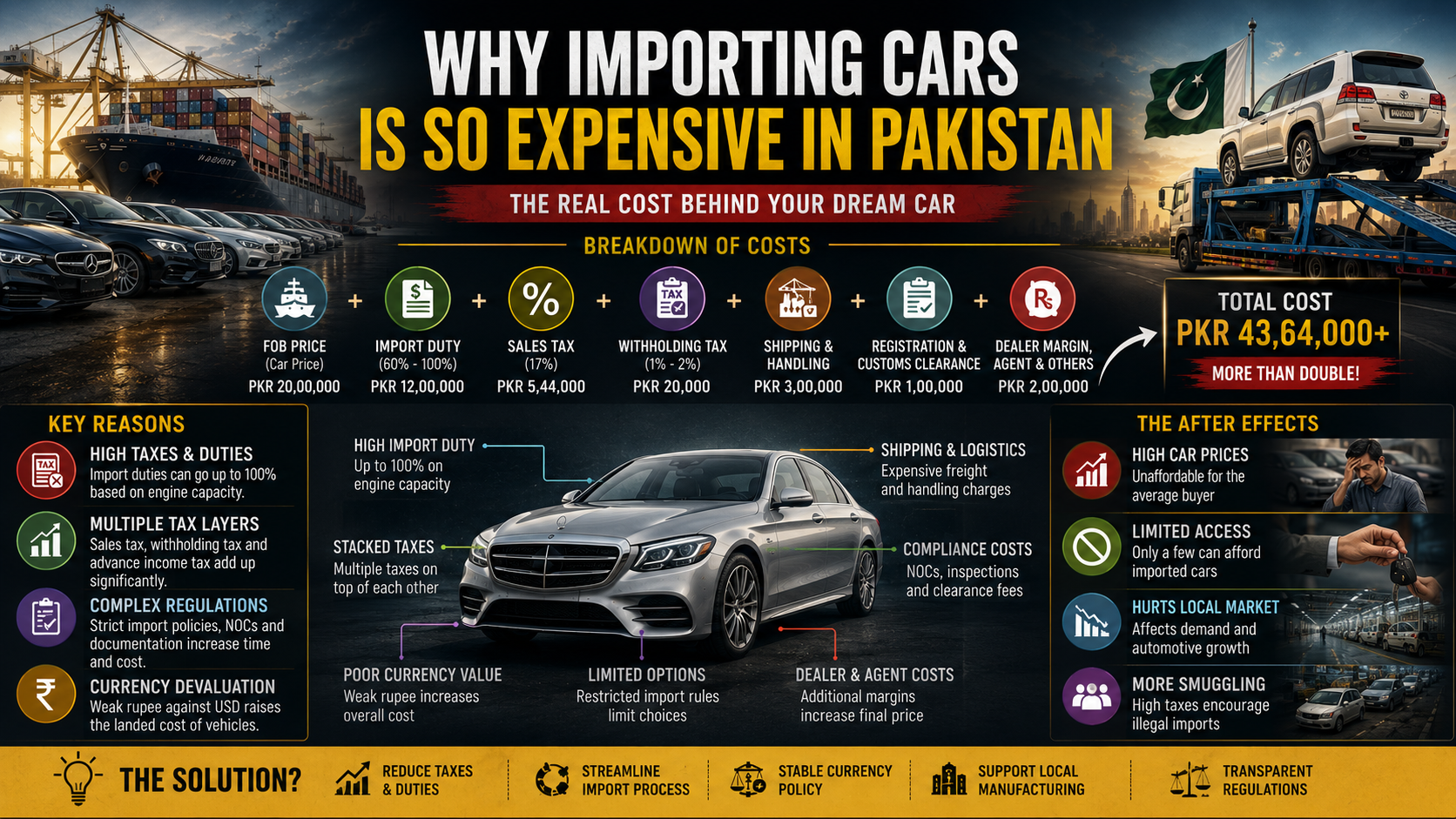
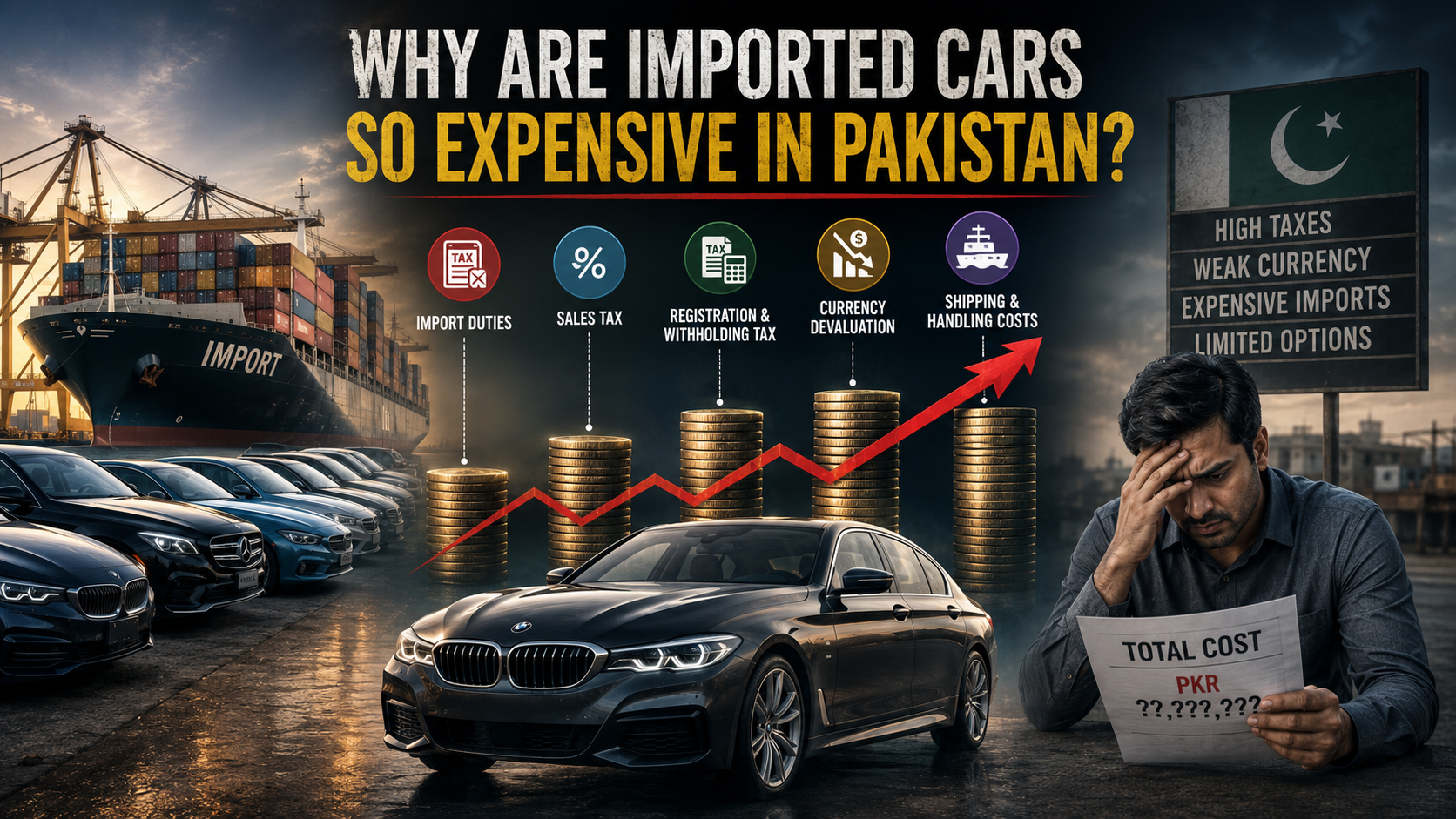
Car import costs breakdown in Pakistan

This Image is Ai generated and used for Illustration purposes only.

 1.Sky‑High Import Duties and Taxes

One of the biggest reasons why importing cars into Pakistan is so expensive is import taxes. Pakistan imposes some of the highest duties on imported vehicles in the world. 

Whenever a car enters Pakistan, it faces multiple layers of taxation: 

  • Customs duty  
  • Regulatory duty  
  • Additional customs duty  
  • Federal excise duty  
  • Sales tax  
  • Withholding taxes  

Each of these adds to the final landed cost of the vehicle. For example, a used Japanese import that costs $5,000 overseas could end up costing more than double after all duties and taxes are applied at ports like Karachi or Port Qasim. 

Because duties are often calculated as a percentage of the car’s value (plus freight and insurance), even modest increases in one tax category can dramatically increase the final price. 

 2.Protectionist Policies for Local Industry

Another reason behind expensive car imports is government policy. 

For many years, Pakistan has pursued protectionist policies to support local automobile manufacturers. Higher duties on imported cars are intended to: 

  • Encourage consumers to buy locally assembled vehicles  
  • Protect domestic investment  
  • Support job creation in assembly and parts manufacturing  

However, these policies also reduce consumer choices and make imported cars less affordable. 

In practice, the cost of protecting local industry often falls on consumers. People who want a quality used car from Japan or Germany end up paying significantly more due to high import duties. 

 3.Inflation and Currency Devaluation

The strength of the Pakistani rupee plays a major role in car import costs. 

Pakistan has experienced episodes of currency depreciation over recent years. When the rupee weakens against the US dollar, import costs rise sharply because vehicles are priced in foreign currencies. 

For example, if the rupee loses value against the dollar: 

  • Importers must pay more rupees to buy the same vehicle overseas.  
  • Duties and taxes (which are calculated in rupee terms) also become more expensive.  
  • Higher shipping and insurance costs are passed down to buyers.  

In short, currency instability makes importing cars significantly more expensive for consumers. 

 4.High Freight and Logistics Costs

Shipping vehicles across oceans is not cheap. Although sea freight rates vary, higher oil prices, port fees, and freight handling costs all add to the total landed cost of an imported car. 

Importers must pay for: 

  • Ocean freight  
  • Insurance  
  • Port handling charges  
  • Customs clearance fees  
  • Transportation from port to the buyer  

Each of these logistics elements contributes to the final price tag that buyers see at dealerships. 

 5.Regulatory Compliance Costs

Pakistan has strict regulations on vehicle imports, especially for used cars. 

For example, many buyers import vehicles from Japan under age restrictions (usually not older than 35 years). These regulations are meant to ensure road safety and emissions standards, but they also limit supply and encourage smuggling or informal imports. 

Complying with legal requirements adds administrative costs, documentation fees, and sometimes delays, all of which translate into higher prices for consumers. 

 7.Black Market and Smuggling Premiums

Because legal import duties are so high, many preferred car models sometimes enter Pakistan through unofficial channels. 

Smuggled vehicles may avoid duties entirely, but they carry their own “premium”: 

  • Higher upfront cash costs  
  • Lack of official warranty  
  • Risks of fines or legal issues  

In effect, the presence of smuggled vehicles pushes legal importers to maintain high prices, because only buyers who can afford expensive official imports remain in the regulated market. 

 7. Impact of High Import Costs on Consumers

The consequences of expensive car imports in Pakistan are broad: 

Reduced Buyer Choices 

Many consumers avoid foreignbuilt vehicles entirely. They end up buying local brands (even if quality or features are inferior) simply because imported cars are too expensive. 

Higher Used Car Market Prices 

When import costs are high, demand for legally imported used vehicles increases. This pushes up prices in the domestic used car market. 

For example, a Toyota Corolla imported from Japan may cost more than a locally assembled version. 

Impact on MiddleClass Families 

Middleclass buyers, who once saw used imports as affordable options, can no longer afford them. As a result, mobility options shrink for middleincome earners. 

 8. How Does This Affect the Auto Industry in Pakistan?

Although protectionist taxes are intended to support local assembly plants, the overall industry also suffers: 

  • Reduced competition: Limited foreign competition can make local auto makers less inclined to improve quality or reduce prices.  
  • Lower investment: Foreign manufacturers may hesitate to enter Pakistan’s market due to tariff barriers, reducing technology transfer and economic growth.  
  • Consumer dissatisfaction: High prices reduce overall vehicle demand, slowing market growth.  

 9. Have Any Policies Tried to Fix This?

At various times, policymakers have attempted reforms to balance duties and improve affordability. These include: 

  • Duty rationalization talks  
  • Trade agreements with importing countries  
  • Duty reductions for electric vehicle imports  
  • Incentives for local parts manufacturing  

However, deeper structural reforms are required to lower overall import costs. 

 10. What Could Improve the Situation?

If policymakers and industry stakeholders want to reduce the cost of car imports in Pakistan, possible measures include: 

Rationalizing Taxes 

Reducing multiple layers of duty and simplifying the tax structure could make imported vehicles more affordable. 

Better Currency Stability 

Stronger currency policies can reduce rupee volatility and import cost inflation. 

Trade Agreements 

Negotiating more favorable trade terms with countries like Japan, Korea, and European suppliers could reduce tariffs. 

Support for Local Parts Manufacturing 

Expanding local components production could reduce the overall price of vehicles assembled in Pakistan. 


Key Points:  

  • High import duties: Multiple taxes and duties inflate costs.  
  • Protectionist policies: Aimed at supporting local industry, but costly for buyers.  
  • Currency devaluation: Weak rupee increases import expenses.  
  • Freight and logistics: Shipping costs add to the landed price.  
  • Regulatory compliance: Documentation and standards increase costs.  
  • Black market effects: Smuggling influences official market pricing.  
  • Consumer impact: Limited choices, higher used car prices, and reduced affordability.  
  • Industry impact: Lower competition and slower growth in auto sector.  


Conclusion: Can Pakistan Make Cars More Affordable? 

The high cost of importing cars in Pakistan stems from a combination of policy choices, taxes, currency issues, and market forces. For consumers, this translates into fewer choices and higher prices. For the industry, it means slower growth and limited foreign collaboration. 

Ultimately, addressing these issues requires thoughtful tax reforms, currency stability, and better trade policies.  

Read More: 

Continue Reading

Editorial

How Is Load-Shedding Poisoning Pakistan’s Economy?

Published

on

How Is Load-Shedding Poisoning Pakistan’s Economy?
This Image is Ai generated and used for Illustration purposes only.

LAHORE – A few hours without electricity may appear to be a temporary inconvenience, but load-shedding poisoning Pakistan’s economy has become a serious national challenge. Behind every power outage is a chain reaction that affects factories, businesses, workers, students, healthcare services, and ordinary households. 

Pakistan’s electricity crisis is no longer limited to homes facing darkness. Instead, it has become an economic issue that affects production, investment, employment, and the cost of living. 

Whenever a factory stops operating, valuable production hours are lost. Similarly, when a small business struggles without electricity, daily income declines. At the same time, companies that depend on generators face higher costs, which eventually increase prices for consumers. 

Although Pakistan has expanded its electricity generation capacity, problems such as circular debt, transmission losses, expensive fuel, and weak distribution systems continue to create power shortages.

How Is Load-Shedding Poisoning Pakistan’s Economy?

This Image is Ai generated and used for Illustration purposes only.

Why Does Load-Shedding Continue in Pakistan? 

Load-shedding occurs when electricity demand exceeds supply or when technical and financial problems prevent the smooth distribution of power. 

Several factors contribute to Pakistan’s energy crisis, including: 

  • Circular debt in the power sector  
  • High electricity generation costs  
  • Transmission and distribution losses  
  • Electricity theft  
  • Aging infrastructure  
  • Growing electricity demand  
  • Slow energy sector reforms  

Over the years, Pakistan has invested in increasing electricity production. However, generation alone cannot solve the crisis because the country also needs an efficient transmission and distribution network. 

Furthermore, financial problems within the power sector make it difficult to maintain a stable and affordable electricity supply. 


How Is Load-Shedding Poisoning Pakistan’s Industrial Growth? 

Are Electricity Shortages Reducing Factory Production? 

The industrial sector is among the biggest victims of Pakistan’s electricity crisis. 

Factories depend on continuous power to operate machinery, complete orders, and maintain production schedules. However, frequent outages force many industries to reduce working hours or rely on expensive backup energy sources. 

As a result, industries experience: 

  • Lower production capacity  
  • Higher operational costs  
  • Delayed export shipments  
  • Reduced competitiveness  
  • Financial losses  

Pakistan’s textile sector, which plays an important role in exports, has repeatedly highlighted energy shortages as a major challenge. 

Moreover, when industries cannot operate efficiently, the impact spreads throughout the economy. Lower production affects exports, government revenue, and employment opportunities. 

Therefore, industrial losses remain one of the clearest examples of how load-shedding poisoning Pakistan’s economy is affecting national progress. 


How Does Load-Shedding Affect Small Businesses in Pakistan? 

Are Small Businesses Struggling Because of Electricity Shortages? 

Small businesses often face the greatest pressure during power outages because many cannot afford expensive backup solutions. 

For shopkeepers, restaurants, workshops, and home-based businesses, electricity is directly connected to daily earnings. 

Power shortages create several challenges: 

  • Reduced working hours  
  • Lost customers  
  • Higher fuel expenses  
  • Equipment problems  
  • Lower profits  

For example, a bakery cannot prepare products without electricity, while a workshop cannot operate machines during prolonged outages. 

Meanwhile, small businesses are already dealing with inflation and increasing costs. Therefore, unreliable electricity creates additional financial pressure for entrepreneurs. 


How Is Load-Shedding Increasing Inflation in Pakistan’s Economy? 

Why Are Electricity Shortages Making Life More Expensive? 

One of the biggest economic effects of load-shedding is its impact on prices. 

When businesses experience power cuts, many depend on diesel generators and alternative energy sources. Consequently, their production expenses increase. 

These additional costs often reach consumers through higher prices of: 

  • Food items  
  • Manufactured products  
  • Industrial goods  
  • Services  

Moreover, electricity is connected with almost every part of the economy. Therefore, an unstable power supply makes controlling inflation more difficult. 

In this way, load-shedding poisoning Pakistan’s economy does not only affect businesses but also reduces the purchasing power of ordinary citizens. 


How Is Load-Shedding Affecting Jobs and Employment? 

Can Electricity Shortages Increase Unemployment? 

A weak energy system creates serious challenges for Pakistan’s employment market. 

When industries face production problems, companies may delay expansion, reduce working hours, or cut jobs. 

This situation especially affects workers in: 

  • Manufacturing industries  
  • Textile factories  
  • Small businesses  
  • Daily wage sectors  

Furthermore, daily wage workers often experience immediate financial losses because fewer working hours directly affect their income. 

A reliable electricity system is essential because businesses cannot expand and create jobs without stable infrastructure. 


How Is Load-Shedding Slowing Pakistan’s Economic Growth? 

Can Pakistan’s Economy Grow Without Reliable Electricity? 

Economic growth depends on productivity, and productivity depends heavily on energy availability. 

When electricity shortages disrupt businesses, Pakistan faces: 

  • Lower industrial output  
  • Reduced exports  
  • Less investment  
  • Higher production costs  
  • Weak business confidence  

As a result, power shortages become a major barrier to economic development. 

Although other economic factors also influence GDP growth, a stable electricity system remains one of the most important foundations for long-term progress. 


Is Load-Shedding Affecting Foreign Investment in Pakistan? 

Can Investors Trust an Economy With Energy Problems? 

Foreign investors usually consider energy reliability before entering a market. 

Companies need confidence that factories, offices, and supply chains can operate without frequent disruptions. 

However, repeated electricity shortages create concerns regarding: 

  • Production delays  
  • Increased costs  
  • Business uncertainty  
  • Lower profitability  

Consequently, improving Pakistan’s energy system is not only necessary for citizens but also important for attracting international investment. 


How Does Load-Shedding Affect Education in Pakistan? 

The impact of electricity shortages extends beyond businesses and industries. 

Students often struggle during: 

  • Exam preparation  
  • Online classes  
  • Evening study hours  

Similarly, schools and universities face difficulties with: 

  • Computer labs  
  • Digital learning facilities  
  • Classroom conditions during extreme weather  

As a result, students without reliable electricity access often face additional educational challenges. 


How Does Load-Shedding Affect Healthcare Services? 

Healthcare facilities require uninterrupted electricity for essential operations. 

Power shortages can disrupt: 

  • Emergency services  
  • Medical equipment  
  • Laboratories  
  • Vaccine storage  
  • Patient care systems  

Although many hospitals use backup generators, prolonged outages increase operational expenses. 

Therefore, reliable electricity is not only an economic requirement but also a matter of public health and safety. 


How Does Load-Shedding Change Daily Life in Pakistan? 

For ordinary citizens, electricity shortages affect almost every aspect of daily life. 

Families experience problems with: 

  • Cooling during hot weather  
  • Food preservation  
  • Remote work  
  • Online education  
  • Household appliances  

Additionally, many households spend extra money on: 

  • Solar panels  
  • UPS systems  
  • Batteries  
  • Generators  

These expenses reduce savings and create further financial pressure, especially for middle and lower-income families.  

Can Pakistan Stop Load-Shedding From Poisoning Its Economy? 

Pakistan needs long-term energy reforms instead of temporary solutions. 

Improve Transmission and Distribution 

Upgrading outdated infrastructure and reducing electricity losses can improve supply reliability. 

Expand Renewable Energy 

Increasing solar and wind energy projects can reduce dependence on expensive imported fuels. 

Resolve Circular Debt 

Addressing financial problems within the power sector is necessary for creating a sustainable energy system. 

Improve Energy Sector Management 

Better governance, reduced electricity theft, and stronger planning can help build a more reliable electricity network. 


Key Points: 

  • Industrial losses: Electricity shortages reduce factory production, increase costs, and affect exports.  
  • Business problems: Small businesses lose working hours, customers, and income due to frequent power outages.  
  • Higher inflation: Companies pass increased energy costs to consumers, making products and services more expensive.  
  • Employment challenges: Reduced industrial activity affects jobs and income opportunities.  
  • Slower economic growth: Power shortages reduce productivity, investment, and GDP growth potential.  
  • Foreign investment concerns: Energy instability makes Pakistan less attractive for some investors.  
  • Education disruption: Students face difficulties with studying, online learning, and digital access.  
  • Healthcare risks: Hospitals require stable electricity to provide uninterrupted services.  
  • Household pressure: Families spend more on alternative energy solutions during prolonged outages.  
  • Need for reform: Pakistan requires better infrastructure, renewable energy expansion, and stronger power sector management.  


Conclusion: Can Pakistan’s Economy Recover Without Fixing Its Energy Crisis? 

Load-shedding poisoning Pakistan’s economy is not simply about electricity disappearing for a few hours. Its effects continue through lost production, higher prices, fewer job opportunities, and weaker economic confidence. 

Pakistan’s economic future is closely connected with its ability to build a reliable and affordable energy system. 

Ultimately, solving the electricity crisis means more than keeping homes powered. It means protecting businesses, creating jobs, attracting investment, and giving the economy a chance to grow. 

When Pakistan loses electricity, it does not only lose power. It loses valuable economic opportunities. 

Read More: 

Continue Reading

Editorial

Why HBO Max Canceled Titans and What It Means for DC’s Future

Published

on

Why HBO Max Canceled Titans and What It Means for DC’s Future
This Image is Ai generated and used for Illustration purposes only.

LAHORE – The cancellation of Titans by HBO Max marked the end of one of DC’s longest-running live-action superhero series. After four seasons, the show concluded its story as Warner Bros. Discovery began shifting its focus toward a new direction for DC entertainment. 

For many fans, the question remains: why did HBO Max cancel Titans despite having a dedicated audience and a successful run? 

The answer is not linked to a single issue. Instead, the decision came during a major transformation at Warner Bros. Discovery, where streaming strategies, DC leadership, production costs, and the future of superhero content were all being reconsidered. 

While Titans developed a loyal fan base, the series was released during a period when DC was moving away from its previous television universe and preparing for a more connected future under DC Studios. 

Why HBO Max Canceled Titans and What It Means for DC’s Future

This Image is Ai generated and used for Illustration purposes only.

Why HBO Max Canceled Titans After Four Seasons 

The decision to end Titans came shortly after Warner Bros. Discovery completed its merger and began reviewing the future of HBO Max content. 

The company started reducing spending, cancelling projects, and restructuring its streaming strategy as it aimed to make HBO Max more profitable. 

Unlike traditional television networks, streaming platforms no longer measure success only through popularity. They also consider: 

  • Production costs  
  • Subscriber growth  
  • Viewer completion rates  
  • Global audience reach  
  • Long-term franchise value  

Although Titans attracted viewers, maintaining an expensive superhero series became more complicated as Warner Bros. Discovery focused on efficiency. 


DC Studios Leadership Changes Changed the Future of Titans 

One of the biggest factors behind the cancellation was the major leadership change at DC. 

In 2022, Warner Bros. Discovery appointed James Gunn and Peter Safran to lead DC Studios and develop a new interconnected DC Universe. 

The new leadership planned to create a unified superhero franchise across films, television shows, animation, and other platforms. 

This created uncertainty for several existing DC projects, including Titans. 

The series existed separately from the upcoming DC Universe, meaning continuing it would have required maintaining two different versions of DC storytelling at the same time. 

For Warner Bros. Discovery, the priority became building a fresh starting point rather than expanding older universes. 


Titans Faced Challenges in the New Streaming Era 

When Titans launched in 2018, it was one of the major original shows for DC’s streaming service, DC Universe, before later moving to HBO Max. 

At the time, the series represented DC’s attempt to compete with Marvel’s expanding television presence. 

However, the streaming landscape changed significantly. 

By the time Titans reached its later seasons: 

  • Streaming platforms were reducing spending  
  • Superhero content became more competitive  
  • Audiences became more selective  
  • Studios started prioritizing major franchise connections  

The success of superhero projects was no longer guaranteed simply because they featured popular comic book characters. 


Viewership and Audience Engagement Played a Role 

Unlike traditional television, streaming platforms generally do not release complete audience numbers. This makes it difficult to judge Titans purely by ratings. 

However, entertainment analysts often look at indicators such as: 

  • Online discussions  
  • Social media engagement  
  • Search interest  
  • Audience retention  
  • International popularity  

Titans maintained a passionate fan community, especially among DC fans who appreciated its darker approach to characters like Nightwing, Raven, Starfire, and Beast Boy. 

However, the series did not reach the mainstream cultural impact achieved by major superhero shows such as Marvel’s streaming releases or other high-profile comic adaptations. 

For a costly superhero production, a dedicated fan base may not always be enough to justify additional seasons. 


Rising Production Costs Made Renewal More Difficult 

Superhero shows are among the most expensive television productions because they require: 

  • Visual effects  
  • Action sequences  
  • Costumes  
  • Stunt work  
  • Large-scale production designs  

As Titans expanded, the budget requirements likely increased alongside the complexity of its storytelling. 

Warner Bros. Discovery was already under pressure to reduce costs and improve streaming profitability after investing heavily in HBO Max content. 

Renewing an expensive series without a clear path to significant subscriber growth became a difficult business decision. 


Critical Reception Was Mixed Despite Strong Fan Support 

Titans received a mixed response throughout its run. 

Many fans praised: 

  • The darker tone  
  • Character development  
  • Performances  
  • Action sequences  
  • The introduction of Nightwing  

However, critics often pointed toward issues involving: 

  • Uneven storytelling  
  • Pacing problems  
  • Changes from comic book versions  
  • Inconsistent character arcs  

The series developed a loyal audience, but it did not achieve universal critical success that could strengthen its case for a long-term future. 


Competition From Other Superhero Shows Increased Pressure 

The superhero streaming market became increasingly crowded during Titans’ run. 

Viewers had access to: 

  • Marvel Studios series on Disney+  
  • DC projects on multiple platforms  
  • Amazon’s superhero content  
  • Animated comic adaptations  
  • New franchise-based streaming shows  

As more superhero content entered the market, audiences became less likely to follow every release. 

Studios began focusing on fewer projects with stronger franchise potential instead of maintaining multiple separate universes. 


What Titans Cancellation Means for DC’s Future 

The cancellation of Titans represents a broader change in DC’s entertainment strategy. 

Warner Bros. Discovery is moving toward a connected DC Universe where characters and stories can exist within a larger plan. 

While Titans ended, its success showed that audiences remain interested in younger DC heroes and team-based superhero stories. 

Characters from the Titans mythology still have significant potential, especially under a new DC structure. 

The challenge for DC is deciding how to bring these characters back while creating a consistent universe that can compete with Marvel. 


Could Titans Ever Return? 

A revival is unlikely in the immediate future because DC Studios is focused on building its new universe. 

However, entertainment history has shown that cancelled shows can return if audience demand remains strong. 

Examples from other franchises prove that fan campaigns, streaming performance, and changing business strategies can sometimes revive popular projects. 

For now, Titans remains complete after four seasons, but its characters could potentially appear in future DC projects. 


Key Points:

  • HBO Max canceled Titans after four seasons during Warner Bros. Discovery’s restructuring.  
  • DC Studios’ new leadership wanted to create a connected DC Universe.  
  • Production costs and streaming profitability influenced renewal decisions.  
  • Titans had a loyal fan base but limited mainstream impact compared with bigger superhero franchises.  
  • The cancellation reflects a wider shift in how studios approach superhero content.  


Why did HBO Max cancel Titans? 

HBO Max canceled Titans as Warner Bros. Discovery changed its streaming strategy and DC Studios moved toward a new interconnected DC Universe. 

Will Titans get a season 5? 

No official plans exist for Titans season 5. The series ended after its fourth season. 

Was Titans successful on HBO Max? 

Titans developed a dedicated fan base and performed well enough to continue for four seasons, but streaming profitability and DC’s restructuring affected its future. 

Is Titans connected to James Gunn’s DC Universe? 

No. Titans existed separately from the upcoming DC Universe being developed by DC Studios. 

Could Titans return in the future? 

A revival is possible but unlikely soon, as DC Studios is currently focused on establishing its new franchise direction. Keep following upfront.pk for further updates. 


Final Thoughts 

The end of Titans was not simply a result of poor performance. Instead, it reflected a major shift happening across Hollywood, where streaming companies are becoming more selective about expensive productions and franchises are being rebuilt from the ground up. 

For many fans, Titans proved that DC’s younger heroes could carry a successful live-action series. The question now is whether DC will bring these characters back in a new form or leave the Titans era behind. 

Did Titans deserve another season, or was its ending the right move for DC’s future? Share your thoughts. 

Read More: 

Continue Reading

Editorial

Why Pakistan’s Gen Z faces challenges today ?

Published

on

Why Pakistan’s Gen Z faces challenges today ?
This Image is Ai generated and used for Illustration purposes only.

ISLAMABAD – Pakistan Gen Z challenges are shaping the experiences of millions of young Pakistanis. Despite being the most digitally connected generation, many feel uncertain about careers, social expectations, and their future.  

Born roughly between the late 1990s and early 2010s, this generation faces a unique set of economic, social, and technological pressures that previous generations never encountered. 

Education and Employment Gaps Highlight Pakistan Gen Z Challenges 

One of the key Pakistan Gen Z challenges is the growing gap between education and employment. Thousands of university graduates enter the job market each year, yet quality employment opportunities are limited. Youth unemployment continues to rise, leaving many overqualified for available positions or struggling to find meaningful work. This disconnect often leads to frustration and social withdrawal. 

Why Pakistan’s Gen Z faces challenges today ?

This Image is Ai generated and used for Illustration purposes only.

Digital Isolation Adds to Pakistan Gen Z Challenges 

Digital life has created both opportunities and challenges for Pakistan’s youth. While social media and online platforms keep Gen Z connected, they can also increase feelings of isolation. Young people may maintain hundreds of online connections but struggle to build meaningful in-person relationships. This disconnect contributes to emotional stress and a sense of being lost in today’s fast-paced, digital-first world. 


Questioning Traditions and Defining Independence 

Another important Pakistan Gen Z challenge is the shift in social expectations. Unlike previous generations, young Pakistanis increasingly question traditional career paths, authority, and social norms. They value flexibility, skill-based recognition, and personal fulfillment over rigid hierarchies. This mindset sometimes creates tension within families and workplaces but also reflects a generation striving for independence and self-respect. 


Technology and Global Exposure Provide Opportunities 

Despite the challenges, Pakistan Gen Z is also highly capable and entrepreneurial. Access to technology, global knowledge, and digital tools enables young people to explore freelancing, e-commerce, content creation, and remote work. These opportunities can transform Pakistan Gen Z challenges into advantages if the right support and policies are in place. 


Society’s Role in Supporting Pakistan Gen Z 

The question is not whether Gen Z is struggling—it is whether Pakistan provides the environment to succeed. Governments, educational institutions, businesses, and families must work together to close gaps between education and employment, digital life and real-life interaction, and ambition and opportunity. Proper guidance, skills development, and employment opportunities can turn this generation into a driving force for Pakistan’s future. 


Key Points:

  • Pakistan Gen Z faces challenges in employment, education, and social expectations.  
  • Digital connectivity increases both opportunity and isolation.  
  • Young Pakistanis question traditional norms and prioritize independence.  
  • Technology, freelancing, and entrepreneurship create new opportunities.  
  • Society and government support are critical for turning challenges into national strengths.  


FAQs:

Why is Gen Z struggling in Pakistan?

Pakistan Gen Z challenges include unemployment, economic uncertainty, social pressure, and difficulties balancing digital and real-life experiences. 

What are the main challenges for Pakistani youth?

Key challenges are limited job opportunities, skill gaps, rising costs of living, and uncertainty about the future. 

Is Pakistani Gen Z different from previous generations?

Yes. Gen Z has grown up with smartphones, social media, and global exposure, which has changed how they communicate, work, and view success. 

Are Pakistani youth moving toward freelancing?

Yes. Many young Pakistanis explore freelancing, online business, and digital entrepreneurship as alternatives to traditional employment. 

Read More: 

Continue Reading

About

Upfront influence about 20 million users and is the number one business and technology news network on the planet


© 2022 upfront. All Rights Reserved.

Trending

Copyright © 2026