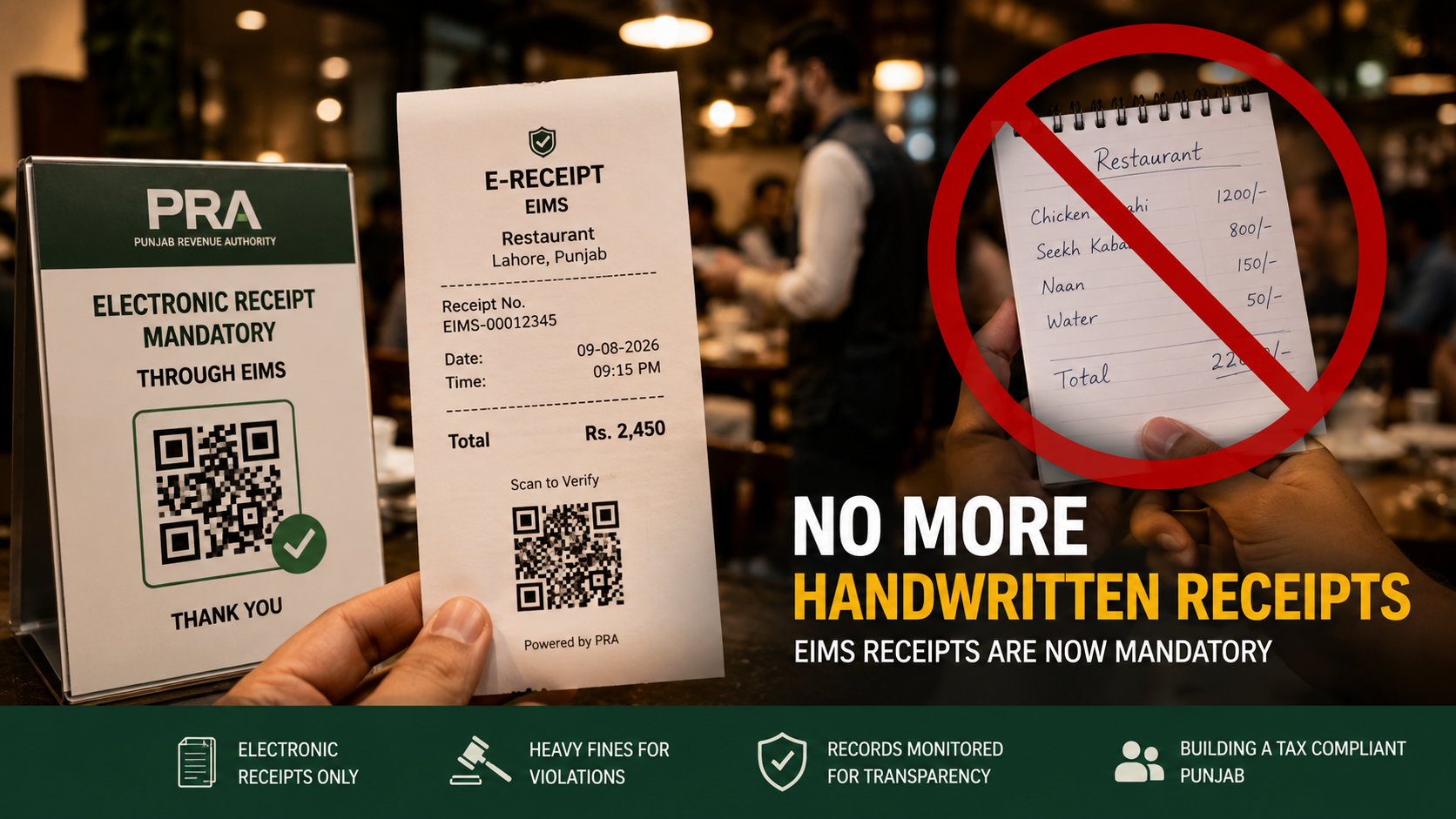
LAHORE – Punjab restaurant receipt fines are set to become a major concern for businesses across the province as the Punjab Revenue Authority (PRA) has banned restaurants, marriage halls and other covered businesses from issuing handwritten or informal receipts.
The authority has ordered businesses to use its Electronic Invoice Monitoring System (EIMS) when issuing receipts to customers. The measure aims to improve transaction monitoring, reduce tax evasion and prevent businesses from manipulating sales records.
Under the new requirements, businesses that fail to issue EIMS-generated receipts could face fines ranging from Rs400,000 to Rs1 million.
PRA Orders Businesses to Use EIMS Receipts
The PRA has directed hotels, restaurants, coffee shops, marriage halls and other relevant businesses to issue receipts through the Electronic Invoice Monitoring System.
The system allows the authority to monitor reported sales and compare transactions for taxation purposes.
Businesses can no longer treat informal documents as substitutes for proper tax receipts. The move particularly targets practices that can make it difficult for authorities to accurately track a business’s actual sales.
Punjab Restaurant Receipt Fines Can Reach Rs1 Million
Businesses that ignore the new requirements could face significant financial penalties.
According to the PRA notification, violations can result in fines between Rs400,000 and Rs1 million. Businesses that repeatedly violate the rules could also face sealing for up to one month.
The penalties make compliance particularly important for restaurants, hotels and marriage halls, where large numbers of daily transactions can make sales monitoring more difficult.
The Punjab restaurant receipt fines also send a clear warning to businesses that authorities intend to take enforcement seriously.
Kitchen Slips and Unpaid Bills Cannot Replace Receipts
The PRA has specifically prohibited businesses from giving customers kitchen order slips, unpaid bills or similar informal documents instead of proper tax receipts.
Customers must receive a valid receipt generated according to the authority’s requirements.
The receipt must include key details such as:
This requirement is intended to make transactions easier to verify and give customers a way to distinguish official tax receipts from informal sales documents.
Businesses Face Action for Record Tampering
The new rules also cover interference with PRA officials and manipulation of sales information.
The authority has warned that businesses could face legal action if they tamper with sales records, refuse to provide required information or interfere with government officials carrying out enforcement duties.
PRA enforcement officers will take action against businesses found violating the requirements.
Why Punjab Is Introducing The New Receipt Rules
The PRA says the measures aim to improve sales monitoring and ensure businesses accurately report their transactions for taxation.
Electronic invoicing can give tax authorities a clearer record of transactions than handwritten receipts, which can be difficult to verify and easier to alter or omit.
For businesses, the changes mean staff will need to ensure every eligible transaction receives the required electronic receipt.
For customers, the new system should make it easier to identify whether they have received an official tax receipt.
PRA Directs Commissioners to Enforce New Rules
The notification was issued on the instructions of PRA Chairman Muazam Iqbal Sapra, with commissioners directed to implement the requirements across Punjab.
The authority has indicated that enforcement officers will take immediate action against businesses that fail to follow the new receipt requirements.
Businesses covered by the rules should therefore ensure their EIMS systems are operational and that employees understand the requirements before issuing customer receipts.
Quick Guide to the New PRA Receipt Rules
| Requirement
|
What businesses need to know
|
| Electronic receipts
|
Covered businesses must issue receipts through the Electronic Invoice Monitoring System (EIMS).
|
| Handwritten receipts
|
Handwritten or informal receipts cannot replace the required EIMS-generated receipt.
|
| Affected businesses
|
Hotels, restaurants, coffee shops and marriage halls are among the businesses covered by the latest PRA directive.
|
| Potential fine
|
Businesses failing to comply with EIMS receipt requirements can face fines ranging from Rs400,000 to Rs1 million.
|
| Repeated violations
|
Repeated violations can lead to the business being sealed for up to one month.
|
| Why the system matters
|
PRA has been using electronic invoicing to improve sales monitoring and tackle manipulation of tax records. Recent enforcement operations have already targeted restaurants, hotels, cafés and fast-food chains over record and invoicing irregularities.
|
| Customer verification |
PRA has encouraged customers to obtain official e-bills and verify tax payments through its facilitation system. |
Key Points:
- The PRA has banned handwritten and informal receipts at covered businesses across Punjab.
- Restaurants, hotels, coffee shops and marriage halls must use the Electronic Invoice Monitoring System (EIMS).
- Businesses can face fines ranging from Rs400,000 to Rs1 million for violations.
- Repeat offenders may face sealing for up to one month.
- Kitchen slips and unpaid bills cannot replace official tax receipts.
- Receipts must include the business name, address, receipt number and PRA QR code.
- The measures aim to improve sales monitoring and reduce tax evasion.
Read More:
For more such updates and content, follow Upfront .