Connect with us

Education

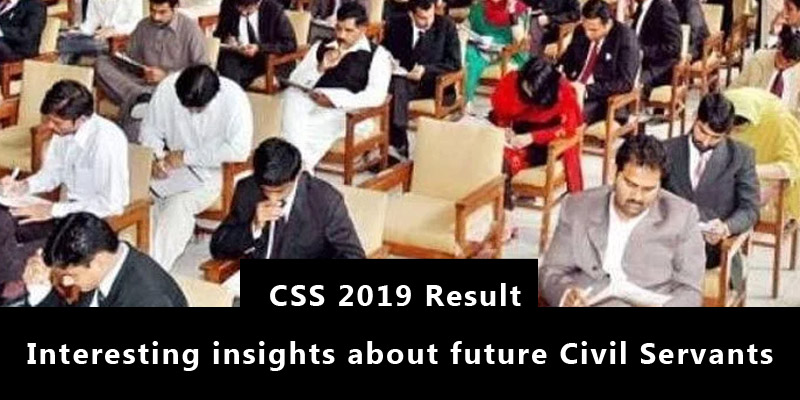
CSS 2019 Result – Interesting insights about future Civil Servants

Published

on

The Federal Public Service Commission has announced its results for the Combined Competitive Examination for the Central Superior Services (CSS) for the year 2019. Let’s look at interesting insights about the results.

Passing percentage

A total of 14,521 candidates appeared in the written exam. As many as 372 students qualified the written exam and proceeded on to the interviews. Out of these, 365 candidates qualified the interview but there is a catch.

Out of these 365 qualified, 214 were allocated to different occupational groups. So, 132 men and 82 women are allocated this year.

Who is the Topper?

Rana Haider Tahir from Punjab topped the exam and opted Pakistan Administrative Service (PAS). Rana Tahir belongs to a family of bureaucrats.

Interestingly, his brother Rana Musa Tahir was allocated to Pakistan Administrative Service in CSS 2017. One of his brothers, Rana Hussain Tahir is already part of Police Service of Pakistan (PSP).

Another interesting fact is mentioned in thee tweet below about the topper being from different gender every other year from last few years.

Candidates from GB

Interestingly, the prominent positions this time were grabbed by the candidates from Gilgit Baltistan/FATA. In this regard, Uzair Ali Khan stood third and opted Pakistan Administrative Service. Junaid Alam stood at 14 while Muhammad Shahsawar Shareef stood 15th.

The Sher Sisters

Interestingly, another sister of the Sher family, Zoha Malik Sher got allocated to the Office Management Group (OMG). This Sher family has now 5 sisters as civil servants. Sassi Malik Sher re-appeared in the CSS exam for 2019 but was not able to be allocated. She is already part of Military Lands and Cantonment Group (MLCG).

Some other insights have been cracked by a civil servant, Junaid Afzal which are as follows:

Number of Seats by Groups

The minimum number of seats was offered by Railways group i.e 1, followed by Military Lands and Cantonment which would have merely 2 officers this time. Inland Revenue Service has a maximum of 47 officers for CSS 2019.

Interestingly, the Office Management Group which had around 75 officers for CSS 2018 would have only 22 officers this time.

Commerce and Trade Group and Pakistan Customs service each have 7 officers this time.

Domicile Wise Allocation

As many as 124 officers are selected from Punjab followed by 29 from Khyber Pakhtunkhwa.

Un-allocated Candidates

The data about the ones who passed the written and interview but could not secure allocation is interesting.

Engineer turned CSP in 3 months without academy

It shows that Punjab is the battleground, be it politics or civil service. The percentage of unallocated candidates here is a whopping 51 percent. As many as 124 candidates were allocated but 129 were left unallocated.

Khyber Pakhtunkhwa and AJK’s unallocation rate is 38 percent while the unallocation rate for Sindh Rural, GBFATA and Balochistan is 0 percent due to the fact that very few candidates pass the written exam.

Gender Wise Distribution

If we analyze the data on the basis of gender, we come to know that 51 women from Punjab, 11 from KPK, 10 from Sindh Urban and only 1 from AJK made it to the list of the allocated candidates.

Nine women from Punjab got allocated to the Inland Revenue Service group while one each from Sindh Urban, Sindh Rural and Balochistan.

When it comes to male candidates, 21 were allocated to Pakistan Administrative Service while 15 were allocated to the Police Service of Pakistan overall.

The Shocking Truth

A shocking truth in the data extracted by the civil servant confirms that the percentage of allocation of women has been decreasing over a period of 5 years.

Starting from CSS 2015 result, the slope is downwards which is alarming.

The graph below shows the rate as moving downwards.

Who is MUHAMMAD ATIF JALIB, the absentee is Viva?

Muhamamd Atif jalib did not appear in interview after having passed the written part but WHY?

The reason is that Muhammad Atif Jalib had been allocated to the Pakistan Administrative Service in CSS 2018. He had appeared in CSS 2019 exams when the result for CSS 2018 was not announced.

What about the ones unallocated

So, it’s a moment of joy for the ones allocated but what about the ones unable to secure allocation.

Having gone through the tweets of serving civil servants, it is evident that CSS is not the end of life. There are multiple ways to live life and earn livelihood.

Civil Service is a path to serve the country but not the only path in this regard.

As far as money or fame is concerned, most of the people who are not civil servant make more of them. In fact the civil servants keep on complaining about the low remuneration.

So, those who were unable can think over and try to re appear but even if they don’t want to re appear, it’s perfectly fine.

Just a few years down the road, you would forget these moments though currently it is difficult to digest these results.

Remember, you have not failed this exam after all. And most importantly, it’s about destiny as well. Ask from the civil servants and they would reply that it’s not the hard work which helped them pass CSS exam but the luck or you can say blessings or karma.

The writer is a civil servant. He can be accessed here.

Education

LGHS MUN concludes after three successful days of the event: Read for details

Published

on

LAHORE – The LGHS MUN finally concluded after 3 successful days, with delegates belonging to several different schools. The committee UNICEF hosted the most delegates from several different schools and colleges. The LGHS MUN took place from 7th November to 9th November, every day, delegates met in their respective committees. Some formed alliances, while others went on the offensive but showed remarkable signs of diplomacy, further raising the standards of the MUN.  

Model United Nations, MUN, is a form of roleplay in which students guise as delegates and represent their country in a type of UN conference and engage in debates related to climate change or International security.

The main objective of an MUN is to bolster the public speaking abilities of students and provide them with an experience in preparing for future conferences, drafting paperwork, and creating policies. The MUN also benefits students by developing their leadership skills, research experiences, and problem-solving abilities.

The LGHS MUN aimed at giving students the most benefits possible of participating in an MUN, as the management continued to emphasize learning through this MUN, even after many delegates suffered from defeat. Many were new to the concept of MUN, but soon after attending LGHS MUN, many got a useful experience for the future, as LGHS MUN served as a kickstart for many talented students who wished to continue their journey as delegates of an MUN.

Upfront sent a team under the leadership of Editor-in-Chief, Haris Sarfraz Ali, and CEO Mohtasim Kamran to cover the LGHS MUN and met with the management to discuss the MUN. The management of the MUN was hopeful that they had done their best to host the best MUN they could’ve possibly hosted.

The event president, Ms. Sameen, was initially worried about the low number of delegates participating in the MUN; however, the Vice-president and other members backed her up, and soon after, a great number of delegates registered for the LGHS MUN. After having a fruitful discussion with the EC members, the Upfront team met with the Media team of the LGHS MUN, who were seen putting their utmost dedication into the event.

The committee with the most delegates in the MUN was UNICEF. The Upfront team approached one of the delegates whose name is not being mentioned, and asked about the veto power of the permanent members of the United Nations in order to test the preparedness of the delegate to answer quick questions. The delegate, however, gave a calm and composed response and added that the veto power should exist, but the way it is used should be changed, as the permanent members are often seen as biased towards a friendly nation, according to the delegate, which hinders the ability of the committee to pass useful resolutions to benefit the world.

The delegates’ response was quick and witty, signaling that he had done research before the MUN.

The MUN first kicked off with a qawwali night on Day One and committee sessions, along with Jummah break. The delegates seemingly had a positive mood from Day One. The last day, Day Three, ended after a formal dinner arranged by the LGHS MUN’s management. The Upfront’s team was successful in covering the event, highlighting Upfront’s commitment to Stay Ahead and Stay Upfront.

For further details, do visit the official Instagram handle of Upfront.


Continue Reading

Education

Riphah University hosts 6th international conference on lifestyle medicine 2025 in Islamabad

Published

on

ISLAMABAD — The 6th International Conference on Lifestyle Medicine (ICLM 2025) commenced at the Highland Country Club & Resort, Islamabad, marking a significant milestone in Pakistan’s journey toward a preventive, compassionate, and sustainable healthcare system.

Jointly organized by the Pakistan Association of Lifestyle Medicine (PALM) and the Riphah Institute of Lifestyle Medicine (RILM), the three-day international summit revolves around the theme “Turning the Tide on Non-Communicable Diseases – A Whole-Person Approach.”

The conference brings together national and international thought leaders, physicians, researchers, and policymakers dedicated to transforming health systems through evidence-based lifestyle interventions that prevent, treat, and even reverse non-communicable diseases (NCDs)—the leading cause of global mortality.

The inaugural ceremony was graced by Syed Mustafa Kamal, Federal Minister for National Health Services, Regulations & Coordination, and Dr. Rizwan Taj, President, Pakistan Medical & Dental Council (PMDC), alongside senior representatives from the World Health Organization (WHO), academia, and medical institutions across the region.

“Lifestyle Medicine is not an alternative—it is the foundation of sustainable healthcare,” said Dr. Beth Frates, Chair of the Riphah Institute of Lifestyle Medicine and a global pioneer in the field. “Through science, compassion, and collaboration, we can redesign healthcare to help people live longer, healthier, and more purposeful lives.”

Highlighting the growing commitment to preventive health, Federal Minister Syed Mustafa Kamal shared that the philosophy of Lifestyle Medicine deeply resonates with him. “We must move from a ‘sick care’ system to a ‘health care’ approach. Lifestyle Medicine offers a clear path forward to build a healthier nation,” he emphasized.

Reflecting its “whole-person” philosophy, ICLM 2025 integrates science with wellbeing—offering plant-based meals, meditation and mindfulness sessions, and discussions on digital health, sleep, and behavioral change. The program includes plenary talks, workshops, and research presentations focused on nutrition, movement, emotional resilience, and social connection as the pillars of a healthier society.

Delegates from the United States, United Kingdom, UAE, and across Pakistan are collaborating on research, training, and advocacy initiatives to strengthen preventive medicine and medical education across South Asia. The event will conclude with the “Islamabad Declaration”—a set of recommendations to integrate Lifestyle Medicine into primary healthcare, policy, and medical curricula nationwide.

A special Gala Dinner and Retreat will celebrate community, empathy, and the shared vision of advancing the social and emotional dimensions of wellbeing.

“ICLM 2025 is not just a conference—it’s a movement toward a more compassionate, community-centered model of healthcare,” said Dr.Shagufta Feroz , Director of RILM. “We hope every attendee leaves inspired to become an agent of change in their own communities.”

With PALM leading advocacy, training, and education, and RILM pioneering clinical integration and academic innovation, Pakistan continues to emerge as a regional hub for Lifestyle Medicine—redefining health as not merely the absence of disease, but the presence of vitality, purpose, and connection.

Continue Reading

Education

Healthcare University at Nawaz Sharif IT City Established in collaboration with NovaCare and Imperial College Healthcare NHS Trust (UK)

Published

on

LAHORE – The Punjab Central Business District Development Authority (PCBDDA), also known as Central Business District Punjab (CBD Punjab), has issued an official clarification in response to reports concerning Imperial College London’s involvement in a development project at CBD NSIT.

In its statement, CBD Punjab clarified that the upcoming Healthcare University and Affiliated Medical College at CBD NSIT is a joint initiative between NovaCare and Imperial College Healthcare NHS Trust (UK)—an independent institution within the UK’s National Health Service (NHS).

The authority affirmed that the project is progressing as planned under the NovaCare–ICHT partnership, reinforcing CBD Punjab’s commitment to creating a state-of-the-art hub for medical education, research, and healthcare innovation in Lahore.

The statement further highlighted that the initiative is being developed under the direct supervision of Imperial College Healthcare NHS Trust (UK), ensuring adherence to international standards of excellence in healthcare and academic development.

Continue Reading

Trending

Copyright © 2026